
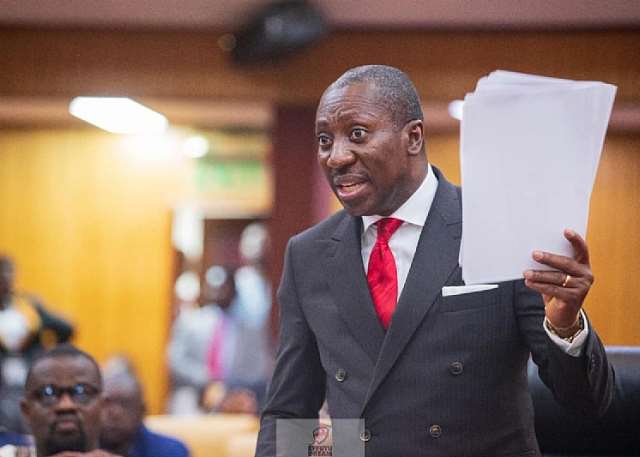

Minority Leader Alexander Afenyo-Markin has strongly criticised the Value for Money Office Act, 2026, describing the newly enacted law as an unnecessary bureaucratic structure that fails to confront the underlying causes of corruption within Ghana’s public procurement system.
In a statement shared on Facebook on Wednesday, May 13, Alexander Afenyo-Markin argued that the legislation, which government has promoted as a major accountability and transparency reform, lacks the institutional independence required to effectively supervise procurement processes and safeguard public resources.

According to the Minority Leader, the composition of the governing board together with its reporting arrangements places excessive authority in the hands of political actors, thereby undermining the credibility and neutrality of the institution.

“What has been presented as a reform in accountability is simply another layer of bureaucracy designed to serve political interests under the guise of transparency,” he stated.

He further contended that a governing board largely populated by partisan political appointees could not be relied upon to independently oversee procurement activities or effectively prevent the misuse of state funds.
Alexander Afenyo-Markin disclosed that the Minority Caucus had earlier cautioned Parliament during deliberations on the bill that the proposed legislation carried the potential to aggravate corruption rather than reduce it.

“At the consideration stage of the bill, I raised these concerns and cautioned the House that the law, instead of fighting corruption, risked introducing a new layer of politically supervised corruption into the procurement process,” he wrote.
The Minority Leader asserted that subsequent developments surrounding the legislation had validated concerns previously raised by the opposition caucus.

He additionally argued that Ghana’s governance difficulties do not stem from the absence of laws or regulatory frameworks, but rather from the ineffective enforcement of existing statutes and oversight mechanisms.

Pointing to the Public Financial Management Act, the Public Procurement Act, as well as internal audit systems already operating across public institutions, Alexander Afenyo-Markin maintained that Ghana already possesses sufficient legal instruments capable of ensuring accountability if properly implemented.
“The real challenge is enforcement. Those institutions must be strengthened, adequately resourced, and their officers held accountable for their responsibilities,” he stressed.
He subsequently urged government to prioritise the strengthening of existing accountability institutions instead of establishing what he characterised as politically supervised structures that could compromise transparency and deepen concerns about partisan influence within the public procurement system.
The remarks are expected to intensify political debate over the newly enacted law and its potential implications for public financial management, procurement oversight, and institutional independence in Ghana.

