
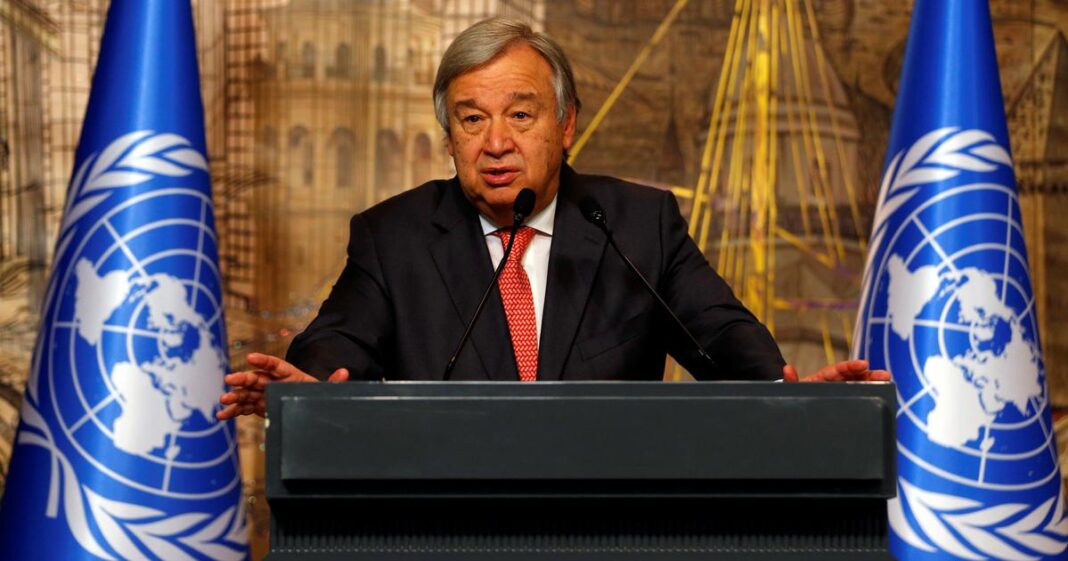

The Secretary General of the United Nations, António Guterres, has delivered a forceful denunciation following a violent confrontation that left three soldiers from Ghana wounded while serving within the peacekeeping ranks of the United Nations Interim Force in Lebanon. The incident unfolded in the southwestern Lebanese village of Al Qawzah on Friday 6 March 2026 during an intense exchange of gunfire that swept across the frontier zone.
The attack has drawn renewed international scrutiny to the deteriorating security environment along the Lebanese Israeli border, an area already strained by rising military confrontation. Observers note that the episode arrives during the most severe resurgence of hostilities since the fragile ceasefire arrangements that followed the regional tensions of 2024. As artillery fire and armed skirmishes increase across the frontier, diplomats warn that the situation has evolved into a delicate test for global diplomacy and crisis management.

According to mission officials, the Ghanaian troops were stationed inside a designated United Nations observation position when heavy firing erupted nearby. The personnel belong to the peacekeeping contingent tasked with maintaining stability between the armed forces of Lebanon and Israel. Their assignment forms part of a long standing international monitoring operation designed to prevent the resumption of full scale warfare in the region.

Medical personnel from the peacekeeping mission confirmed that two of the injured soldiers are currently receiving treatment at a UN medical facility within the operational theatre. The third and most seriously wounded serviceman required emergency evacuation to the Lebanese capital of Beirut where specialised medical attention could be provided. The urgent transfer reflects the increasingly hazardous conditions confronting international observers deployed in volatile conflict corridors.

In an official communiqué released by the United Nations headquarters in New York City, Secretary General Guterres condemned the incident in unequivocal terms. The statement emphasised that the three Ghanaian peacekeepers sustained their injuries while positioned inside a clearly identified United Nations installation during the outbreak of heavy gunfire in Al Qawzah. The UN leader expressed his sincere hope that the wounded soldiers would experience a swift and complete recovery.
The condemnation reflects growing concern within the international community regarding the erosion of protections traditionally extended to peacekeeping personnel. For decades, the blue helmet worn by United Nations soldiers has symbolised neutrality and international cooperation in conflict zones. However, recent incidents across several global theatres have raised fears that such safeguards are becoming increasingly fragile amid modern warfare dynamics.

Secretary General Guterres underscored that international law provides explicit protection for United Nations personnel and facilities. The safety and security of UN staff, equipment and installations, he noted, must remain inviolable under all circumstances. Any deliberate assault against peacekeepers or their infrastructure, he warned, could potentially constitute a violation of international humanitarian law and may be treated as a war crime under global legal frameworks.
The UN chief therefore called for full accountability for any individuals or entities responsible for the attack. His remarks reinforced a long standing principle of international peacekeeping operations which holds that neutrality must never be exploited by combatants seeking tactical advantage.

The shooting incident occurs at a moment when the broader Middle Eastern security landscape has entered a new and unpredictable phase. Regional tensions have escalated sharply following a series of military developments involving United States, Israel and Iran. Analysts note that confrontations between these powers have intensified since late February 2026, with strategic infrastructure and military installations increasingly becoming targets of retaliatory operations.

Recent reports indicate that Israeli forces launched strikes against Iranian oil related facilities in Tehran on 7 March, prompting Tehran to vow reprisals against both American and Israeli interests throughout the Middle East. This widening confrontation has raised fears of a broader regional conflict capable of drawing multiple actors into a complex and dangerous escalation.
Within this volatile environment, southern Lebanon has emerged as a critical flashpoint. Armed exchanges between Israeli forces and fighters associated with Hezbollah have intensified, transforming the frontier area into a secondary theatre of confrontation. For peacekeepers stationed in the region, the convergence of these geopolitical tensions has dramatically increased operational risk.
Experts in international security caution that peacekeeping forces frequently become unintended casualties when armed groups engage in dense and unpredictable urban warfare. Unlike conventional battlefields, modern conflict zones often feature overlapping lines of engagement where non combatants, humanitarian workers and neutral observers are exposed to sudden bursts of violence.
The United Nations mission in Lebanon operates under the authority of United Nations Security Council Resolution 1701, adopted in the aftermath of the 2006 Lebanon War. That resolution mandated the deployment of UN peacekeepers to supervise the cessation of hostilities between Israeli forces and Hezbollah fighters and to assist the Lebanese armed forces in maintaining stability along the border.
For nearly two decades the mission has functioned as a buffer presence designed to reduce the likelihood of renewed war. However, the resurgence of cross border hostilities in 2026 has placed enormous pressure on the mechanisms established by the resolution.
Humanitarian agencies have also reported growing civilian displacement within the southern regions of Lebanon. United Nations assessments indicate that more than eighty thousand residents have been forced to abandon their homes as artillery fire and aerial bombardment intensify. The mass movement of civilians underscores the fragile nature of the ceasefire arrangement that Resolution 1701 was intended to protect.
Amid these developments, Ghana’s role within the peacekeeping mission has drawn renewed attention. For decades, the West African nation has maintained a strong reputation as one of the most dependable contributors to international peacekeeping operations. Ghanaian soldiers serve in multiple missions across Africa and the Middle East, earning widespread respect for their professionalism and discipline.
Within the Lebanese mission, Ghana ranks among the largest troop contributing countries, deploying personnel tasked with patrolling volatile border zones, monitoring ceasefire compliance and supporting humanitarian efforts. The injury of the three Ghanaian peacekeepers therefore highlights the very real dangers confronting those who volunteer to serve under the United Nations banner.
As tensions continue to mount, the United Nations has issued an urgent appeal for restraint among all parties engaged in the conflict. Secretary General Guterres has called upon the combatants to immediately de escalate their military activities and recommit themselves to the obligations established under Security Council Resolution 1701.
The appeal reflects a broader diplomatic effort to prevent the current crisis from spiralling into a full scale regional confrontation. For the international community, the safety of peacekeepers deployed in southern Lebanon remains inseparable from the larger challenge of restoring stability to one of the world’s most volatile geopolitical landscapes.
Ultimately, the fate of the wounded Ghanaian soldiers and the security of their fellow peacekeepers will depend upon the willingness of regional actors to return to dialogue and respect the international legal frameworks designed to shield neutral observers from the devastation of war. In a region where the margin between fragile calm and widespread conflict is perilously thin, the preservation of these principles has never been more urgent.

