
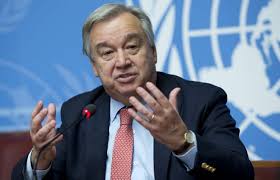

The Secretary-General of the United Nations, António Guterres, has called for urgent global action to eliminate discriminatory laws and ensure justice for women and girls worldwide.
In a message marking International Women’s Day on March 8, 2026, the UN chief said the occasion this year focuses on advancing rights, action and justice for all women and girls, stressing that legal inequality remains a major barrier to gender equality.

According to him, women across the world currently enjoy only about 64 per cent of the legal rights available to men, a situation that continues to shape nearly every aspect of their lives.

He explained that in many parts of the world, legal discrimination still prevents women from owning property, seeking divorce or taking up employment without the permission of their husbands. In addition, he noted that marital rape is still not recognised as a criminal offence in more than 40 countries.

The Secretary-General further pointed out that several legal frameworks continue to limit women’s access to education, restrict their ability to transfer citizenship to their children and, in some cases, even control their freedom of movement outside the home.
He added that even in countries where laws exist to protect women’s rights, discrimination and weak enforcement often make it difficult for women to access courts and obtain legal support.

Mr. Guterres observed that many of the unjust laws affecting women today have existed for centuries. However, he warned that the world is also witnessing a troubling new trend in which progress made in advancing women’s rights is being reversed.
He cited rising authoritarianism, increasing political instability and renewed efforts to reinforce patriarchal systems as factors threatening gains achieved over the years, including improvements in workplace protections and sexual and reproductive rights.

The UN chief therefore urged the international community to unite in fulfilling the commitments outlined in the global development framework known as the Sustainable Development Goals and the Beijing+30 Action Agenda.

He stressed that confronting discriminatory laws and practices, while safeguarding the progress already made, is essential to guaranteeing the dignity, opportunities and freedoms that women deserve.
“When we are not equal under the law, we are not equal,” he said, emphasising that the time has come to make justice a reality for women and girls everywhere.

