
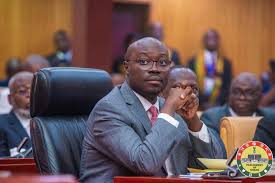

Ghana’s Minister responsible for Finance, Cassiel Ato Forson, has indicated that the national economy is increasingly exhibiting clear evidence of stabilization and renewed momentum following the profound financial turmoil that shook the country during the period spanning 2022 through 2023.
In remarks shared through an online public statement on Thursday, March 5, the minister conveyed a sense of cautious optimism, explaining that Ghana is gradually emerging from the most difficult phase of the crisis as authorities advance comprehensive reforms designed to rebuild fiscal credibility, restore macroeconomic balance, and strengthen the architecture of economic governance.

The statement accompanied the signing of a bilateral debt restructuring arrangement between the Government of Ghana and the European nation of Belgium, an agreement that forms part of the country’s broader international effort to reconfigure its external liabilities following the sovereign debt crisis that compelled authorities to renegotiate repayment obligations with creditors across the globe.

According to the finance minister, the agreement reflects an important step within Ghana’s wider recovery programme, which seeks not only to restore stability but also to construct stronger institutional safeguards capable of preventing a recurrence of the economic conditions that triggered the crisis.

“Today the narrative is evolving,” Dr Forson wrote in his public message. “Our country is moving toward recovery and experiencing a meaningful economic revival, while at the same time we are establishing more resilient systems to ensure that such a situation does not emerge again in the future.”
The crisis that engulfed the Ghanaian economy several years earlier had forced the government to suspend payments on portions of its external financial obligations, an extraordinary measure that underscored the depth of the fiscal distress confronting the country at the time. Rapidly rising public debt levels, combined with declining investor confidence, high inflation, and currency depreciation, had placed severe pressure on national finances and prompted urgent policy intervention.

In response, authorities embarked upon a sweeping programme of debt renegotiation with international creditors aimed at restoring sustainability to the country’s balance sheet. Central to this strategy has been engagement with bilateral partners and financial institutions in order to restructure repayment terms and reduce the immediate burden of debt servicing.
The latest agreement with Belgium therefore represents another milestone in Ghana’s continuing dialogue with official lenders participating in the country’s external restructuring framework. Dr Forson explained that the accord marks the eighth arrangement finalized with members of the Official Creditor Committee, a consortium of creditor nations coordinating their negotiations with Ghana under the broader restructuring initiative.

Officials view these agreements as critical pillars of the national recovery strategy because they provide the fiscal breathing space required for economic reforms to take effect. By extending repayment timelines and adjusting the structure of outstanding obligations, the government hopes to create conditions that allow public finances to stabilize while growth gradually resumes.

The restructuring effort forms part of a comprehensive economic programme that has also included fiscal consolidation measures, reforms in public financial management, and renewed cooperation with international financial institutions. Policymakers argue that these steps are essential not only to rebuild investor confidence but also to strengthen the resilience of the Ghanaian economy against future shocks.
For the administration in Accra, the conclusion of successive bilateral restructuring agreements signals tangible progress in what has been a complex and delicate negotiation process. Each agreement with a creditor nation advances the government’s objective of restoring long term debt sustainability while reinforcing the credibility of its broader economic recovery agenda.
As discussions with remaining creditors continue, officials maintain that the country has already begun to experience early signs of stabilization. Authorities believe that sustained reforms, combined with the gradual resolution of outstanding debt negotiations, will place Ghana on a firmer path toward durable growth and financial stability in the years ahead.

