
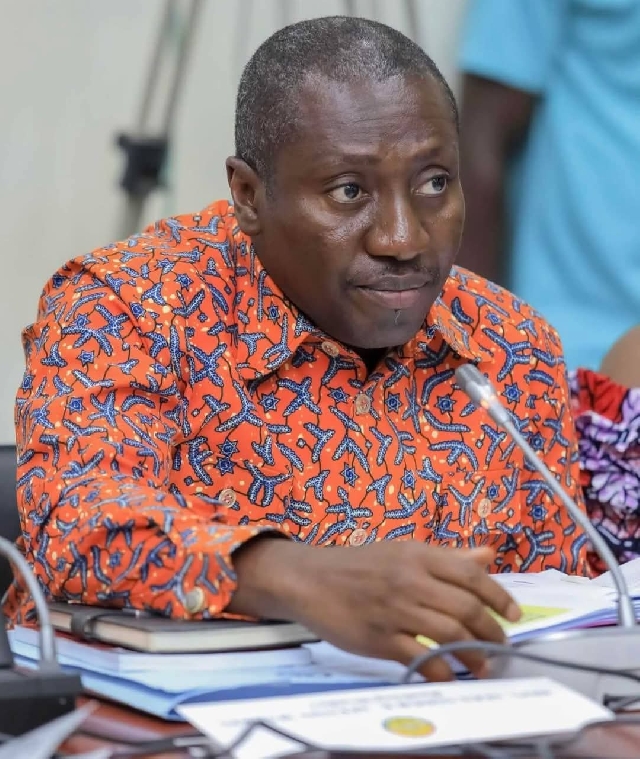

The Minority Leader in Parliament, Alexander Afenyo-Markin, has formally rescinded earlier accusations and rendered an unqualified apology to the Minister for the Interior, Mohammed Mubarak Muntaka, following a heated dispute over alleged irregularities in the ongoing recruitment exercise within Ghana’s security services.
The dramatic reversal unfolded after the First Deputy Speaker of Parliament, Bernard Ahiafor, invoked parliamentary authority to refer the Minority Leader to the Privileges Committee on grounds of possible contempt. The referral came in response to a formal complaint by the Interior Minister, who contended that the claims levelled against him were devoid of evidentiary foundation and injurious to his reputation.

At the centre of the controversy were assertions by Mr Afenyo-Markin that the enlistment of an external information technology firm to facilitate aspects of the recruitment process constituted a fraudulent enterprise and imposed excessive financial burdens upon prospective applicants. The remarks, delivered within the charged atmosphere of parliamentary debate, ignited intense scrutiny and partisan friction.

However, during plenary proceedings on Wednesday, March 4, the Minority Leader adopted a conciliatory posture, unequivocally withdrawing the contested statements. Addressing the Speaker, he clarified that he harboured no intention to malign or discredit the Minister and acknowledged that, should his earlier observations have conveyed such an impression, they were hereby fully retracted. He further pledged that any subsequent concerns arising from public administration matters would be channelled through appropriate institutional mechanisms rather than articulated in a manner susceptible to misinterpretation.

The retraction marked a notable de escalation in what had rapidly evolved into a confrontation with potential disciplinary ramifications. Observers within the legislative chamber interpreted the apology as an effort to safeguard both parliamentary decorum and collegiality, particularly in light of the serious implications associated with allegations of corruption in public recruitment exercises.
Responding with measured candour, the Interior Minister accepted the apology, though not without articulating the personal toll exacted by the episode. He characterised the accusations as profoundly distressing, emphasising the reputational weight borne by public office holders when confronted with claims of grave misconduct. To be publicly linked with heavy wrongdoing, he suggested, is not merely politically damaging but emotionally burdensome, especially when the accusations diverge from one’s intentions and actions.

Nonetheless, in a gesture underscoring institutional maturity, he declared his willingness to embrace reconciliation, affirming that he accepted the apology wholeheartedly. He further appealed for the contentious remarks to be expunged from the official parliamentary record, expressing hope that such a step would symbolically restore equilibrium and render the incident as though it had not transpired.
The episode underscores the delicate balance between robust oversight and responsible discourse within Ghana’s legislative framework. While Parliament remains the arena for rigorous scrutiny of executive conduct, the proceedings also illuminate the imperative of evidentiary precision and reputational fairness. In the end, the exchange, though fraught with tension, concluded with an affirmation of accountability, contrition and the enduring primacy of parliamentary civility.


