
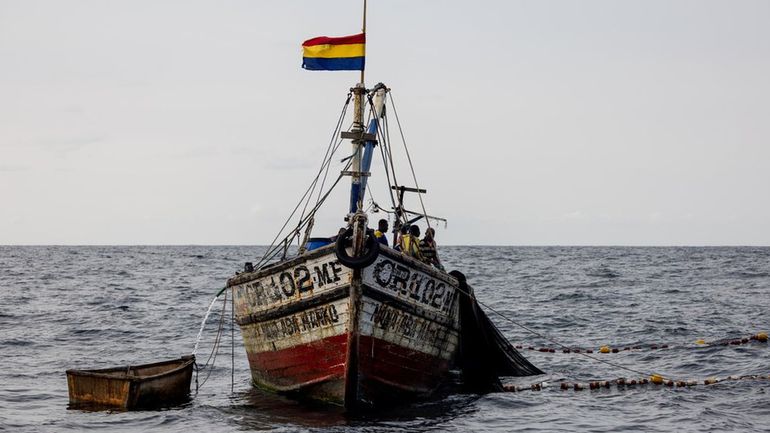

(image credit : pulse GH)
The Ghana Armed Forces has formally announced the successful recovery of seventy one Ghanaian artisanal fishermen who were left drifting in open waters following a brazen armed robbery incident along the maritime corridor off Gomoa Nyanyano and Senya Bereku in the Central Region. The operation, executed through an integrated naval and aerial response, culminated in the safe return of all affected seafarers to shore, averting what could have evolved into a far graver humanitarian and security emergency.

In an official communiqué dated February 26, 2026, and endorsed by Captain Veronica Adzo Arihin, Acting Director General of Public Relations for the Armed Forces, the military establishment confirmed that the search and recovery mission reached its conclusion after a distress alert was received during the early hours of that morning. According to the statement, coordinated deployment by maritime and air assets ensured rapid location and retrieval of the stranded crews.

The Armed Forces reaffirmed its institutional resolve to safeguard Ghanaian fishermen, suppress piracy and sea borne criminality, and guarantee navigational security within the nation’s Exclusive Economic Zone, an expanse of strategic maritime territory that underpins fisheries, offshore energy exploration, and commercial shipping activity.

The ordeal originated during a nocturnal fishing voyage on February 25, when armed assailants reportedly approached the fishing flotilla approximately thirty five nautical miles offshore. Eyewitness accounts indicate that the perpetrators discharged warning rounds into the night sky before subduing crew members at gunpoint and confiscating outboard propulsion engines, portable generators, and assorted personal belongings. Stripped of their primary means of navigation and power, the fishermen were rendered immobile and left exposed to ocean currents and environmental uncertainty.
At first light on February 26, a comprehensive rescue mobilisation unfolded. High speed interceptor craft operated by the Ghana Navy Special Boat Squadron spearheaded the maritime sweep, reinforced by additional naval vessels drawn from the Eastern and Western Commands. Simultaneously, aerial reconnaissance support from the Ghana Air Force enhanced situational awareness, enabling search teams to cover an expanded maritime grid with heightened precision. Local fishermen, demonstrating communal solidarity characteristic of Ghana’s coastal settlements, supplemented official efforts by assisting in locating drifting canoes.

Of the seventy one rescued individuals, twenty four were transported to Tema in the Greater Accra Region for initial reception and logistical coordination, while forty seven disembarked at Senya Bereku to the emotional embrace of awaiting relatives and community members. The absence of fatalities or physical injuries has been widely described by authorities as a testament to the speed and professionalism of the response.
Speaking on Asempa FM, Deputy Defence Minister Yaw Brogya Gyamfi confirmed that all victims were accounted for and none had been abducted. He clarified that the assailants appeared primarily motivated by the theft of valuable marine equipment rather than hostage taking, a pattern consistent with certain forms of opportunistic maritime banditry observed in segments of the Gulf of Guinea.

The Central Regional Minister, Ekow Panyin Okyere Eduamoah, likewise informed JoyNews that no deaths or bodily harm were recorded, emphasising that the overriding priority throughout the operation was the swift and secure repatriation of the stranded crews.

Maritime security specialists note that while Ghana has not experienced the scale of piracy incidents seen in other parts of West Africa, isolated armed robberies targeting fishing vessels underscore the persistent vulnerabilities facing small scale operators. Outboard motors in particular constitute high value assets within artisanal fisheries, often representing the most capital intensive component of a canoe’s equipment inventory.
The successful culmination of the rescue mission has therefore resonated beyond the immediate relief of families; it has reinforced public confidence in the operational readiness of Ghana’s security architecture. By integrating naval strike capability, aerial surveillance, and community participation, the Armed Forces demonstrated a layered response model suited to the evolving security dynamics of coastal waters.
As investigations continue into the perpetrators of the attack, the episode has rekindled national discourse surrounding maritime domain awareness, sustained investment in patrol assets, and the imperative of protecting livelihoods that depend upon the sea. For the seventy one fishermen now safely ashore, however, the dominant narrative is one of survival, solidarity, and the decisive intervention of a military establishment determined to defend Ghana’s sovereign waters.

