
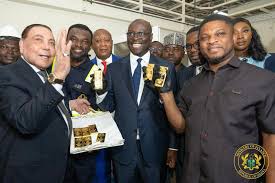

Ghana’s Minister of Finance, Dr. Cassiel Ato Forson, has lauded the Gold Coast Refinery as a pivotal achievement in the nation’s ongoing push to transform its industrial base and broaden economic modernization following a thorough review of operations at the facility this week. The tour underlined the government’s determination to deepen domestic value addition in the gold sector and reduce reliance on the export of unrefined minerals.
Dr. Forson made the assessment alongside top officials from the Ghana Gold Board (GoldBod) including its Chief Executive Officer, Sammy Gyamfi, and Deputy Chief Executive Officer, Richard Nunekpeku, after they were welcomed and guided through the state-of-the-art installation by Dr. Saeed Deraz, Chairman and Chief Executive Officer of the Gold Coast Refinery.

In remarks after the walkthrough, the Finance Minister praised the leadership and workers of the refinery for successfully establishing and running a globally competitive gold processing plant that stands as a symbol of Ghana’s ambition to retain greater value from its vast mineral wealth. He explained that this initiative aligns with a long-held vision first articulated nearly a decade ago that the country must start refining its own precious metals locally rather than shipping unprocessed bullion abroad.

Ghana, historically one of Africa’s top gold producers, has long exported the bulk of its gold in raw or semi-processed form, a practice that sapped potential revenue and under-leveraged the nation’s resource base. Recent partnerships and policy measures now aim to invert that tradition by encouraging exports of refined bullion, capturing more economic benefit and enhancing Ghana’s competitiveness in global markets.

The refinery — capable of handling up to two tonnes of gold weekly — is part of this broader strategy to build a gold processing ecosystem that generates skilled jobs, boosts foreign exchange earnings, and strengthens the gold value chain from mine to market. Dr. Forson said the facility represents a decisive move away from simply selling raw ore toward exporting fully refined Ghanaian gold, a shift that is expected to deepen value addition in the mining sector and create opportunities for backward and forward linkages in related industries.
In addition to refining capacity upgrades, Dr. Forson disclosed that the government has teamed up with GoldBod to establish a modern fire assay laboratory by the end of the year. This facility will provide Ghana with its first domestic scientific capability to accurately test and authenticate gold purity and value, reducing dependence on foreign laboratories and enhancing the transparency and accuracy of royalty assessments. The move is seen as a critical step toward strengthening the institutional framework that supports the mineral sector and maximising returns for the state.

“This new laboratory and refinery expansion are cornerstones of our economic reset strategy, designed to add value to our natural resources, reinforce institutional capacity, and ensure that the wealth beneath our soil benefits Ghanaian citizens first,” Dr. Forson stated, highlighting the alignment of these efforts with the government’s broader economic transformation agenda.
The inspection and associated policy announcements coincide with wider reforms in the gold industry, including a historic partnership between GoldBod and Gold Coast Refinery formalized earlier this year that strengthens local refining capabilities and supports Ghana’s goal to shift away from exporting raw or partially processed gold.

As Ghana continues to recalibrate its approach to mineral resource management, initiatives like the refinery and fire assay lab are expected to play a central role in fostering downstream processing, improving export earnings, and creating a more resilient, value-driven mining economy in the years ahead.

IMAGE SOURCE: Adomonline

