
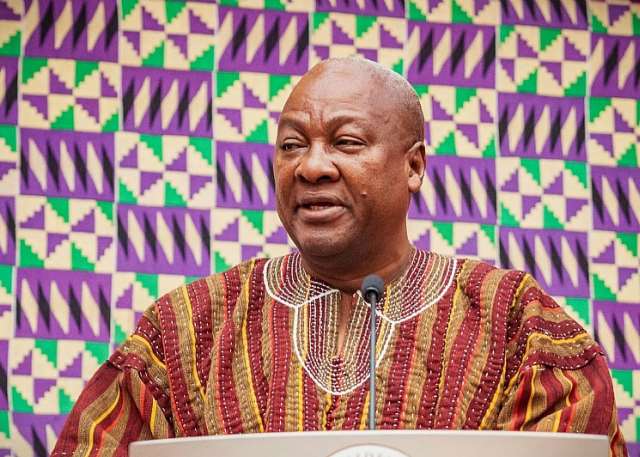

President John Dramani Mahama has openly admitted that even his own administration did not anticipate the speed at which Ghana’s economy has begun to recover, describing the turnaround as both startling and humbling after the depth of the crisis his government inherited.
Speaking on Sunday, January 25, at the First Sky Group’s Thanksgiving Service in the Northern Region, the President struck a reflective and almost incredulous tone as he addressed congregants. The economic picture confronting his government at the start of its mandate, he recalled, was so dire that expectations were deliberately conservative. In his own assessment, Ghana would need at least two years of painful adjustment before any meaningful signs of recovery could realistically appear.

What has unfolded instead, Mahama said, has upended those projections.

Against a backdrop of widespread scepticism, both locally and abroad that the economy has shown signs of stabilisation and rebound at a pace few predicted. According to the President, the improvement has been so pronounced that it has drawn unsolicited admiration from major international partners, including the International Monetary Fund and the World Bank, institutions that only recently had Ghana at the centre of crisis-management discussions.

He pointed to key macroeconomic indicators as tangible proof that the tide has turned. Inflation, once spiralling at alarming levels, has fallen sharply, while the Ghanaian cedi has staged a remarkable resurgence after years of depreciation. These developments, Mahama suggested, are not cosmetic adjustments but structural signals that confidence is slowly returning to the economy.
“When we assumed office, the situation was extremely difficult,” the President said, drawing on his prior experience in office to underscore the severity of the challenge. “I have done this job before, and even with that experience, I honestly believed it would take about two years before we could speak of a turnaround. Yet here we are.”

The tone of his remarks blended policy realism with personal conviction. While acknowledging the role of fiscal discipline, economic restraint, and careful management, Mahama also framed the recovery in spiritual terms, crediting what he described as divine grace for the unexpected momentum.
“We are all surprised, truly shocked, by the speed of the recovery,” he told the congregation. “Every time I sit with IMF and World Bank officials, they express amazement at what Ghana has achieved in such a short time. Ghana has now become something of a reference point, a poster example, in their engagements.”

He cited what he called extraordinary gains: inflation falling from 23.8 per cent to 5.4 per cent within a year, and the cedi appreciating by 37 per cent over the same period. Achievements of that scale, he argued, go beyond technical competence alone.

“Bringing inflation down so dramatically and restoring strength to the cedi in such a short time can only be attributed to the grace of God,” Mahama said.
Yet beneath the celebratory tone lies a deeper political and economic subtext. Ghana’s recovery comes after years of economic turbulence marked by debt distress, currency volatility, and painful austerity measures that tested public patience. For many Ghanaians, the figures cited by the President offer hope, but also raise questions about sustainability, distribution, and whether early macroeconomic gains will translate into improved living conditions on the ground.
For now, Mahama’s message was clear: the recovery may still be fragile, but its pace has rewritten expectations. What began as a cautious rescue mission has evolved, far sooner than anticipated, into a narrative of surprise, even for those steering the ship.

