
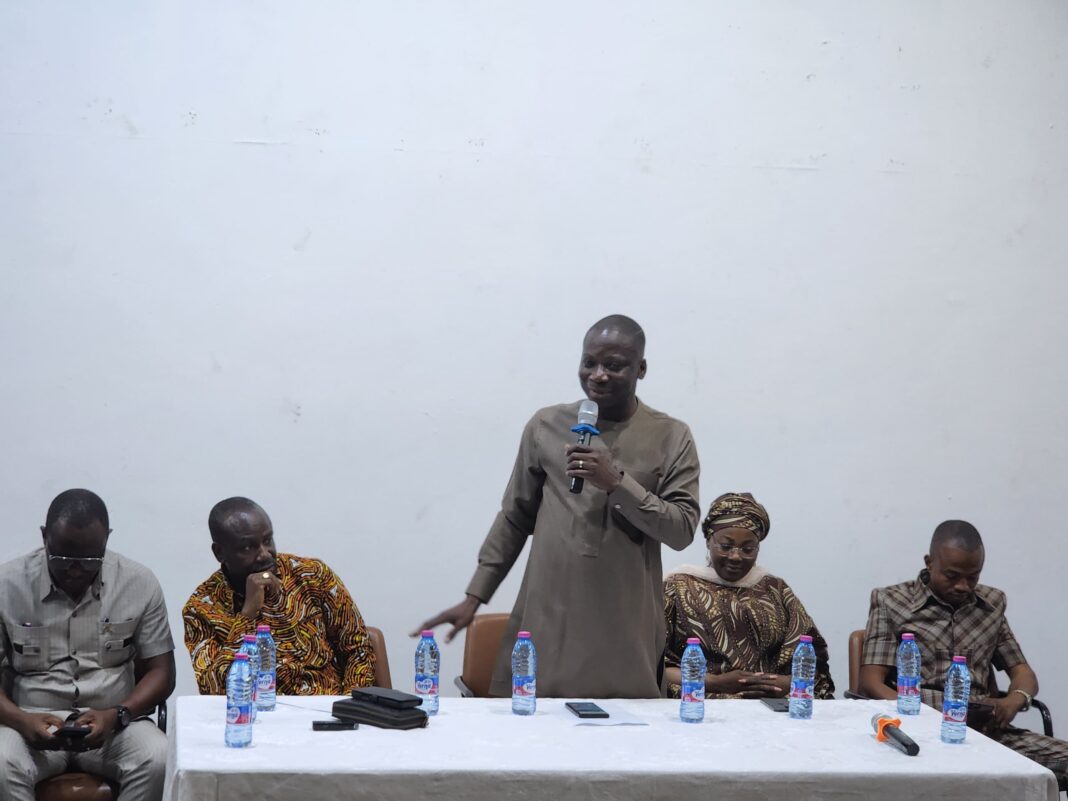

The Accra Metropolitan Assembly (AMA) Monday raised concerns about the government’s fumigation contract with the Jospong Group of Companies, operators of Zoomlion Ghana Limited, citing a lack of consultation and transparency.
Madam Florence Kuukyi, Director of Public Health, AMA emphasised the need for a review to ensure accountability.

She said: “We want a review and repackaging of the SIP contract so that we, the implementers, actors, will also have a say in it.”

Madam Kuukyi stated during a working visit engagement with the Parliamentary Select Committee on Sanitation and Water Resources in Accra.

“Whatever they are doing, our faces are following them. If they are doing it right, we will know. If they are not doing it right, we will know,” she added.
 She expressed frustration over the current process, where contracts were signed without involving key actors within the assemblies.

“All these contracts are always signed at the blind side of the implementers… They don’t involve us in whatever they do. They only bring you a report to sign as a witness,” Madam Kuukyi noted.
This isn’t the first time Zoomlion’s contracts have faced scrutiny.

In 2017, investigations revealed that 11 Jospong companies, including Zoomlion, were single sourced for a GH₵98 million fumigation contract without adequate consultation with local assemblies.

Some assembly officials allegedly claimed they were unaware of the companies supposed to undertake the exercise in their areas.
Meanwhile Mr John Oti Bless, Chairperson of the Parliamentary Select Committee on Sanitation and Water Resources, on Monday announced a comprehensive plan to address Ghana’s sanitation woes.
Key initiatives he mentioned included reviewing Contract Processes.
“We are going to do everything possible to review the current contract agreements for sanitation services, ensuring local assemblies and technocrats are involved to boost accountability and effectiveness,” he said.
He also cited a National Sanitation Authority Bill, where he explained that advocating for the passage of this bill would establish a unified body for managing sanitation issues and public health concerns as well as promoting a cohesive approach nationwide.
Mr Oti Bless said these when he addressed the media after day one of a working visit by the Committee to Accra Metropolitan Assembly, Korley Klottey Municipal Assembly and Ayawaso Central Municipal Assembly all in the Greater Accra Region to ascertain and oversee the state of sanitation and water resources in the region as part of a three-day tour and a parliamentary oversight duties.
According to Mr Oti Bless, also the National Democratic Congress (NDC) Member of Parliament (MP) for Nkwanta North, the Committee will be embarking on regional visits to all 16 regions to assess sanitation and water resource challenges firsthand, gathering insights from local stakeholders to inform policy decisions.
“After this, we will compile a comprehensive report based on findings from these visits, which will be presented on the Floor of the House, and for government implementation, ensuring data-driven solutions,” he said.
He emphasised the need for collaboration with Local Assemblies and Municipal and Metropolitan District Assemblies (MMDAs) to understand their challenges and develop tailored solutions, fostering a collaborative approach.
“These initiatives aim to enhance sanitation management, promote accountability, and support Ghanaian-owned businesses while maintaining high standards of service delivery.
“By involving implementers in contract processes and pushing for policy reforms, the committee seeks to address long-standing issues plaguing the sanitation sector,” the Chairperson told the media.
As Mr Oti Bless emphasised, “A clean nation is a healthy nation, and a healthy nation is a wealthy nation”, Ghana’s Coalition of NGOs in Water and Sanitation (CONIWAS) is also pushing for increased WASH budget allocation and timely disbursements for improvement in the country’s sanitation landscape.
Mr John Oti Bless has also called for a review of the use of Internally Generated Funds (IGF) by District Assemblies to pay for sanitation services when District Assembly Common Funds are delayed.
During a working visit to the Korle Klottey Municipal Assembly (KoKMA), Mr Oti Bless emphasised the need for contract signing between assemblies and service providers.
Mr Victor Acquaye, Municipal Environmental Health Analyst at KoKMA, highlighted challenges such as refuse collection backlog, fuel and spare parts hikes, overloading of refuse cars, and disposal site issues.
He appealed for government support to equip the Assembly with logistics and funds.
“We need a formula component for solid waste for adjustment and the regulation of refuse collectors into standard conformity,” Mr Acquaye stated.
Mr Emmanuel Baisie, Municipal Coordinating Director, KoKMA, noted that KoKMA invests a substantial part of its IGF into sanitation, underscoring the Assembly’s commitment to addressing sanitation challenges.

