
26 October 2024 – Today the Commonwealth Heads of Government adopted the Commonwealth Principles on
Freedom of Expression and the Role of the Media in Good Governance at their summit meeting in Apia, Samoa.
These Principles highlight the importance of freedom of expression and media freedom to democracy. They state
that Commonwealth governments ‘should consider repealing or amending laws which unduly restrict the right to
freedom of expression.’
The Commonwealth Human Rights Initiative and the Commonwealth Journalists Association today call on States to
take practical and effective steps to end arbitrary and excessive restrictions on free expression. The Commonwealth
as a whole must audit progress and engage with civil society to ensure that these Principles are implemented in
reality.
Freedom of expression is not just a right in itself – it is the foundation that allows us to exercise and defend all other
human rights, and is safeguarded under international law.
However, as we know all too well, this right is under threat.
According to UNESCO, in Commonwealth countries alone, 178 journalists were killed between 2006 and 2020.
Furthermore, the impunity rate for the killings of journalists during that same time is 96% — which is notably
higher than the global impunity rate of 87%. Reporters Without Borders (RSF) has documented 547 journalists
imprisoned globally as of the end of 2023, with legal harassment often used as a tool to stifle dissent and
investigative reporting.
Many Commonwealth countries still maintain restrictive, colonial-era laws that curtail free expression, suppress
diverse voices, and inhibit the transparency that is essential for democracy.
In the Commonwealth, 41 countries continue to criminalise defamation; 48 countries still retain laws related to
sedition; and 37 still have blasphemy or blasphemy-like laws, as set out in a soon to be released report by the
Commonwealth Human Rights Initiative (CHRI) and the Commonwealth Journalists Association (CJA), with other
Commonwealth partners, entitled Who Controls the Narrative? Legal Restrictions on Freedom of Expression in the
Commonwealth.
“These laws, often enforced through criminal sanctions, have a chilling effect on activists, journalists, and others
who fear retaliation for speaking truth to power”, said William Horsley of the Commonwealth Journalists
Association. “This has led to an alarming rise in self-censorship and a decline in the independent and dissenting
voices that are vital for holding governments accountable.”
The Principles were first put forward by a group of civil society organisations in response to a general deterioration
in legal protections and the working environment for journalists. The CJA convened other civil society
organisations, including the CHRI, Commonwealth Lawyers Association and the Institute of Commonwealth
Studies, before Commonwealth member states reviewed and adopted the Principles in the form which today was
adopted by heads of government at this 2024 CHOGM.
States are ‘urged to take concrete and meaningful steps to implement them within their domestic frameworks, as set
out in the CHOGM Samoa Communiqué. The joint report Who Controls the Narrative? Legal Restrictions on
Freedom of Expression in the Commonwealth reveals the increasing use of criminal law provisions, including those
related to defamation, sedition, blasphemy, and national security, to restrict freedom of expression and media
freedom within the Commonwealth. The report is the product of extensive collaboration between Commonwealth
partners, legal experts, academics, human rights advocates, and media professionals, and provides a comprehensive
analysis of the legal frameworks governing freedom of expression and outlines clear pathways for reform.
In addition to analysing legal restrictions on free speech in Commonwealth states, the report puts forward actionable
recommendations for reform. These include regional and national-level proposals, as well as broader
Commonwealth-wide recommendations aimed at strengthening legal frameworks, promoting judicial independence,
encouraging media pluralism, and enhancing international accountability mechanisms. These reforms are essential
for establishing an environment where free expression can thrive, allowing individuals to speak without fear of
reprisal.
“While many member states share a colonial legal legacy that includes repressive laws still in effect today, they also
share a commitment to democratic governance and the rule of law as set out in the Commonwealth Charter. The
Commonwealth has the 3 potential to lead by example in promoting freedom of expression through legal reform,
ensuring that criminal laws are not misused to silence dissent,” said Sneh Aurora, Director of the Commonwealth
Human Rights Initiative. “The Principles provide an important opportunity for Commonwealth governments to
bring their national laws in line with international human rights laws.

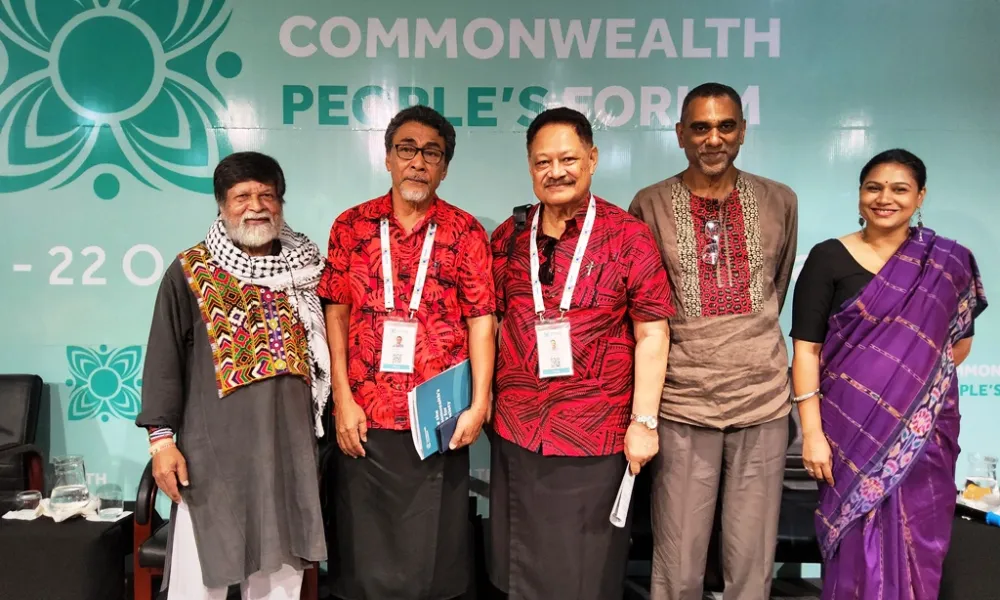
The Commonwealth adopts Principles on Freedom of Expression
- Advertisement -
- Advertisement -
www.ghanareaders.com
- Advertisement -

