

SOURCE: BBC
- Trump on talks: US President Donald Trump said no talks are underway or scheduled with Iran, just one day after saying his administration had established a back channel with Iran’s Islamic Revolutionary Guard Corps. Iran has denied any talks were taking place.
- Oil prices climb: Global oil pricesare now at their highest levels since July, as hopes of a resolution fade.
- Strait of Hormuz: Trump posted an imageshowing the waterway as “New US Territory,” after Iran reiterated key demandsfor its reopening. Tensions around the strait remain high after a vessel was struck by an “unknown projectile,” according to the UK’s maritime agency.
- Expanding conflict: Elsewhere, the US has criticizedIsraeli strikes on a Syrian air base as an “unnecessary escalation,” and Yemen’s Iran-backed Houthis said today they had again targeted Saudi Aramco’s Jazan refinery on the Red Sea coast in Saudi Arabia.
Air defense forces in the United Arab Emirates registered a “missile threat” on the country late Tuesday, according to local authorities.

Emirati officials urged members of the public to “remain in a safe place and follow warnings and updates from official sources,” the National Emergency Crisis and Disaster Management Authority said in a statement on X.

The statement did not provide details about the source of the threat, whether any missiles were intercepted or whether there were any casualties or damage.

10 MIN AGO
The Strait of Hormuz was pivotal in the breakdown of the last US-Iran agreement

Iran’s parliament speaker Mohammad Bagher Ghalibaf today reiterated his country’s key demands of the US for reopening the critical Strait of Hormuz, including the lifting of sanctions on Iranian oil and the US ending its military threats.


July 1: US and Iranian negotiators traveled to Doha, Qatar, for indirect negotiations. The delegations made “positive progress,” Qatari Foreign Ministry spokesperson Majed al-Ansari said.
July 7: Iran fired on three commercial vessels in Oman’s territorial waters near the Strait of Hormuz, according to a US official. US Central Command said it launched strikes against Iran as “punishment.”
July 8: Iran warned it would deliver a “crushing response” to the US strikes, and the country’s Islamic Revolutionary Guard Corps (IRGC) said it had launched attacks at 85 US military targets across Bahrain and Kuwait. US President Donald Trump castigated Iran’s leaders as “evil, sick people” at the NATO summit in Turkey, saying the memorandum of understanding was “over.” Hours later, the US launched more strikes against Iran.
July 9: Tehran said the US military struck a railway bridge in northern Iran. CENTCOM said the US hit around 90 military targets in another round of strikes. A US official told CNN that both countries were continuing to engage in technical negotiations on nuclear issues.
July 10: Trump said the US had agreed to continue talks with Iran, but also that Washington had informed Tehran the ceasefire was no longer in effect. Ghalibaf said Tehran was prepared for “all-out defense” if the US broke the agreement. The Trump administration imposed fresh sanctions on Tehran.
July 11: Iran’s foreign minister accused the US of violating a clause on Tehran’s nuclear program in their agreement.
July 12: The IRGC announced it had closed the Strait of Hormuz after firing a warning shot at a vessel attempting to use an unauthorized route to cross the waterway. The US military launched more strikes on Iran and insisted that the strait was still open.
July 13: US attacks across Iran continued into the afternoon, killing at least two people, Iranian media reported. Trump said he would reinstate a blockade of Iranian ships in the Strait of Hormuz, and the US carried out more strikes on Iran overnight.
President Donald Trump’s suggestion he will bomb Oman if it impedes US efforts in the Strait of Hormuz is “not a credible threat in any sense,” according to Jasmine el-Gamal, former Middle East adviser at the US Department of Defense.
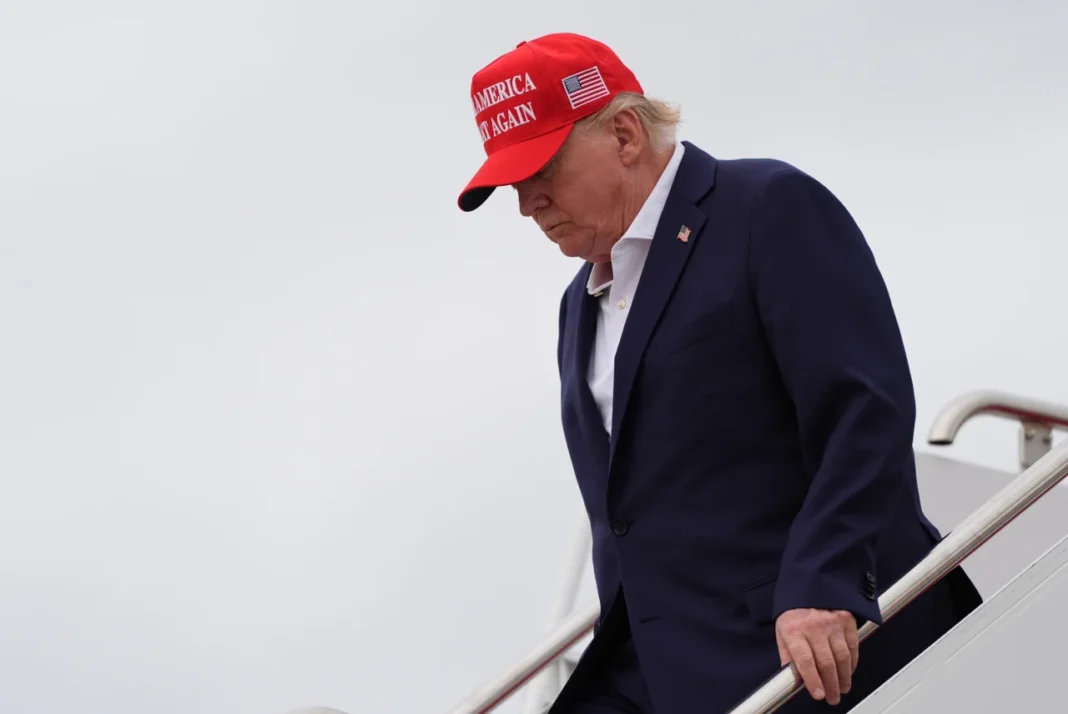
President Donald Trump said Tuesday that there are no talks underway or scheduled with Iran, one day after saying his administration had established a back channel with Iran’s Islamic Revolutionary Guard Corps, the military arm that reports to the country’s supreme leader.
“There are no talks or conversations going on, or scheduled, with the Islamic Republic of Iran. The Naval Blockade remains in full force and effect. The Hormuz Strait is open and operating. All water mines have been removed or detonated,” Trump wrote in a Truth Social post.
Iran’s parliament speaker, Mohammad Bagher Ghalibaf, has been a key negotiator with the US during the conflict.
This comes after Trump said Friday that he plans to declare the strait a US territory after “we finish defeating Iran.”
Trump has repeatedly claimed the US “owns” the Strait of Hormuz, parts of which are in the territorial waters of Iran and Oman. However, maritime law experts point out claiming a territory is not this simple.
“Under US law, claiming territory by a presidential declaration (or) decree is not enough. There are important constitutional requirements that must be cleared first,” said Jason Chuah, professor of maritime law at City St. George’s, University of London, and a distinguished fellow at the Maritime Institute of Malaysia.
“Under international law, annexation is contrary to the United Nations Charter. Territories including bodies of water can only be taken through agreement or cession,” Chuah told CNN.
“Under international law, this could only be done if Iran agreed to cede its territorial waters in the strait to the US,” he said. “I think this is a very unlikely scenario.”
“The strait is neither Iranian property nor Omani property in the ordinary sense of a piece of real estate. It is sovereign territory very much subject to an international regime of maritime navigation,” he said.
The United States has criticized Israeli strikes on a Syrian airbase early on Tuesday.
“We are deeply concerned that the confirmed Israeli airstrikes on Abu al-Duhur Airbase constitute an unnecessary escalation that does not advance regional stability,” said the Trump administration envoy on Syria, Tom Barrack.
He added that Washington was encouraging all parties to prioritize “logical discourse” over further military incidents.
Israel has not confirmed it carried out the strikes on the air base, which is near Idlib in north-western Syria and has few serviceable aircraft.
Barrack said on X that the government in Damascus had neither adopted a predatory posture nor maintained proxy forces. “It has, in fact, repeatedly indicated a preference for de-escalation with Israel.”
US President Donald Trump posted an image on social media Tuesday showing the Strait of Hormuz labeled as “New US Territory.”
The picture of a map includes a circle around the strategic waterway, which is located between Iran and Oman at the entrance to the Persian Gulf, with the words “New US Territory” displayed over the area.
The president’s Truth Social post came one day after he said declaring the strait a US territory was a “great idea.”
“I mean we control it,” Trump told reporters in the Oval Office when asked what he meant last week when he said he would soon declare the strait to be US territory.
“We control it with the blockade, and I like the idea of declaring it a territory,” the president added.
Iran’s parliament speaker and key negotiator, Mohammad Bagher Ghalibaf, issued a list of demands today in exchange for Tehran reopening the Strait of Hormuz.
Military operations
Washington and Tehran agreed on the “immediate and permanent termination of military operations on all fronts, including in Lebanon.”
They said they would not “initiate any war or any military operation against each other,” or threaten or use any force against each other.
The parties agreed to “respect each other’s sovereignty and territorial integrity and to refrain from interfering in each other’s internal affairs.”
Strait of Hormuz
The US agreed to end its naval blockade of Iranian ports within 30 days of signing the agreement.
In exchange, Iran would make “its best efforts” to “ensure the safe passage of commercial vessels with no charge” through the Strait of Hormuz for 60 days.
Economy
The US agreed to work with partners to develop a plan “for the reconstruction and economic development” of Iran, including a fund of least $300 billion.
It would also make efforts to eliminate “all types of sanctions” against Iran, including those implemented by the United Nations.
Until those sanctions were terminated, the US agreed to issue waivers for the export of Iranian crude oil, petroleum products and derivatives.
The US also agreed to unfreeze Iranian funds and assets that had previously been frozen.
Nuclear
Iran agreed that it “shall not procure or develop nuclear weapons.”
Washington and Tehran “also agreed to discuss the issue of enrichment” related to Iran’s “nuclear needs.”
Oil prices rise as Iran issues demands to reopen Strait of Hormuz. Catch up
Iran’s parliament speaker Mohammad Bagher Ghalibaf issued another list of demands today, saying the US needs to fulfill them before Tehran reopens the Strait of Hormuz.
Here’s what else is going on in the Middle East today:
Oil prices climbed to the highest level since July today, as traders’ hopes of a swift resolution to the US-Iran conflict fade. Brent crude futures, the global oil benchmark, were up 0.1% to $91 a barrel early this morning ET.
Yemen’s Iran-backed Houthis have said they targeted Saudi Aramco’s Jazan refinery, a major crude oil refinery located on the Red Sea coast in southwestern Saudi Arabia. CNN cannot independently verify the claim, and there has been no immediate comment from Saudi authorities.

