
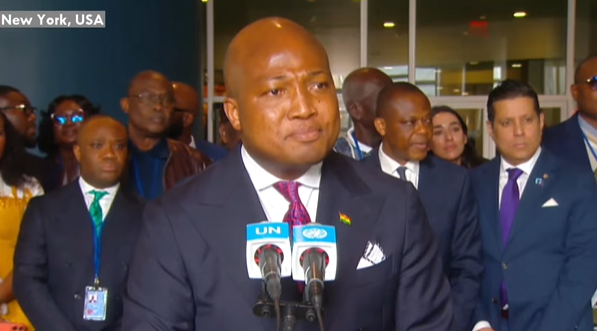

The Minister for Foreign Affairs, Samuel Okudzeto Ablakwa, has characterised the adoption of the landmark resolution on the transatlantic slave trade by the United Nations as a resounding triumph for justice, asserting that the decision restores the dignity and intrinsic humanity of Africans and people of African descent across the world.
Speaking from the United States following the decisive endorsement by the United Nations General Assembly on Wednesday March twenty five, he described the outcome as a defining milestone in the enduring international pursuit of truth, historical recognition, and moral accountability.

In an emotionally resonant reflection, the Foreign Minister declared that the adoption transcends symbolic diplomacy, representing a profound acknowledgement of the suffering endured by generations of Africans subjected to enslavement. He emphasised that the moment carries deep historical significance, affirming that the voices and experiences of ancestors have been honoured through a collective global act of recognition.

The resolution, which secured overwhelming backing from one hundred and twenty three member states, formally designates the trafficking and enslavement of Africans as the most egregious crime against humanity, thereby elevating its status within the hierarchy of international moral and legal condemnation. This decisive endorsement reflects a growing consensus within international human rights law that historical injustices must be confronted with clarity and conviction.

Mr Ablakwa underscored that the achievement extends beyond the mere passage of a formal instrument, describing it instead as a powerful moral pronouncement by the international community. According to him, the adoption represents a deliberate choice to prioritise remembrance over silence, dignity over historical erasure, and shared human identity over division.
He further expressed gratitude to the diverse coalition of member states that supported the initiative, as well as those that engaged constructively throughout the consultative process, even where perspectives diverged. He noted that such dialogue reflects the maturity of global diplomacy and reinforces the legitimacy of the final outcome.

While celebrating the milestone, the Minister cautioned that the adoption does not signify the culmination of the journey but rather a significant advancement within a broader continuum of engagement. He affirmed that Ghana, in collaboration with its international partners, remains committed to sustained dialogue and cooperative efforts aimed at deepening global understanding and accountability.
In his assessment, the resolution marks a transformative juncture in how the international system confronts the legacy of slavery, insisting that the magnitude and enduring consequences of the transatlantic slave trade necessitate recognition at the highest institutional levels. He argued that such acknowledgement is essential for fostering meaningful healing and preventing historical repetition.

The Foreign Minister clarified that the initiative is not designed to apportion blame but rather to create a constructive space for truth telling, education, and candid global discourse. By framing the resolution in this manner, he positioned it as a unifying instrument capable of bridging historical divides while promoting collective reflection.

He also highlighted that the resolution opens new avenues for sustained international engagement on reparatory justice, describing it as part of a broader architecture aimed at restoration, reconciliation, and equitable partnership. Within this evolving discourse, issues of structural inequality rooted in slavery are increasingly being brought to the forefront of global policy consideration.
Calling upon member states to translate commitment into action, he urged governments to pursue inclusive and sincere dialogue on reparations, emphasising the necessity of addressing entrenched disparities that continue to shape global socio economic realities. He maintained that remembrance must be accompanied by tangible steps toward justice.
In a concluding reflection imbued with both resolve and aspiration, Samuel Okudzeto Ablakwa affirmed that while history itself cannot be altered, the manner in which it is remembered and the lessons drawn from it remain within humanity’s control. He suggested that this collective decision signals a renewed global commitment to building a future grounded in justice, inclusivity, and shared humanity, thereby transforming memory into a force for progress.

