
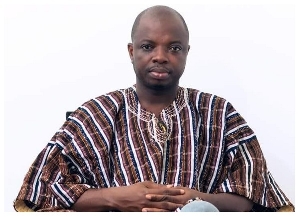

Emeritus Prof Dinkum💃 Alex Kyeremeh:
I was gravely rocked into a hotbed of disgruntlement when i heard about the queer account that, Chairman Abronye had been summoned by the National Investigation Bureau (NIB), apropos a supposed defamatory statement against John Mahama. In fact, it was beyond my ken to concede the feasibility of that bulletin. The perversion of power under the second coming of John Mahama is sorely mind – bending. On this note, i will preview the bearing of the law on the commitments of the National Investigation Bureau (NIB) and the panorama and what institutes defamation, to reckon, if it is under the sway of the NIB for any ostensible defamatory cases or not _ for, the hue of Chairman Abronye’s comment will be presumably ranged as ‘ defamation ‘.

Ghana’s national security framework comprises critical institutions responsible for the execution of security policies and management of the national security agenda. Which ordinarily portrays that, the NIB is one of the subsets of the National Security Agencies. Those institutions perform functions, which have direct posture on the uniform will and welfares of Ghanaians, securing the national interest as enshrined in chapter six of the 1992 Constitution _ all those organizations perform national security functions. Communally, they are been catalogued as ‘ National Security Agencies ‘. They, however, have distinct roles as far as the universal agenda of policing the national interest (i.e national security) is concerned ; thus, their roles are diametrically opposed to another, vis – á – vis their modes of operations.

Section 12(1) of ‘ The Security and Intelligence Agencies Act 1996, (Act 526) spells out functions of the intelligence agencies as;

- a) Collect, analyze, retain and disseminate as appropriate information and intelligence respecting activities that may constitute threats to the security of the state and the governed of Ghana.
- b) Safeguard the economic wellbeing of the state against threats pose by the acts or omissions of persons or organizations both inside and outside the country.
- c) Protect the state against threats of espionage, sabotage, terrorism, hijacking, and piracy, drug trafficking and similar offences.
- d) Protect the state against the activities of persons, both nationals and non – nationals intended to overthrow the government of Ghana through illegal political, military, industrial or other means or through any other unconstitutional method, and
- e) Perform such other functions as may be directed by the president or the National Security Council.
By virtue of Section 40 of the Act; we could hear the burble that, ” subject to the constitution, a personnel of any of the International Agencies [which yes, includes the NIB ] shall in the performance of his/her duties under this Act have the same rights, powers and protection as conferred by law on a police officer in the performance of his/her duties “.
The Ghana Police Service was established under Article 200 of the 1992 constitution and it’s to perform its orthodox mantles among others, of preserving law and order. The details of the service are set out under Article 203 of the 1992 constitution. These include among others; control and administration of the police service and the delegation to other persons of powers to drill persons and the conditions subjected to which the delegation may be made. The s. 40 of the Act decorously, confers on the NIB powers to intrude into matters of ‘ national security concerns ‘ and not otherwise.

Therefore, the prime onuses of the NIB are ; counter – sabotage, counter – espionage, counter – terrorism, counter – subversion, counter – narcotics, counter – surveillance criminal investigations of national security dimension, border and internal security.
‘ Counter – sabotage ‘ denotes an act, or omission intended to cause physical damage to vital national installations, i.e, oil installations, bulk ammunition depots, power stations, vital security and national assets in furtherance of the agenda of a foreign power, belligerent organization or subversive organization and however, has no analogy with defamation.

ON THE PHASE OF THE CONTEXT OF DEFAMATION;

The High Court has jurisdiction to deal with matters involving the enforcement of human rights as enshrined under Article 33(1) of the 1992 Constitution of Ghana. The High Court also has sovereignty to tackle matters of defamation, both under common law and under customary law. For execution of human rights, the episode must be commenced with an originating motion on notice, while defamation actions are get stuck into by writ. There is no jury for either action, and costs are awarded at the discretion of the judge.
Defamation in Ghana is regulated by two legal regimes; customary law and common law tort principles. Customary laws are defined in the Constitution of Ghana as “the rules of law, which by custom are applicable to particular communities in Ghana”.
As per the customary law, defamation is bridled to the spoken words, i.e. slander. Customary law does not appreciate libel because, the courts have held that writing is not familiar with customary law. Under the common law regime, however, defamation can be categorized as either slander or libel.
Ghanaians may therefore choose to bring an action for defamation either under common law or customary law.
There are a multiple of factors, which may apprise the preference, e.g. the damage occasioned by the defamatory words or the defences available. Under customary law, the truth of the defamatory words is no defence; while at common law, the fact that, the words are true may serve as a defence to a defendant in a defamatory suit. The in fashion alternative with many lawyers is to institute the action under the common law rather than under customary law.
Libel was a criminal offence under Ghanaian law until 2001, when Parliament passed the Criminal Code (Repeal of the Criminal and Seditious Laws – Amendment) Act 2001, to de-criminalise it. Libel is now solely a civil action, for which civil nostrums like damages may be sought for. The Ghanaian courts carry on to highlight and expound on the common law principles of defamation: legal rights and sweet balms.
Chairman Abronye made a valid proposition, because in every job recruitment, funds are allocated to that cause, so where, there are expulsions of people from their works, then the initial image will be that, who will tap those funds and apparently, the president _ which in this case, John Mahama. So, that theorem cannot be ascribed as either defamatory or liable to investigatory questioning. Even theoretically, if it was slander (defamation), he may have had a palpable defences to that effect and thus, ‘ truth ‘. So, in the case of Kweku-Baako v. Kennedy Agyapong (Unreported) Suit No. GJ/51/2019, Her Ladyship Afia Serwaa Asare-Boakye intimated that, “the truth of a defamatory statement, if established, is a complete defence no matter how careless, ignorant, or vindictive the defendant was”. And that “the actions in defamation are designed to penalize falsehood, and truth accusations are treated as lowering reputation only to its rightful level “. And from the above – explanatory scenarios, it was incumbent on Chairman Abronye to quiz about the subsequent journey of those funds meant to subsidize the disbanded workers.
Also, Chairman Abronye rallied behind ‘ fair comment ‘ _ the defence of fair comment is designed to accommodate insulation to people, whose statements are an opinion on matters of public interest. In London Artists Ltd. v. Littler [1969] 2 QB 375, a matter of public interest was defined as “whenever [it] is such as to affect people at large, so that they may be legitimately interested in, or concerned at what is going on; or what may happen to them or others”. However, the citizenry were eagerly anxious to decipher the harbour of those funds and legally and rightfully, he had the constitutional punch in embarking on such agitation.
So, sapiently, that call on him to appear before the National Investigation Bureau (NIB) was otiose and fatuous, since it didn’t fall within their discretionary powers to either probe him or sought for his prosecution. The manner this NDC government are employing this institution, which isn’t meant for those assignments, just to dragoon their untamed critics is sorry and Ghanaians must kick up the fuss of such iron – fisted rule, because our portrayal on the global soil is our perennial decent democratic creeds, therefore, we must with one accord, cushion it from any insensitive suppressions.
By: Prof. Dinkum.
(The Buzzing Rapine Of Erudition)
E – mail : dinkumchoice@gmail.com

