
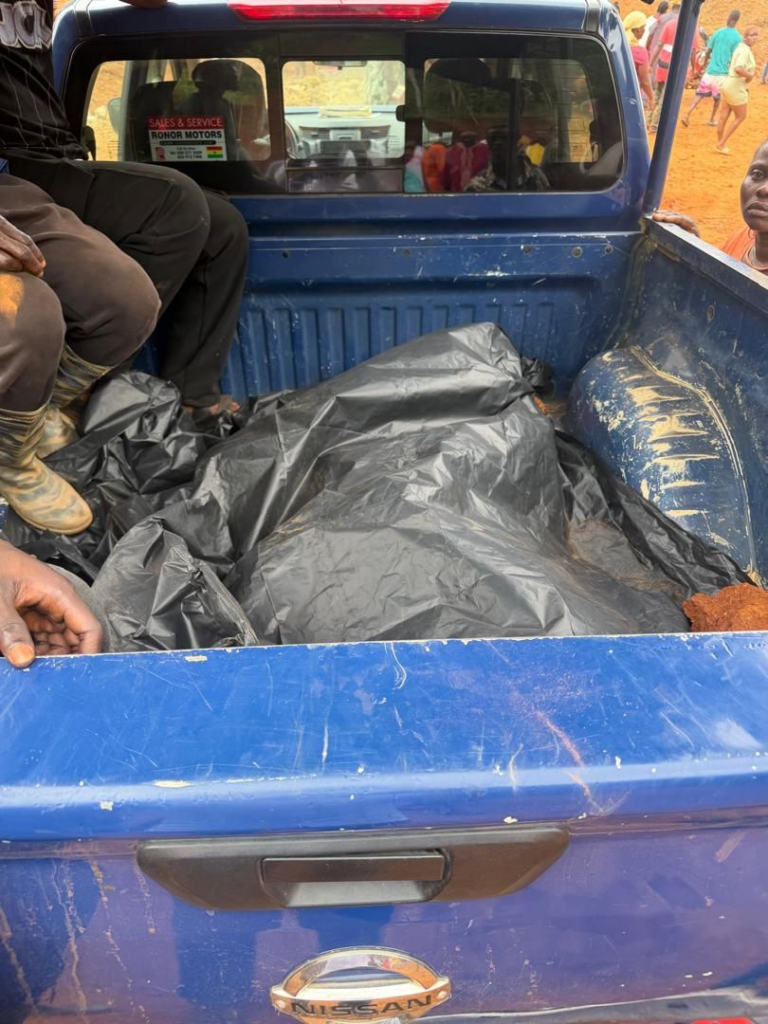

Once again, galamsey has claimed human lives.
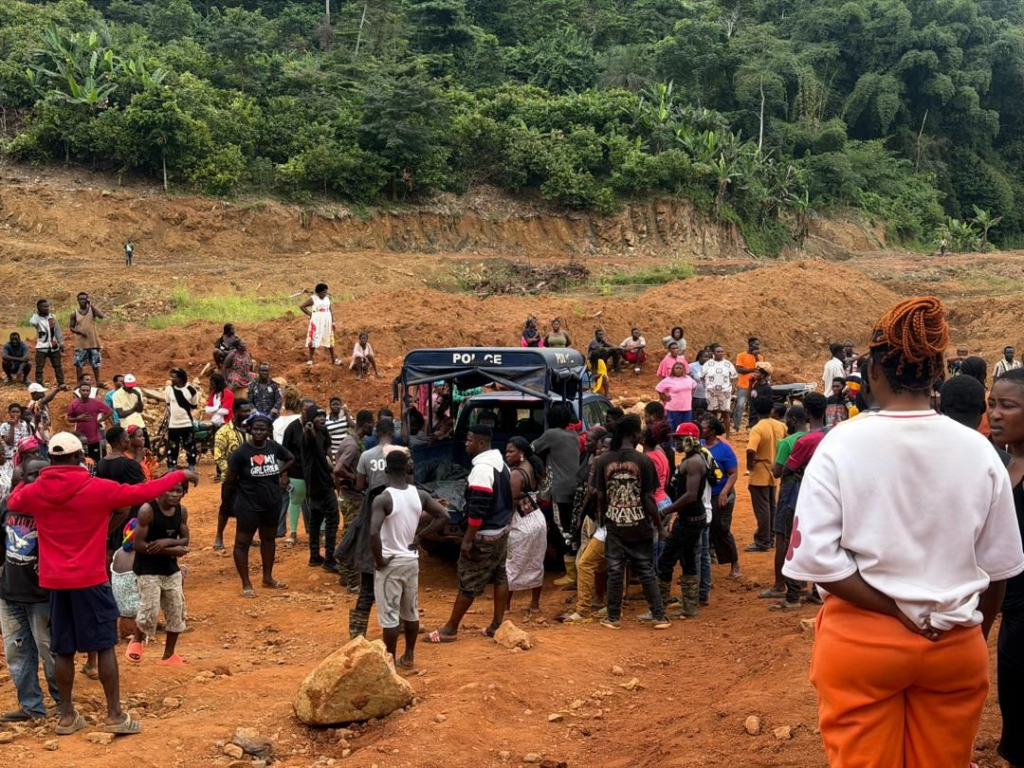
Seven people are feared dead after being trapped at a reclaimed mining site at Asaman Tafo in the Atiwa East
District of the Eastern Region. A police-led evacuation operation was reportedly completed, with all seven persons
found unresponsive. The precise circumstances of the tragedy remain under investigation.
Whatever the eventual findings, however, the tragedy represents another grim chapter in Ghana's seemingly endless
story of deaths associated with illegal mining.
In March this year, one illegal miner died and three others were injured when a galamsey pit collapsed at Assin
 Subriso in the Central Region. That incident followed several other mining-related deaths in the area. In May, four
more illegal miners were killed when a pit collapsed at Bepotenten Sukuum in the Amansie Central District of the
Ashanti Region. They were reportedly working at an abandoned mine site that was in the process of being
reclaimed.
These are not isolated tragedies. They are symptoms of a national problem that has become so persistent that deaths
at illegal mining sites are increasingly treated as routine news.
And that is precisely the danger.
Ghanaians must not become so accustomed to reports of collapsed pits, drowned miners, poisoned rivers and
destroyed forests that these tragedies cease to shock the national conscience.
The human cost is only one dimension of the crisis. Illegal mining has become an assault on Ghana's environment,
economy and future. The Forestry Commission has reported that illegal mining had affected 8,923.8 hectares of
forest reserves across 45 forest reserves and a national park as of December 2024.
The National Development Planning Commission has similarly identified galamsey as a national security and
environmental concern, linking it to deforestation, land degradation, water pollution, loss of state revenue and
diminished investor confidence. It reported that only 56 per cent of Ghana's water bodies had good ambient quality.
The situation is therefore much bigger than the destruction of a few mining sites. Ghana is progressively consuming
some of the natural assets upon which its future depends.
And yet, after years of political declarations, military operations, task forces, arrests, excavator seizures and
promises, galamsey remains alive and flourishing.
The question is no longer whether government is fighting galamsey
The government is certainly doing something.
The National Anti-Illegal Mining Operations Secretariat, or NAIMOS, was established in 2025 as a central
coordinating body for intelligence-led operations against illegal mining. Government says that since July 2025,
NAIMOS operations have resulted in the seizure of 94 excavators, the destruction of nearly 3,000 changfang
machines and the arrest of 237 suspects. It has also announced plans for permanent deployments in major mining
hotspots.
NAIMOS deserves credit where credit is due.
But the existence of operational successes does not mean the larger strategy is succeeding.
Indeed, NAIMOS itself has acknowledged that Ghana is "not out of the woods yet." Its own leadership has
described illegal mining as an existential threat to the country and warned about its implications for water security
and national security.
The question, therefore, is not whether NAIMOS has seized excavators or disrupted illegal mining operations.
The question is whether Ghana is actually stopping illegal mining from returning after the task forces leave.
That is where the national strategy appears to have a fundamental weakness.
Why must Accra continually send soldiers to the bush?
The Daily Searchlight has consistently argued that Ghana's problem is not necessarily the absence of institutions,
personnel or laws.
It is the failure to make the institutions that already exist work.
Galamsey does not happen in some mysterious, ungoverned territory.
It happens in identifiable districts, municipalities and communities.
There is a District Assembly in every district. There is a District Chief Executive. There is a District Security
Council. There is a police command. There are traditional authorities. There are assembly members. There are local
government officials. There are environmental and mining officials.
The Local Governance Act, 2016 (Act 936), expressly gives District Assemblies responsibility for the overall
development of their districts, including the development, improvement and management of human settlements and
the environment, as well as responsibility, in cooperation with security agencies, for security and public safety.
The Security and Intelligence Agencies Act, 2020 (Act 1030), goes further. It establishes a District Security Council
chaired by the DCE and comprising, among others, the District Police Commander, District Crime Officer,
intelligence officials, Immigration, Fire Service, NADMO and the designated military representative. Its functions
include providing early warning of security threats and taking immediate steps to ensure law and order and assist
affected populations in emergencies.
So why should a few hundred soldiers have to be transported from Accra or elsewhere to discover what local
authorities are already supposed to know?
Make the district the frontline of the war
We believe Ghana should fundamentally rethink its anti-galamsey architecture.
Instead of making national task forces the primary instrument of enforcement, government should make the district
the basic unit of accountability.
Every mining district should have a continuously updated register identifying:
every licensed small-scale mining operation;
every abandoned mining site;
every reclaimed mining site;
every active galamsey site;
every excavator and other heavy equipment operating in the district;
the owners and operators of such equipment;
the landowners or persons controlling the affected land; and
the traditional and local authorities responsible for the areas concerned.
Every DCE should be required to report periodically to the Regional Minister and the appropriate national
authorities on the galamsey situation in the district.
If illegal mining is discovered in a district, the first question should not simply be: "Where is NAIMOS?"
It should be:
"What did the District Security Council know, when did it know it, and what did it do?"
That is a far more sustainable system of accountability.
The law already provides formidable weapons
There is also no shortage of legislation.
The Minerals and Mining Act, 2006 (Act 703), as amended, contains serious sanctions against illegal mining. The
2019 amendment, Act 995, provides severe penalties for persons who undertake mining without the required licence
and for those who facilitate illegal mining. It also criminalises the provision of mining support services in certain
circumstances and imposes particularly severe sanctions where foreigners unlawfully participate in mining.
Ghana has also strengthened its environmental legal framework through the Environmental Protection Act, 2025
(Act 1124), which consolidates environmental protection law and specifically provides for environmental
management issues relating to mining in forest reserves and other environmentally sensitive areas.
The EPA has already directed persons involved in unauthorised mining in and around water bodies to cease their
activities and warned that equipment would be seized and offenders prosecuted.
The problem, therefore, is increasingly difficult to explain as a legal deficiency.
It is an enforcement and accountability deficiency.
Follow the money, not just the miners
There is another uncomfortable issue that Ghana must confront.
The men operating excavators at illegal mining sites are not necessarily the people who finance the operations.
Galamsey is an economic enterprise. Somebody supplies the machinery. Somebody provides the fuel. Somebody
finances the operation. Somebody buys the gold. Somebody provides the logistics. Somebody protects the operation.
If enforcement concentrates overwhelmingly on the young men at the pit while the financiers, equipment owners,
gold buyers and other beneficiaries remain untouched, Ghana will continue fighting the symptoms while leaving the
disease intact.
The law must therefore be applied upwards, not merely downwards.
An excavator should not simply be seized and photographed for the newspapers. Its ownership should be traced. The
financier should be identified. The gold-buying chain should be investigated. Bank accounts and assets connected to
serious illegal mining operations should be subjected to lawful investigation and, where the evidence supports it,
prosecution and confiscation.
The objective should be to make illegal mining economically irrational, not merely temporarily inconvenient.
And what about the young men?
There is also a social reality that government cannot ignore.
Many of the people entering galamsey are young Ghanaians seeking income. A recent study by Solidaridad West
Africa and the Minerals Commission found children between 10 and 17 years working at dangerous, abandoned and

unregulated mining sites in parts of the Eastern Region. The study identified poverty, peer pressure and the
attraction of quick income as important drivers.
This is why simply declaring war on the miner at the bottom of the pyramid will not solve the problem.
Government must create credible alternatives.
Licensed and properly regulated small-scale mining must become a genuine alternative to galamsey. Cooperative
mining schemes, mechanised but environmentally responsible operations, agricultural employment, vocational
training and other local economic opportunities must be concentrated in the communities from which galamsey
draws its labour.
A young man who can earn a decent living legally is less likely to risk his life inside an unstable illegal pit.
Reclamation must mean reclamation
The Asaman Tafo tragedy contains another important lesson.
A reclaimed mining site should not become an abandoned mining site with a new label.
If a site has supposedly been reclaimed, who certified it?
Who inspected it?
Was it physically secured?
Was the community warned that the area remained dangerous?
Who remains responsible for it?
The Environmental Protection Act, 2025 provides for a reclamation financial security scheme for the mining
industry. Ghana should use such mechanisms to ensure that reclamation is not simply an administrative exercise on
paper.
Every abandoned pit should either be properly filled, securely fenced or otherwise rendered inaccessible and safe.
Otherwise, today's illegal mining site becomes tomorrow's death trap.
The political problem
Ultimately, however, the galamsey problem is political.
Successive governments know where illegal mining occurs. They know the districts involved. They know the
communities. They know the rivers. They know the forest reserves. They know the machinery. They know the laws.
They also know the political consequences of taking unpopular action.
And therein lies the uncomfortable truth.
It is much easier politically to announce another task force than to hold a DCE, police commander, traditional
authority, local official, financier or politically connected individual accountable for allowing illegal mining to
flourish under his or her watch.
It is easier to announce an operation than to sustain it.
It is easier to destroy an excavator than to dismantle the financial network behind it.
It is easier to arrest a miner than to prosecute the person who financed the operation.
It is easier to make a national declaration than to enforce accountability district by district.
Ghana must stop playing to the gallery
The Daily Searchlight therefore believes that Ghana needs a different approach.
NAIMOS should continue its intelligence-led national operations, particularly against organised and heavily armed
mining syndicates. But the national task force should complement—not replace—the institutions that are
permanently located in the affected communities.
The District Assembly, District Security Council, police, traditional authorities, Minerals Commission and
environmental authorities must become the permanent frontline.
And there must be consequences for failure.
If galamsey continues unabated in a particular district, government should be able to identify the officials
responsible for that district and demand answers.
If an excavator repeatedly returns to an area after enforcement operations, somebody should explain how it got back.
If a supposedly reclaimed site becomes an illegal mining site again, somebody should be held accountable.
If financiers repeatedly escape while labourers are arrested, the enforcement strategy should be deemed a failure.
Ghana cannot task-force its way out of galamsey indefinitely.
The country needs intelligence, local accountability, sustained enforcement, prosecution, financial investigation,
genuine alternatives for young people and credible reclamation.
Most importantly, it needs political courage.
The battle against galamsey will not be won by the number of soldiers deployed, excavators seized or press
conferences held.
It will be won when the cost of engaging in illegal mining becomes greater than the profit—and when every person,
from the miner at the pit to the financier behind the excavator, understands that the law will find him.

Until then, Ghana will continue to mourn the dead, bury the victims, condemn galamsey and then wait for the next
tragedy.
That is not a strategy. It is merely a cycle.
And Ghana deserves better.
(
Editorial of The Daily Searchlight of 31 st August, 2026)


