
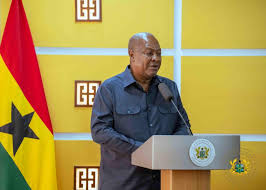

President John Dramani Mahama is expected to receive a comprehensive briefing this week from the National Airline Taskforce established to lead efforts toward restoring Ghana’s national carrier.
The anticipated engagement will present a structured and detailed roadmap outlining the strategy for reintroducing Ghana’s presence within the international aviation industry after years of absence.

The President indicated that the reestablishment of a national airline extends beyond symbolic value, emphasising its potential to generate employment across multiple professional categories, including pilots, cabin crew, engineers, and other aviation specialists.

He made these remarks on Monday, 27 April, during a ceremony at Kotoka International Airport, where he arrived to perform the sod cutting for the expansion of Gate C1 at Terminal 3 as well as the construction of a new concourse designed to connect Terminals 2 and 3.

During the event, he stated that he is expecting to receive a concrete and actionable presentation from the taskforce, expressing optimism that the initiative will ultimately restore Ghana’s national identity within both the African and global aviation landscape.
Ghana has remained without a national airline since the collapse of Ghana International Airlines in 2010, following earlier operational challenges faced by Ghana Airways. Over the years, multiple administrations have explored revival strategies, often involving partnerships with foreign investors, but these efforts have not yet produced a sustainable outcome.

The absence of a national carrier has resulted in heavy reliance on international airlines for long haul travel, a situation that has implications for revenue retention and limits the expansion potential of Ghana’s domestic aviation sector.
Industry stakeholders have consistently argued that a well structured and efficiently managed national airline could strengthen Ghana’s position as a regional aviation hub, particularly in light of ongoing infrastructure improvements at Kotoka International Airport.

The current initiative forms part of a broader policy direction under the Mahama administration aimed at enhancing the aviation sector, improving connectivity, and leveraging air transport as a catalyst for economic growth, trade facilitation, and tourism development.


