
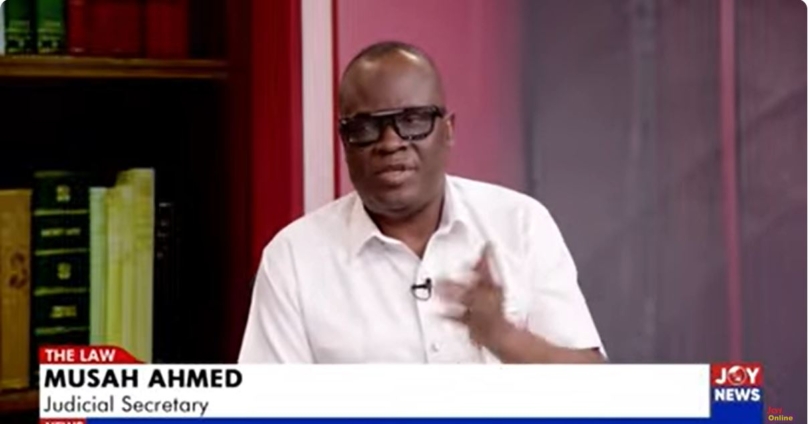

The Judicial Secretary, Musah Ahmed, has confirmed that Ghana’s judiciary is intensifying efforts to ensure efficient, speedy, and effective justice delivery through the establishment of ‘specialised courts’.
Speaking on JoyNews’ The Law on Sunday, he explained that the move is grounded in the principle of specialisation, similar to the division of labour in economics, to improve efficiency in handling complex cases.

“Just as specialisation in production increases efficiency, specialised courts allow the judiciary to deliver justice expeditiously to all persons, without fear or favour,” he said.

He highlighted that the Chief Justice envisions divisions within the High Court that focus on areas such as corruption and public accountability, natural resources and illegal mining (galamsey), state asset recovery, and organised crime. Each division is designed to handle cases with technical complexity and high public interest.

Illegal mining remains a major concern in Ghana due to its environmental and social impact. “The issue has gone beyond ministerial discussions and now requires coordinated executive and judicial action. Special courts will ensure offenders are tried swiftly, sending a clear signal that illegal mining will no longer be tolerated,” Mr Ahmed said.
On financial irregularities, he cited the 2024 Auditor General’s report, which recorded GH¢18.4 billion in public sector irregularities, a 109% increase from 2023.

“Many of these offences exploit systemic loopholes. Establishing specialised courts for state asset recovery and financial crimes will ensure these offenders are held accountable, and public resources are protected,” he added.
Mr Ahmed urged citizens to support and engage with the specialised courts initiative. “This is about upholding the rule of law, protecting public resources, and ensuring justice is delivered fairly and efficiently.”

In brief, and in reaction to the above, I think that it is also necessary to remind the Judicial Secretary, and the Chief Justice, that this is a matter that has already been decided by the Supreme Court (The Fast Track High Court Case), and the decisions therein are binding on the Judicial Secretary, and then the Chief Justice.

Again, the pair would be wise to be mindful of the fact that the ubiquitous ‘Fast Track High Courts’ have disappeared from our system, as has the tribunal system. There is a reason for this; things done to pursue political agendas under the cover of so-called efficacy, have the tendency to disappear with the political systems that spawn them.
Our 1992 Constitution is grounded on the principle of equality. All are equal, and when they fall foul to the law, are supposed to appear before the same courts, no matter the crime. There should not be a court for galamsey, and court for white colour crimes, when what is at play, are the same legal principles.
I say without shyness, that the current attempts are just efforts to create a system to see off political prisoners into jail.
Like the tribunals and the Fast Track High Courts, they would also disappear into political ignominy.
(Periscope Depth of 2nd March, 2026)

