
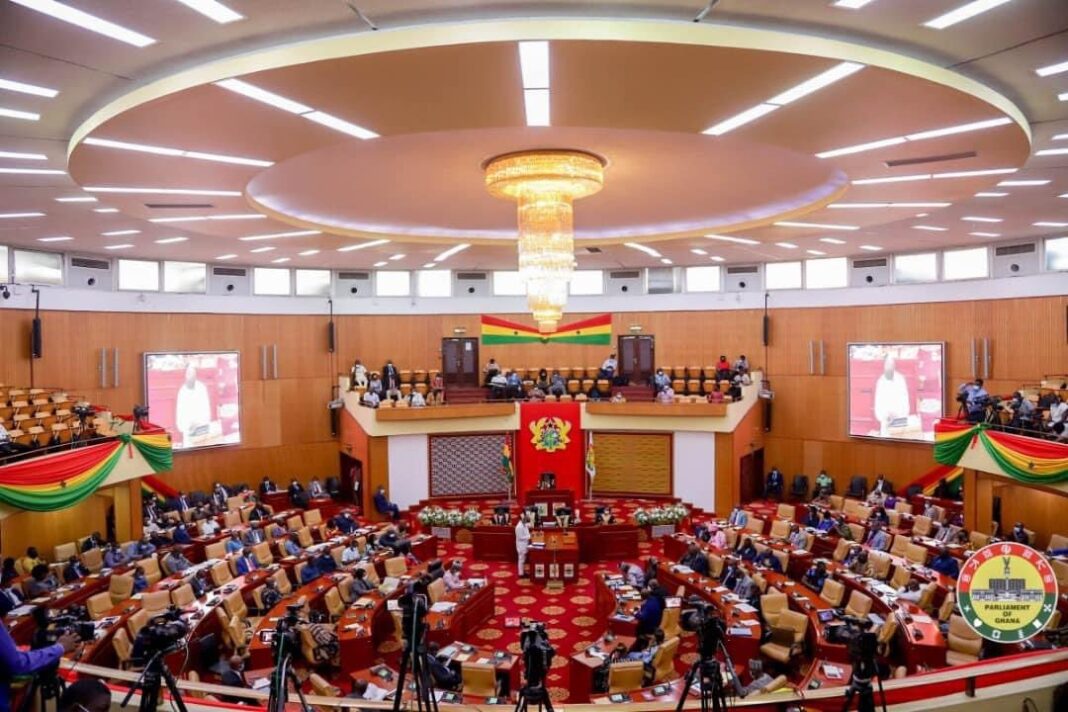

Accra, Dec. 13 (GNA) — The Minority Caucus of the New Patriotic Party (NPP) in Parliament has demanded the immediate resignation of the Majority Leader, Mr Mahama Ayariga, and the Majority Chief Whip, Mr Rockson Nelson Dafeamekpor, following their controversial attempt to abolish Ghana’s Office of the Special Prosecutor (OSP).
The call comes in the wake of a Private Member’s Bill jointly sponsored by the two Majority leaders, which sought to repeal the Office of the Special Prosecutor Act, 2017 (Act 959) and transfer all the OSP’s investigative and prosecutorial powers to the Attorney-General’s Department.

President Intervenes, Requests Withdrawal of Bill
The proposed bill triggered widespread public and political backlash, prompting President John Dramani Mahama to step in. The President publicly described the OSP as “a vital cog in the fight against corruption” and formally requested the sponsors of the bill to withdraw it.

President Mahama stressed that the OSP remains central to his government’s anti-corruption agenda and urged Parliament to exercise restraint and patience while efforts are made to strengthen the institution rather than dismantle it.

“The Office of the Special Prosecutor plays a critical role in promoting transparency, accountability, and good governance, and my government remains committed to supporting and strengthening it,” the President said.
The President’s position was later confirmed by his spokesperson, Mr Felix Kwakye Ofosu, who reiterated the administration’s commitment to empowering state institutions tasked with combating corruption.
Minority Accuses Executive of Interfering With Parliament
In a strongly worded statement signed by Mr Habib Iddrisu, First Deputy Minority Whip and NPP Member of Parliament for Tolon, the Minority Caucus condemned both the bill and the President’s intervention.

The statement argued that the Executive has no constitutional authority to direct Parliament, particularly on matters involving a Private Member’s Bill.
“The executive has no authority to dictate what happens in Parliament,” the Minority stated.
The NPP Minority further alleged that the attempt to abolish the OSP was retaliatory, following the OSP’s recent arrest of Mr Martin Kpebu, a vocal critic of the Office and a known supporter of the National Democratic Congress (NDC).

According to the Minority, the move raises serious concerns about political interference and the future independence of anti-corruption institutions in Ghana.

The Caucus contrasted the current situation with the NPP’s tenure in government, stating that despite criticism and pressure, the party consistently defended the independence and autonomy of the OSP.
Heated Exchange on the Floor of Parliament
The controversy spilled onto the floor of Parliament on Thursday, when Mr Habib Iddrisu openly criticized the President’s request to withdraw the bill.
“Mr Speaker, the Executive wants to control Parliament. The President is now dictating to Members of Parliament. When the Majority Leader and Majority Chief Whip decided to file a Private Member’s Bill, the President ordered them to withdraw it. The Executive has no authority to dictate what happens in this House,” he said.
Ayariga Announces Withdrawal of Bill
In response to the growing controversy and the President’s position, Mr Mahama Ayariga announced plans to withdraw the bill. He said the decision was taken in deference to the President’s request, adding that he had confidence in President Mahama’s judgment and leadership.
The bill, which was formally introduced on Thursday, December 4, argued that the OSP duplicated the functions of the Attorney-General, faced constitutional and structural challenges, and imposed high operational costs on the state.
The sponsors contended that returning prosecutorial authority over corruption-related cases to the Attorney-General would enhance efficiency and reduce institutional overlap.
NDC MP Defends President’s Position
In a related development, Mr Yusif Sulemana, the NDC Member of Parliament for Bole-Bamboi and Deputy Minister for Lands and Natural Resources, publicly supported the President’s request for the withdrawal of the bill.
Speaking to journalists in Parliament, Mr Sulemana described the President’s action as an expression of opinion, not an attempt to control or undermine Parliament.
“I strongly agree with the President that it is premature. This is far from directing Parliament or directing the Majority,” he said.
He suggested that the bill appeared to have been introduced in an emotional atmosphere, rather than through careful policy consideration.
“You could see there was some emotional reaction. The President does not react to emotions, and that is why he has called for restraint,” Mr Sulemana added.
Call for Review, Not Abolition
While backing the President, Mr Sulemana called for a comprehensive review of the OSP’s performance, rather than its outright abolition.
He urged Parliament to critically assess the Office’s effectiveness, expenditure, and overall impact in fighting corruption.
“Let us pause and examine whether the OSP is meeting its objectives. We should look at how much has been spent so far and the outcomes achieved,” he said.
Background
The Office of the Special Prosecutor is Ghana’s premier anti-corruption institution, mandated to investigate and prosecute corruption-related offences involving public officials and private individuals. It was established to operate independently of political influence, particularly from the Attorney-General’s Department.
The latest controversy has reignited national debate over the balance between parliamentary independence, executive influence, and the future of Ghana’s anti-corruption architecture.

