
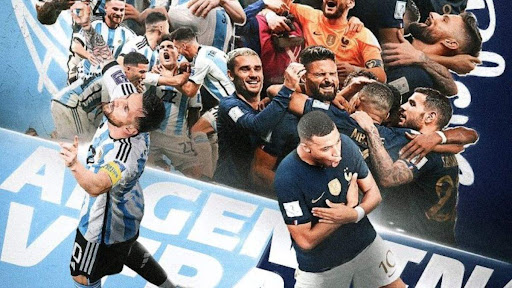

By Phil McNultyChief football writer at Lusail Stadium
Fifa World Cup
Host nation: Qatar Dates: 20 November-18 December Coverage: Live on BBC TV, BBC iPlayer, BBC Radio 5 Live, BBC Sounds, and the BBC Sport website and app. Day-by-day TV listings – Full coverage details
Lionel Messi’s last dance will continue until the music stops in Qatar on Sunday as he now stands just 90 minutes away from the ultimate accolade of having a World Cup forever attached to his name.
Just like Diego Maradona stamped himself indelibly on Argentina’s 1986 win in Mexico and Brazil striker Ronaldo wrote a redemption story in Yokohama in their 2002 triumph, this will be known as Messi’s World Cup if he inspires victory against either France or Morocco in the final.
Argentina’s campaign in Qatar opened with the ignominy of what is still this World Cup’s biggest shock when they lost to Saudi Arabia.
But how the master Messi and his apprentice Julian Alvarez swept aside Croatia in their 3-0 semi-final win delivered an ominous warning that they are reaching the sort of perfect crescendo their fans were still hitting in Lusail Stadium long after the final whistle.
So it is all back to the space-age Lusail on Sunday to see if Argentina can win a third World Cup in their sixth final, and whether the player some label the greatest the game has ever seen can finally get his hands on the prize that has remained tantalizingly out of his reach.
It seemed, for a while at least, that the perfect ending the romantics and those who support Argentina crave would be transformed into a nightmare as a grimacing Messi bent over in the 19th minute, stretching and feeling the top of his left hamstring.
Messi, who equaled Lothar Matthaus’ World Cup record of 25 matches played, moving at a walking pace, which the 35-year-old does quite a lot in his current mode of operation, clearly feeling discomfort.
But he received the biggest tonic of all after 34 minutes when he lashed the opener past Dominik Livakovic from the penalty spot after Croatia’s keeper had fouled Alvarez.
Alvarez then took Messi’s header just inside the Croatia half five minutes later before embarking on a long and winding road to goal, aided by rebounds off Josip Juranovic and Borna Sosa, before beating Livakovic.
The high point of this duo’s masterclass came after 69 minutes when Messi, the magician from Rosario, more or less made one of the tournament’s outstanding defenders disappear.
Messi looked to be trapped by the touchline but a twist and sleight of foot took him away from Josko Gvardiol, now regarded as an ‘A-List’ defender and touted for a £70m move away from RB Leipzig, to set up the predatory Alvarez.
At that moment, Messi did not just mesmerize Gvardiol once, but on a couple more occasions for good measure.
It was pitched as Messi for Argentina against Luka Modric for Croatia, two magnificent players who have World Cup history stretching back to Germany in 2006.
It was not to be Modric’s night. He will not have the chance to make amends for the defeat by France in the 2018 final in Moscow but received warm applause from all around the stadium when he was substituted with nine minutes left.
Fans in Buenos Aires celebrate Argentina reaching the World Cup final
At the final whistle, Argentina coach Lionel Scaloni slumped tearfully into Messi’s arms in a gesture of thanks for the performance that has taken them both to the brink of the crowning glory of their careers.
The Messi story goes on to Sunday when he will have the opportunity to finally erase the memories of his very obvious distress and disappointment when he failed to stop Argentina from losing 1-0 to Germany in Rio’s iconic Maracana in 2014.
And as an indicator of his longevity and enduring talent, his contribution against Croatia meant he has become the first player to score and assist in four separate World Cup matches since 1966 – against Serbia in 2006 and Mexico, the Netherlands, and Croatia here in Qatar.
Argentina scored 12 goals at this World Cup. Messi has netted five and assisted three – he was not given another assist for the header which set Alvarez on his way to the goal to double Argentina’s lead.
He has 11 goals at World Cups in total, which is the Argentina record.
And Messi is now level with Kylian Mbappe in the race for the Golden Boot at Qatar with five goals. Could that contest also be settled on the biggest global sporting stage of all on Sunday?
Messi or Maradona?
BBC Sport pundit and former England captain Alan Shearer suggest Argentina lifting the World Cup on Sunday could have a wider significance when it comes to the argument of who is the greatest footballing product from that country – Messi or Maradona?
Shearer said: “What a story it would be if Argentina win the World Cup. Would it put an end to the debate about Messi or Maradona?
“We said if Messi wins the World Cup here it might have to be him. That has been the difference [in the past], that has been the splitting point – Maradona has won the World Cup. If Messi were to win it here my view would change.”
For club and country, Messi has won it all and done it all – except for winning the World Cup.
Could that moment of destiny arrive at Lusail Stadium on Sunday? If it does this will always be known as Lionel Messi’s World Cup.

France’s Didier Deschamps could become only the second manager to lead a nation to victory at two separate World Cups, after Vittorio Pozzo with Italy in 1934 and 1938
Fifa World Cup
Host nation: Qatar. Dates: 20 November-18 December. Coverage: Live on BBC TV, BBC iPlayer, BBC Radio 5 Live, BBC Sounds, and the BBC Sport website and app. Day-by-day TV listings – Full coverage details

Already a World Cup winner as player and manager, Didier Deschamps could write another incredible chapter in his footballing story on Sunday, in potentially his last game in charge of France.
Les Bleus could become the first country since Brazil in 1962 to retain the trophy, with Deschamps aiming to be the first coach since 1938 – and only the second ever – to guide his nation to two World Cup successes.
The 54-year-old’s contract expires at the end of the tournament, and whatever happens in Sunday’s final against a Lionel Messi-inspired Argentina, Deschamps’ place in French football folklore is assured.
Didier Deschamps lifts the World Cup after France’s 3-0 win over Brazil in 1998 final, with team-mates Marcel Desailly (left) and Laurent Blanc alongside him
‘Never anything more than a water carrier
Deschamps had a glittering playing career, with spells in France, Italy, England, and Spain, and was regarded as one of the game’s finest defensive midfielders.
But not everyone was a fan.
“Deschamps gets by because he gives 100%, but he’ll never be anything more than a water carrier. You find players like him on every street corner,” said former France team-mate Eric Cantona in an interview in September 1996.
Referencing his Champions League final wins with Marseille in 1993 and Juventus in 1996, Deschamps responded: “How many players can you find on street corners who have won two European Cups?”
By the time he retired in 2001, he had played in four Champions League finals (and been an unused substitute as Valencia lost in 2001) and had won five domestic championships (two with Marseille and three with Juventus) as well as the Coppa Italia with Juventus and the FA Cup with Chelsea.
He gained 103 international caps, captaining France as they won their first World Cup in 1998 followed two years later with victory at Euro 2000.
Deschamps’ team-mate Marcel Desailly, speaking to the BBC for the documentary How To Win The World Cup, said: “Didier has been my captain of all my teams and you could see he was a natural leader.”
The story of the 1998 World Cup
An obsession to succeed and excellent man-management skills
A career in coaching was the obvious progression and after spells at Monaco, Juventus, and Marseille, Deschamps became France’s boss in 2012.
After losing in the 2006 World Cup final, 2010 was a disaster for winless France. They finished bottom of their group, with the players refusing to train after a bust-up between manager Raymond Domenech and striker Nicolas Anelka.
World Cup-winning defender Laurent Blanc was next in charge but stepped down after the quarter-final loss to Spain at Euro 2012 – his only tournament.
“There was a lot of respect when Didier took over and we knew, with the obsession he had to succeed, he would identify the correct strategy for the national team,” added Desailly.
France, under Deschamps, reached the quarter-finals of the 2014 World Cup, losing to eventual winners Germany, and made the final of the 2016 Euros they hosted, before Portugal beat them 1-0.
France hosted Euro 2016 and reached the final, but lost as Portugal’s Eder scored the only goal

It was clear France was building something special, with Deschamps’ man-management and tactical skills shining through.
In their opening match at the 2018 World Cup, France scraped a 2-1 win over Australia and Deschamps was seen telling his players their opponents had produced twice as many sprints and ran twice as far, with striker Kylian Mbappe highlighted for a lack of effort.
Midfielder Paul Pogba questioned the tactics, saying they were unsure where to attack from and Deschamps replied: “I’m not saying you, I’m saying we, and I’m including myself. I will protect each of you, one by one, but you have to act.”
“Didier finds the right words with the right person at the right time – he’s a master at that,” said ex-press officer Philippe Tournon.
“He knows when to get out the stick and when to get out the carrot, whether to soften the blow or rap them on the knuckles.”
They met Sunday’s opponents Argentina in the last 16 in Russia and won 4-3 in a thriller, but Deschamps’ man-management skills were again tested afterward.
Some of the players had gone out, and returned in the early hours, boisterous, waking up those sleeping when defender Adil Rami sprayed a fire extinguisher at them, filling the hotel corridor with steam.
Tournon said: “Of course the smoke detectors went off, waking the whole hotel. My room was next to Didier’s and I thought he was ready to tear them apart.
“Didier had a word and, with his sixth sense of his relationship with the players and the unity of the group, told me ‘if I lay into them it might break something we’ve been building for five or six weeks’.”
France then beat Uruguay and Belgium before a 4-2 win over Croatia gave Deschamps World Cup success as both player and manager.
In the celebrations, Pogba, while pointing at Deschamps, was seen shouting at the camera “he is the star, it’s him, the star is on his head”.
Didier Deschamps: How France’s manager expertly led his team to World Cup glory in 2018
Watch How To Win The World Cup on BBC iPlayer
‘A team stronger than the individuals’
France came into the 2022 World Cup facing questions after failing to win four games in June and with Ballon d’Or holder Karim Benzema picking up an injury.
Striker Benzema joined injured midfielders Pogba and N’Golo Kante, who both started the 2018 final, on the sidelines, yet France has been able to cope without the trio.
Mbappe has five goals, 36-year-old Olivier Giroud has four, while Antoine Griezmann, operating in a deeper role, has three assists and created the most opportunities in the tournament.
France’s 4-2-3-1 formation has allowed Mbappe and Ousmane Dembele to attack from the wide positions, while Adrien Rabiot and Aurelien Tchouameni have provided the midfield platform in the absence of Pogba and Kante.
France qualified for the last 16 with a game to spare and their only difficult moment came in the second half of the quarter-final with England before Giroud scored a late winner.
“Didier has created a team that’s stronger than the individuals, which maybe wasn’t always the case,” said England boss Gareth Southgate.
A 2-0 win over Morocco took them into their fourth World Cup final in seven tournaments.
French football journalist Julien Laurens, speaking on BBC Radio 5 Live, added: “Deschamps is doing an incredible job.
“This team is very similar to the team that won in 2018 – because it’s the same coach.
“They could play better, but Deschamps has made them a ruthless winning team. That’s all they care about. It’s all about winning.”
Fifa World Cup
Host nation: Qatar Dates: 20 November-18 December Coverage: Live on BBC TV, BBC iPlayer, BBC Radio 5 Live, BBC Sounds, and the BBC Sport website and app. Day-by-day TV listings – Full coverage details

Youth versus experience, the defending champions, and the challengers.
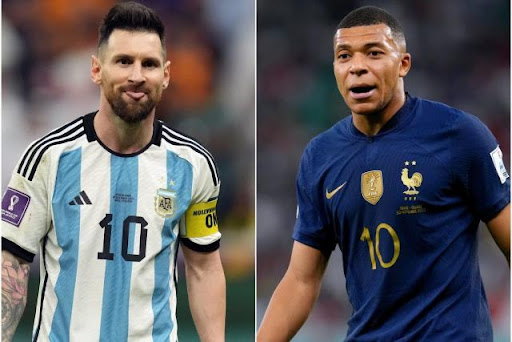
Imagine having the master that is Lionel Messi and the young, already very exciting talent of Kylian Mbappe at your disposal. Well, now you have.
Do you dare leave one out? Perhaps another youngster, Julian Alvarez, has impressed you? Who will dominate your midfield? Then do you go for Hugo Lloris or Emiliano Martinez in goal?
Before Sunday’s enticing final between Argentina and France, have a go at picking your combined XI, and let us know your selection using #bbcfootball. Go well!
Messi vs Mbappé: Argentina face France in World Cup 2022 showdown
GETTY IMAGES
This Sunday is a big day for sports fans because it’s the World Cup final in Qatar.
Reigning and defending champions France will take on Argentina at 3 pm at the Lusail Stadium in Doha, which is the largest football stadium in Qatar.
But can France’s Mbappé help his team get a double World Cup victory or will this competition be known as ‘Messi’s World Cup’ with him lifting the biggest football trophy of all?
Both teams will be giving it everything and we want to know who you will be rooting for and who you want to see win the Qatar World Cup 2022.
And with Messi and Mbappé going head to head, who do you think is the best player? Can you pick between them? Take part in our vote and let us know who you think is the best player in the world in the comments below.

