
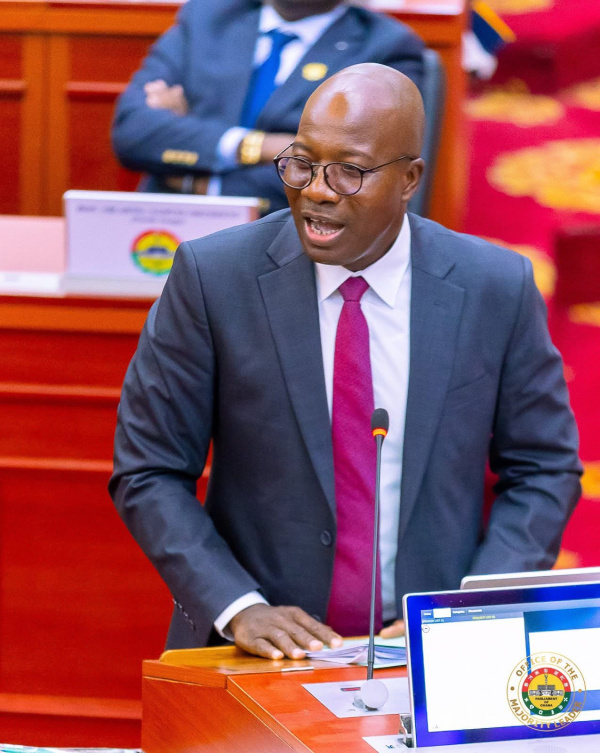

Majority Leader Ayariga’s Stance Scrap OSP to Fund a Stronger AG
The call for the abolition of the Office of the Special Prosecutor (OSP) has gained significant momentum within the opposition National Democratic Congress (NDC), as highlighted by Majority Leader Mahama Ayariga’s address to Parliament on Wednesday, December 4. This strong stance from a key NDC figure is not an isolated incident but rather the culmination of growing political and public dissatisfaction with the OSP’s performance, perceived politicization, and effectiveness.

Mahama Ayariga’s Argument: Empowering the Attorney-General

Speaking in Parliament, Mr. Ayariga argued that the OSP should be scrapped and its anti-corruption mandate re-allocated to a strengthened and adequately resourced Attorney-General’s (AG) Office. His main points centered on:

Under-resourcing the AG’s Office: He questioned the rationale behind allocating substantial funds to the OSP while the constitutionally mandated prosecutor, the AG, remains under-resourced.
OSP’s Failure to Deliver: Ayariga contended that despite the significant allocation of funds, the OSP has failed to meet public expectations in effectively investigating and prosecuting high-profile corruption cases.

Abolition as a Legislative Imperative: He advocated for the abolition through a private members’ bill or an expedited executive bill, stressing that removing the OSP would not protect corrupt individuals but simply streamline the anti-corruption framework.
The Context: Why the OSP is Under Scrutiny

The push to abolish the OSP, an institution created by the New Patriotic Party (NPP) government to fulfill a 2016 campaign promise to fight “grand corruption,” has reached this height due to several compounding factors:

Unfulfilled Expectations and Lack of Convictions: The OSP was established to be an independent, swift, and potent tool against corruption. However, critics argue that after years of operation and significant spending, the office has secured very few high-profile convictions, leading to widespread public dissatisfaction and the perception of ineffectiveness. This has raised the question of whether it is an anti-corruption panacea or a facade.
Allegations of Politicization and ‘Witch-Hunting’: A key reason for the NDC’s strong stance is the perception, shared by a ‘sizeable number’ of voters, that the OSP is a “mere conduit to ‘witch-hunt’ erstwhile government officials”—a common pattern in Ghana where new governments prioritize investigating their predecessors. This fuels the narrative that the office lacks the political neutrality essential for its mandate.
Overlapping and Conflicting Functions: The OSP’s functions often overlap with other state anti-corruption bodies like the Economic and Organized Crime Office (EOCO), the Commission for Human Rights and Administrative Justice (CHRAJ), and the Police Service. This duplication can lead to the siphoning of scarce resources and a lack of a coherent legal framework for fighting corruption.
Recent Controversies: The OSP has faced increased scrutiny, including the detention of private legal practitioner Martin Kpebu, which has further inflamed public debate over the office’s investigative methods and adherence to due process.
NDC’s Broader Strategy and Concerns
The rising chorus of NDC voices calling for the OSP’s dissolution is part of a broader political strategy and institutional critique:
Challenging the NPP’s Anti-Corruption Legacy: By attacking the OSP, the NDC directly challenges the NPP’s commitment to fighting corruption, presenting the institution as a failed project and a drain on state resources.
Structural Critique of the Legal Framework: The NDC argues that the OSP’s dependence on the AG for prosecution authority, or the perceived limitations in its legal framework, ultimately undermines its effectiveness. They contend that it’s the structural weakness—where the constitution ties the hands of all anti-corruption bodies to the AG—that needs fixing, and empowering the AG is the better, more sustainable solution.
Future Policy Signal: The calls serve as a clear signal that if the NDC were to return to power, the OSP, as currently structured, would likely be abolished, aligning with the concerns raised by some experts about the predicted temporariness of the OSP beyond the government that created it.
The video below discusses the removal attempt of the Special Prosecutor and the Minority’s reaction to it, which provides further context for this political debate.
OSP Removal Attempt: Minority Slams Government Over ‘Targeted Attack’
⚖️ Majority Leader Mahama Ayariga’s Insistence: Abolish OSP, Empower the Attorney-General
The call for the abolition of the Office of the Special Prosecutor (OSP) has gained significant momentum within the opposition National Democratic Congress (NDC), as highlighted by Majority Leader Mahama Ayariga’s address to Parliament on Wednesday, December 4. This strong stance from a key NDC figure is not an isolated incident but rather the culmination of growing political and public dissatisfaction with the OSP’s performance, perceived politicization, and effectiveness.
Mahama Ayariga’s Argument: Empowering the Attorney-General
Speaking in Parliament, Mr. Ayariga argued that the OSP should be scrapped and its anti-corruption mandate re-allocated to a strengthened and adequately resourced Attorney-General’s (AG) Office. His main points centered on:
Under-resourcing the AG’s Office: He questioned the rationale behind allocating substantial funds to the OSP while the constitutionally mandated prosecutor, the AG, remains under-resourced. He stated, “Look at the budget, why have we not been resourcing the Attorney General? After resourcing the OSP more than the Attorney General, [OSP] is still not delivering.”
OSP’s Failure to Deliver: Ayariga contended that despite the significant allocation of funds, the OSP has failed to meet public expectations in effectively investigating and prosecuting high-profile corruption cases. This sentiment reflects a general public dissatisfaction, noted in some studies, with the OSP’s inability to secure a large number of high-profile convictions despite its mandate as a “flagship anti-corruption institution.”
Abolition as a Legislative Imperative: He advocated for the abolition through a private members’ bill or an expedited executive bill, stressing that removing the OSP would not protect corrupt individuals but simply streamline the anti-corruption framework. He declared, “I’m of a strong conviction that the OSP should be abolished, whether through a private members’ bill as advised by former Speaker, Prof. Mike Oquaye, or a call on the executive to expedite a bill that we will consider and approve by the House.”
The Context: The Height of Calls from NDC Talking Heads
The rising chorus of NDC voices calling for the OSP’s dissolution is driven by a convergence of political and performance-related concerns:
Perception of Politicization and ‘Witch-Hunting’: For many in the NDC, the OSP is viewed as a political weapon targeting the opposition rather than a neutral, potent anti-graft agency. This perception is heightened by the pattern in Ghanaian politics where new administrations often focus investigations on predecessors. The OSP’s investigation into prominent NDC figures, including the case that once involved Mr. Ayariga himself, fuels this narrative of a “political agenda”.
Dissatisfaction with Conviction Rate: While the OSP has reported on asset recovery and a number of cases currently standing trial (33 persons as of a recent report), critics point to the low number of successful high-profile convictions (7 convictions) as evidence of ineffectiveness. The high public expectation for swift, decisive action against grand corruption has gone largely unmet, leading to the argument that the office is an “unjustified” drain on state resources.
Controversies Over Due Process: Recent public incidents, such as the detention of private legal practitioner Martin Kpebu following a confrontation at the OSP’s headquarters, have further inflamed public debate over the office’s methods and adherence to due process, providing additional fodder for political critique.
Structural Critique: Overlap and Incoherence: NDC officials argue that the OSP’s functions overlap significantly with existing bodies like the Economic and Organized Crime Office (EOCO) and the Attorney-General’s Department. Mr. Ayariga’s solution—empowering the AG—is rooted in the belief that a single, constitutionally mandated, and well-resourced body is a more effective and sustainable structural solution to fighting corruption than a new, often controversial, semi-autonomous agency.
The video below discusses the removal attempt of the Special Prosecutor and the Minority’s reaction to it, which provides further context for this political debate.
This video discusses a recent attempt at the removal of the Special Prosecutor and the political reaction from the Minority, which is directly relevant to the high-stakes political discussion on the OSP’s future.

