
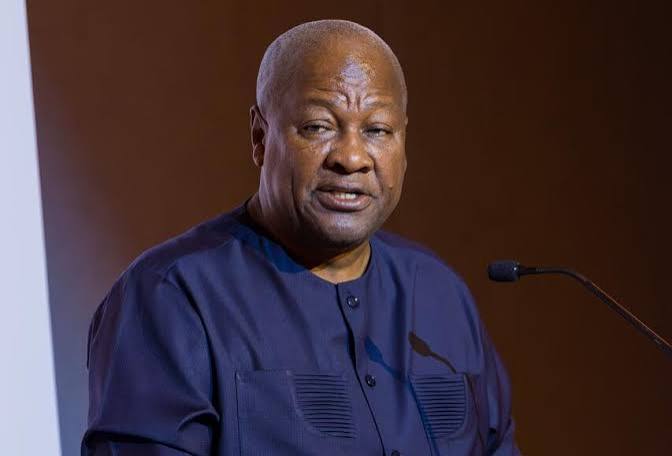

President John Dramani Mahama has issued a firm warning to State Owned Enterprises that the government will no longer tolerate the continued accumulation of financial losses at the expense of the national budget, calling on their boards and management teams to embrace greater efficiency, accountability and financial discipline.
The President said his administration had fundamentally recalibrated its relationship with State Owned Enterprises and would increasingly demand tangible returns from institutions entrusted with the management of assets belonging to the Ghanaian people.

Speaking at a conference organised by the State Interests and Governance Authority at the La Palm Royal Beach Hotel, President Mahama said the era in which persistent losses incurred by public enterprises could simply be absorbed by the state had to come to an end.

He maintained that organisations operating with public resources must demonstrate a clear commitment to efficiency, responsible administration and the creation of measurable value for the citizens whose assets they manage.

“Persistent losses will no longer be quietly absorbed into the national budget,” President Mahama declared.
According to him, the continued financial dependence of State Owned Enterprises on government support creates an avoidable strain on public finances and places additional pressure on a national budget that must also accommodate numerous competing development priorities.

He therefore emphasised that leadership within State Owned Enterprises must be directly associated with measurable performance, sustainable value creation and improved profitability.
President Mahama reminded boards of directors, chief executives and management teams that the institutions they supervise are not personal possessions or private commercial interests, but custodians of assets belonging collectively to the people of Ghana.

He identified the country’s ports, electricity infrastructure, factories, water systems, pension funds, lands, buildings, equipment and government owned equity interests as examples of valuable national resources that are held in trust for the Ghanaian public.

“These assets do not belong to any government, a board, or a chief executive. They belong to the people of Ghana, and you and I hold them only in trust for the people,” he said.
The President consequently stressed that the responsibility of those appointed to manage such institutions extends beyond occupying influential positions or administering existing structures. Rather, their performance must be measured by the extent to which they preserve public assets, improve institutional productivity and generate meaningful benefits for the country.
He said the fundamental principle guiding the conference was that public ownership should translate into public value, suggesting that the mere existence of a State Owned Enterprise could no longer be regarded as sufficient justification for its continued operation.
President Mahama therefore challenged every institution represented at the gathering to provide credible evidence demonstrating what it had contributed to the Ghanaian people.
He urged the leadership of State Owned Enterprises to examine their operations critically, identify areas of inefficiency and adopt measures capable of improving their financial sustainability while protecting the interests of the state.
The President’s remarks signal a stronger emphasis on performance based management within Ghana’s public enterprise sector, with boards and executives expected to assume greater responsibility for the financial and operational outcomes of the institutions placed under their supervision.
His position also reinforces the broader objective of ensuring that public assets are managed as national investments rather than as permanent recipients of government financial assistance.
President Mahama maintained that Ghanaian taxpayers should not continually be required to finance institutions that possess valuable assets and significant commercial potential but remain unable to generate sufficient returns from their operations.
He consequently called for a renewed culture of accountability in which those entrusted with public enterprises are required to justify their decisions, demonstrate measurable results and ensure that national resources are deployed in ways that produce tangible benefits for citizens.
The President’s message to State Owned Enterprises was therefore unequivocal: public ownership must carry a corresponding obligation to deliver public value, while leadership positions within such institutions must be accompanied by measurable responsibility, financial prudence and demonstrable results.

