
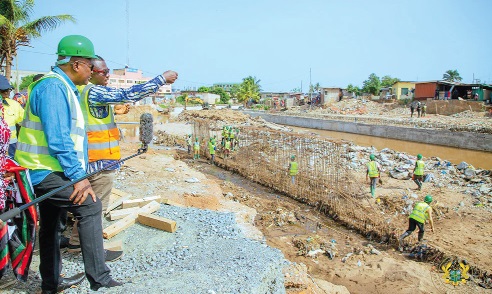

President John Dramani Mahama has issued a strong national warning against the growing practice of using drainage channels as dumping grounds, declaring that irresponsible waste disposal has become one of the major factors worsening flooding across Ghana and threatening the safety of communities.
The President made the remarks during an inspection of the Alajo drainage system in Accra as part of the ongoing National Clean Up Exercise launched following the devastating floods that struck parts of the country on June 29. The exercise, which brought together government institutions, security agencies, sanitation workers, traditional authorities, volunteers and residents, is aimed at clearing blocked waterways, removing accumulated waste and restoring drainage systems damaged by recent heavy rains.

President Mahama said the Alajo flooding incident exposed the dangerous consequences of years of poor sanitation practices, explaining that the drainage channel had become severely obstructed by a combination of accumulated silt, plastic materials and household refuse, preventing the effective movement of stormwater during heavy rainfall.

According to the President, the condition of many drainage systems across urban Ghana reflects a broader environmental challenge where essential waterways designed to protect communities have gradually been transformed into illegal disposal sites.

He explained that the materials discovered inside the Alajo drain demonstrated the seriousness of the problem, with discarded construction materials, broken furniture, household items and other forms of waste found blocking the natural flow of water.
President Mahama expressed concern that some residents continue to dispose of large and inappropriate items directly into drains despite the availability of alternative waste management systems, warning that such practices create serious consequences for entire communities whenever rainfall intensifies.

He emphasised that drainage channels exist solely for the movement of water and should never be treated as substitute locations for household or commercial waste disposal.
“The drains are not garbage instruments,” the President cautioned, stressing that citizens must adopt responsible waste disposal habits and make use of officially provided sanitation facilities rather than placing communities at risk through careless actions.

He encouraged residents to utilise skip containers and designated waste collection points positioned across urban areas, explaining that these facilities exist to ensure refuse is collected, transported and disposed of properly without endangering drainage networks.

The President argued that solving Ghana’s recurring flooding challenges requires more than government intervention and infrastructure investment. He said lasting change depends heavily on a transformation in public attitudes towards sanitation, environmental responsibility and community ownership.
Reflecting on Ghana’s traditional communal values, President Mahama noted that communities historically placed strong emphasis on collective responsibility for maintaining clean surroundings. However, he observed that rapid urbanisation has weakened these practices, creating a situation where some individuals feel disconnected from the consequences of their actions because of the anonymity associated with city life.
He called on Ghanaians to restore the culture of communal cleanliness and recognise that protecting the environment is a shared responsibility rather than a duty belonging exclusively to government agencies.
The President further highlighted that the recent floods, which caused significant destruction and loss of lives, should serve as a national turning point by encouraging citizens to rethink their relationship with the environment and adopt more sustainable sanitation practices.
While acknowledging the devastating impact of the floods, President Mahama described Ghana as a resilient nation capable of recovering from adversity through collective action, discipline and cooperation among citizens and institutions.
He expressed appreciation to the security services, traditional leaders, sanitation workers, volunteers and residents who participated in the clean up campaign, describing their involvement as a demonstration of national solidarity during a difficult period.
Beyond the immediate two day clean up exercise, the President revealed that government intends to continue improving drainage maintenance through the provision of additional specialised equipment to support regular desilting activities and proper removal of waste from waterways.
He explained that one of the major challenges affecting previous drainage interventions has been the failure to completely evacuate removed silt and garbage from affected areas. When excavated materials are left beside waterways, subsequent rainfall often washes them back into drainage channels, reversing the progress made during cleaning exercises.
President Mahama therefore stressed that effective flood prevention requires a complete process involving the removal, transportation and proper disposal of waste collected from drains.
The renewed focus on sanitation comes amid growing concerns over Ghana’s vulnerability to flooding, particularly in rapidly expanding urban centres where inadequate drainage infrastructure, poor waste management practices and unregulated development continue to increase exposure to climate related disasters.
Over the years, flooding has become one of Ghana’s most persistent environmental challenges, particularly in Accra and other densely populated areas. Major flood incidents have repeatedly resulted in deaths, destruction of homes and businesses, disruption of economic activities and significant financial losses to individuals and the state.
Experts have consistently maintained that while expanding drainage infrastructure is important, infrastructure alone cannot solve Ghana’s flooding crisis unless combined with responsible waste management, effective enforcement of environmental regulations and a sustained change in public behaviour.
President Mahama’s intervention therefore represents a broader national conversation about the relationship between citizen behaviour, urban development and disaster prevention. The message from government is clear: while authorities have a responsibility to provide infrastructure and sanitation services, citizens must also play their part by protecting the very systems designed to safeguard their communities.
As Ghana continues its recovery from the June 29 floods, the government believes that a combination of improved drainage management, modern sanitation equipment and renewed public commitment to environmental cleanliness will be essential in reducing future flood risks and building safer, more resilient communities.

