
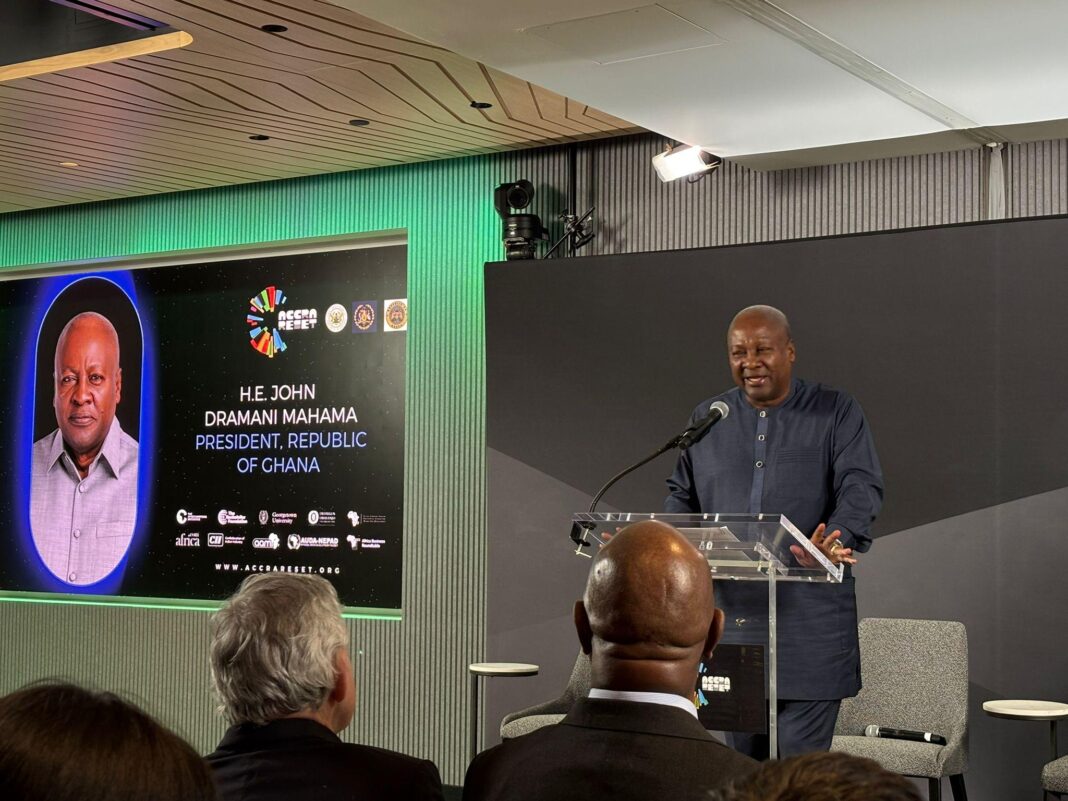

President John Dramani Mahama has unveiled the Health Investment and National Gateway, known as H Enabler, as a continental initiative designed to simplify regulatory procedures, strengthen clinical validation and facilitate the commercialisation of health innovations and investments across Africa.
The initiative was announced during President Mahama’s keynote address at the Alamein Africa Forum in Egypt, where he underscored the need for greater investment in pharmaceutical manufacturing and the development of stronger regional health value chains.

President Mahama said H Enabler had been developed in collaboration with the African Medicines Agency, Institut Pasteur and Afrochampions in response to regulatory and financial obstacles that have continued to impede investment and innovation within Africa’s health sector.

He explained that the platform would function as a data driven framework that brings regulatory procedures, clinical assessment and commercialisation together within a coordinated system, thereby giving health innovators and investors a more structured pathway through the various stages required to take products from development to the marketplace.

According to the President, reducing unnecessary regulatory obstacles is essential to establishing a more effective continental environment for pharmaceutical production and attracting the scale of investment required to expand Africa’s health manufacturing capacity.
He said the H Enabler initiative formed part of broader efforts to strengthen the continent’s ability to manufacture medicines and vaccines locally, while gradually reducing its longstanding dependence on imported health products.

President Mahama noted that Africa currently imports more than 70 per cent of its pharmaceutical products and almost 99 per cent of its vaccines. He said this dependence results in substantial financial resources flowing outside the continent as African countries procure essential medicines and vaccines from external markets.
He said H Enabler was therefore intended to establish a more predictable environment for manufacturers and investors while encouraging the emergence of integrated regional health value chains capable of supporting greater local production and improving the continent’s capacity to meet its own health needs.

The President also disclosed that, through the Accra Reset Presidential Council, Ghana was deploying specialised task forces and reform interlock observatories to monitor capital movements, follow through on policy commitments and identify non tariff barriers that continue to obstruct the development of regional value chains.

President Mahama further called for stronger participation from private investors, industrial developers, commercial banks and sovereign wealth funds in the expansion of Africa’s pharmaceutical and broader health manufacturing sector.
He argued that the scale of transformation required could not be achieved through public sector intervention alone and would require sustained participation from financial institutions, industrial players and private capital willing to invest in production capacity and regional health infrastructure.
The President also urged African regulators to accelerate the operationalisation of the African Medicines Agency, stressing the importance of a harmonised regulatory environment across the continent.
He said an effectively coordinated system could allow a medicine that receives approval through a harmonised continental framework to gain access to multiple African markets without manufacturers having to navigate entirely separate approval processes in every country. The African Medicines Agency was established to strengthen medicines regulation, support regulatory harmonisation and promote greater local pharmaceutical production across the continent.
President Mahama maintained that closer cooperation among African regulatory authorities, coupled with increased investment in domestic pharmaceutical manufacturing, would be central to strengthening Africa’s health sovereignty.
He said greater local production would also place African countries in a stronger position to respond to future health emergencies, particularly by reducing vulnerabilities created by heavy reliance on external suppliers for essential medicines, vaccines and other critical health products.
The H Enabler initiative consequently places regulatory coordination, investment mobilisation, clinical validation and commercialisation within a broader continental effort to build stronger African health industries and retain more of the economic value generated by the sector within the continent.

