
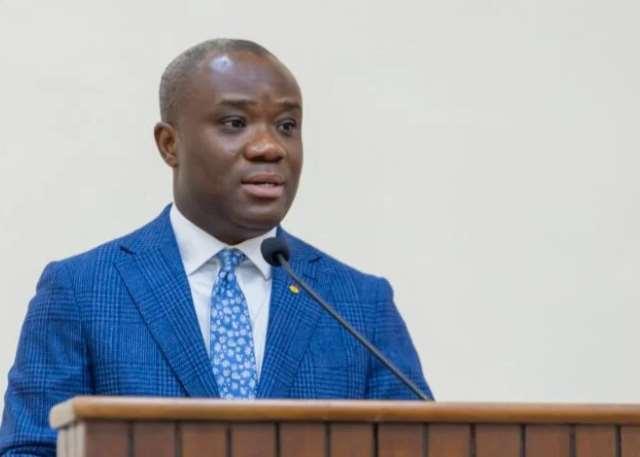

The Minister for Government Communications Felix Kwakye Ofosu has firmly rejected allegations that road contracts awarded under the Ministry of Roads and Highways were predominantly executed through sole-sourcing, insisting instead that the overwhelming majority were processed via competitive tendering.
His response comes in the wake of a report by the Media Foundation for West Africa through its investigative platform The Fourth Estate, which scrutinised procurement practices under the government’s Big Push programme.

The report examined 107 major Big Push contracts awarded between August 2025 and February 2026 and concluded that 81 of them, representing approximately 76 percent, were awarded through sole-sourcing, raising questions about transparency, compliance, and competitive fairness in the procurement process.

Speaking at the Government Accountability Series in Accra on Monday June 15, Kwakye Ofosu disputed the interpretation of the findings, arguing that the report did not capture the full scope of procurement activity within the Ministry of Roads and Highways.

He stated that a total of 1,441 road projects were awarded by the ministry in 2025 and 2026, with 1,301 of those contracts, representing 90.28 percent, awarded through open competitive tendering.
He further clarified that only 66 of the 140 projects under the Big Push initiative were awarded through single sourcing, which he said translates to 47.14 percent of the programme’s contracts rather than a dominant share.

He also indicated that sole sourcing accounted for just 4.58 percent of the total 1,441 contracts awarded by the ministry within the stated period, insisting that such figures contradict claims that the system was overly reliant on non competitive procurement.
According to him, the remaining Big Push contracts were distributed between restricted tendering processes and inherited projects that had already been awarded under single sourcing by the previous administration.

He explained that various implementing agencies, including the Ghana Highway Authority, the Department of Urban Roads, and the Department of Feeder Roads, operated under approvals granted by the Public Procurement Authority Board when selecting procurement methods for specific projects.

He noted that the Ghana Highway Authority secured approval for 72 Big Push projects, with 51 executed through single sourcing and 21 through restricted tendering.
He further stated that the Department of Urban Roads managed 16 approved projects, of which 11 were awarded through single sourcing and 5 through restricted tendering, while the Department of Feeder Roads handled 29 projects, with 4 awarded through single sourcing and 25 through restricted tendering.
The minister maintained that these figures demonstrate that sole sourcing was not the principal procurement method within the Ministry of Roads and Highways and rejected claims that the ministry had effectively become reliant on non competitive contracting.
He argued that describing the system as a sole sourcing driven structure is not supported by the available evidence, insisting that the data shows a procurement process largely anchored in competitive tendering.
Kwakye Ofosu further defended the use of single sourcing in selected cases, explaining that the Big Push initiative is designed as a fast track infrastructure programme intended to accelerate road development, stimulate employment, and support broader economic growth objectives.
He added that in certain instances urgent national priorities necessitated expedited procurement methods in order to ensure timely delivery of critical infrastructure under the programme.

