
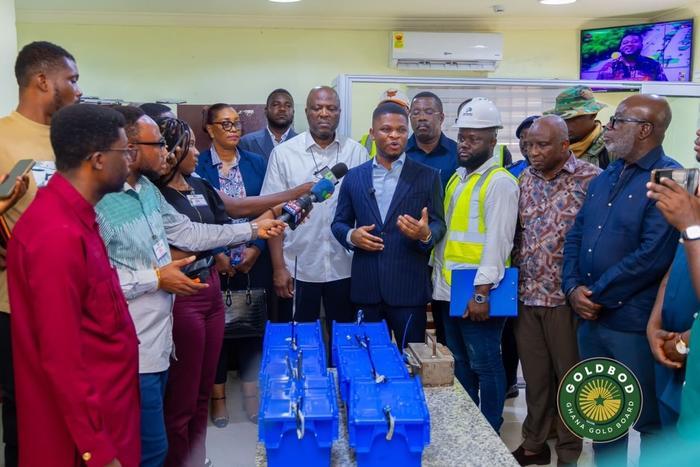

The Ghana Gold Board (GoldBod) has announced that its artisanal and small scale mining gold trading operations generated US$1.011 billion in foreign exchange in October 2026, with the entire amount reportedly sold to authorised commercial banks through its electronic GoldBod GoFX platform.
The announcement, issued on Monday, November 2, comes as the state owned gold trading institution intensifies its efforts to channel proceeds from Ghana’s small scale gold industry into the domestic foreign exchange market and support the country’s external reserve accumulation programme.

According to the Board, it is targeting US$1.2 billion in foreign exchange generation from its artisanal and small scale mining operations in November, representing an increase of approximately 18.7 per cent over the amount reported for October.

Of the anticipated November proceeds, US$800 million is expected to be supplied to commercial banks to strengthen dollar availability and support liquidity in the foreign exchange market.

The proposed allocation represents approximately 66.7 per cent of the November target, leaving US$400 million whose intended destination or specific allocation has not been explained in the announcement. GoldBod has not indicated whether that balance will be channelled towards the Bank of Ghana’s international reserve accumulation programme or retained for other operational purposes.
The Board says the planned transactions will be conducted through its GoldBod GoFX platform in accordance with its approved Foreign Exchange Sales and Intermediation Framework, which is intended to promote transparency, equitable allocation and compliance with applicable regulatory requirements.

The framework establishes a structured mechanism through which foreign exchange generated from gold exports is distributed to participating financial institutions. Under arrangements announced on October 5, participating banks are ordinarily expected to submit their requests twice weekly, on Tuesdays and Thursdays. Where demand exceeds the available allocation, the dollars are to be distributed proportionately among eligible banks.
Participating institutions must also demonstrate that their requests are backed by genuine unmet customer demand or an existing foreign exchange short position, rather than speculative activity. Transactions are expected to be settled on the same day, with the Bank of Ghana maintaining regulatory oversight and access to transaction records through the electronic platform.

The November projection must, however, be considered against GoldBod’s preceding monthly performance and its earlier commitments. In its September 30 announcement, the Board reported generating US$1.871 billion from small scale gold operations during September, exceeding its original US$1.4 billion target by US$471 million, equivalent to approximately 134 per cent of the target.

Of September’s proceeds, US$701.3 million was sold to commercial banks, while US$1.170 billion was transferred to the Bank of Ghana to strengthen international reserves. The Board had initially anticipated distributing US$700 million to each institution, meaning that both allocations exceeded their respective projections.
The September performance followed an August outturn of US$1.315 billion, comprising US$668.21 million supplied to commercial banks and US$646.59 million made available to the central bank for reserve accumulation.
However, October’s figures reveal an important departure from the previous month’s arrangement. Before October commenced, GoldBod had announced a total foreign exchange generation target of US$1.5 billion, comprising US$1 billion earmarked for commercial banks and up to US$500 million intended for the Bank of Ghana’s reserve accumulation programme.
The subsequently reported October generation of US$1.011 billion therefore fell US$489 million short of the overall projection, representing approximately 67.4 per cent of the announced target. Although the amount reportedly supplied to commercial banks exceeded the original US$1 billion banking allocation by US$11 million, the November 2 announcement does not explain what happened to the previously projected US$500 million central bank allocation.
This distinction is important because foreign exchange supplied to commercial banks serves a different immediate purpose from foreign exchange transferred to the central bank for reserve accumulation. The two channels contribute to Ghana’s external stability, but they should not be treated as interchangeable accounting entries.
The latest announcement also needs to be distinguished from GoldBod’s wider gold export statistics. On October 20, 2026, the Board disclosed that it had aggregated and exported 85.4 tonnes of artisanal and small scale gold valued at US$11.6 billion between January 1 and October 20. During the same period, large scale mining companies reportedly exported 76 tonnes valued at US$11.1 billion.
These figures demonstrate the considerable scale of the small scale gold trade, but the US$11.6 billion represents the cumulative reported value of gold exports over almost ten months. It must not be confused with the US$1.011 billion in foreign exchange that GoldBod says it generated during October alone.
The broader economic strategy behind these transactions is the Ghana Accelerated National Reserve Accumulation Policy (GANRAP), covering the 2026 to 2028 period. Introduced by Finance Minister Dr Cassiel Ato Forson and subsequently passed by Parliament, the policy seeks to increase Ghana’s international reserves to the equivalent of 15 months of import cover by the end of 2028.
The programme establishes intermediate targets of at least 8.6 months of import cover by the end of 2026 and 11.8 months by the end of 2027. According to the Ministry of Finance, Ghana entered the programme with gross international reserves of US$13.8 billion, equivalent to 5.7 months of import cover at the end of 2025.
The policy estimates that achieving its ultimate objective will require an average annual net addition of approximately US$9.5 billion to international reserves after accounting for external debt repayments, foreign exchange market operations, energy obligations and other statutory payments. It also establishes a weekly gold purchasing target of approximately 3.02 tonnes, comprising 2.45 tonnes from artisanal and small scale mining and 0.57 tonnes from large scale mining.
GoldBod occupies a central position in this strategy following the enactment of the Ghana Gold Board Act, 2025 (Act 1140). The legislation established the institution as the principal authority responsible for regulating and undertaking the purchase, trading, assaying and exportation of gold from the artisanal and small scale mining sector.
Under the new arrangements, GoldBod operates through licensed aggregators and buyers, with the objective of bringing more gold transactions into the formal economy, improving traceability and reducing the foreign exchange losses associated with unofficial gold exports.
The reforms followed years of difficulties involving gold smuggling, fragmented regulation and inadequate repatriation of export proceeds. GoldBod’s own historical figures indicate that artisanal and small scale gold exports increased from 63.6 tonnes in 2024 to approximately 103 tonnes in 2025, generating reported foreign exchange earnings of about US$10.8 billion in the latter year.
Nevertheless, the programme faces important questions concerning operational costs, financial accountability and the environmental consequences of expanding small scale mining.
In its 2026 assessment of Ghana’s economy, the International Monetary Fund (IMF) highlighted substantial financial losses associated with the previous Bank of Ghana Domestic Gold Purchase Programme, which preceded GoldBod’s assumption of full operational responsibility.
The Fund estimated that the programme generated losses exceeding US$1.7 billion in 2025, equivalent to approximately 1.5 per cent of gross domestic product. These losses were associated with service charges, assay expenses, trading margins, off taker discounts and exchange rate differences arising from the purchase and sale of gold.
Importantly, these historical losses relate to the previous programme and should not be presented as losses incurred by GoldBod on its October 2026 transactions. GoldBod assumed responsibility for the programme’s operations and associated costs from July 1, 2026, under arrangements involving the Government and the central bank.
The IMF has also emphasised the importance of controlling GoldBod’s operational expenditure, improving transparency and publishing quarterly financial disclosures. Under the revised arrangements, the authorities have committed to reducing operational costs to approximately five per cent of gold purchase costs, compared with an average of 14.5 per cent in 2025.
The Fund has further drawn attention to persistent gold smuggling, the sector’s limited fiscal revenue contribution following the removal of the withholding tax on unprocessed precious minerals, and environmental degradation associated with illegal mining activities. These concerns underline the importance of ensuring that increased gold exports translate into sustainable economic benefits rather than merely higher trading volumes.
Consequently, while GoldBod’s reported October foreign exchange generation and its November projection represent significant developments in Ghana’s gold trading and foreign exchange management strategy, the actual contribution to national economic stability will depend on independently verifiable transaction records, the cost of acquiring and exporting the gold, the effective distribution of foreign exchange and the amount ultimately retained within the country’s international reserves.
The Board’s November target therefore places renewed attention on its ability to sustain gold purchases, meet its export commitments and supply the banking system with foreign currency while maintaining the financial discipline required under GANRAP.

