
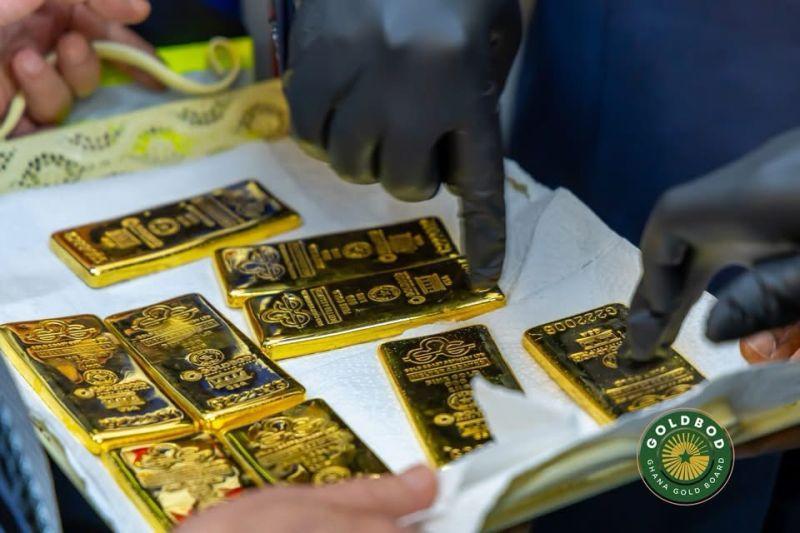

Ghana’s gold export sector recorded a remarkable increase in earnings during the first half of 2026, even as the volume of bullion shipped overseas experienced a marginal contraction amid logistical disruptions associated with the escalating conflict in the Middle East.
Figures from the Bank of Ghana indicate that gold export proceeds climbed by 49 percent to approximately US$12.50 billion between January and June 2026, compared with US$8.39 billion during the corresponding period of 2025. The development further reinforces gold’s dominant position within Ghana’s external trade structure, with the precious metal accounting for more than two thirds of the country’s total export receipts during the period.

The substantial improvement in revenue, however, was not accompanied by a corresponding expansion in the quantity of gold exported. Export volumes stood at approximately 2.80 million fine ounces, representing a modest 0.5 percent reduction from the 2.81 million fine ounces recorded during the first half of last year.

The principal explanation for the divergence between export value and physical volume lies in the exceptional rise in international gold prices. The average realised price increased by 49.7 percent to US$4,463.80 per fine ounce, allowing Ghana to generate considerably more foreign exchange despite shipping marginally less gold than it did during the same period in 2025.

The Bank of Ghana has nevertheless attributed the slight reduction in shipment volumes partly to disruptions that emerged following the outbreak of the Middle East conflict. The disturbance has exposed the vulnerability of an export network that depends significantly on established international trading and refining corridors to move Ghanaian gold into major global markets.
The World Bank has similarly drawn attention to the consequences of the regional instability, indicating that some Ghanaian gold consignments had to be diverted through Shanghai and India after disruptions affected the conventional route through the United Arab Emirates. Such diversions have introduced additional transportation expenses, longer delivery periods and greater operational uncertainty into an export chain that has become increasingly important to Ghana’s foreign exchange position.

The significance of the development becomes clearer against the backdrop of Ghana’s growing dependence on gold as a source of external liquidity. The Bank of Ghana reported that total merchandise exports reached US$18.29 billion in the first six months of 2026, while the country’s trade surplus expanded to US$8.81 billion from US$5.76 billion during the corresponding period of 2025. Gold was by far the largest contributor to that performance.
Recent GoldBod data also underline the concentration of Ghana’s gold trade around a relatively small number of international markets. In 2025, Dubai absorbed more than 72 percent of Ghana’s small scale gold exports channelled through the national aggregation system, while India accounted for about 25 percent. Together, the two destinations represented 98.8 percent of those exports, highlighting both the commercial importance and the strategic vulnerability associated with such market concentration.

The latest disruption therefore arrives at a particularly important moment for Ghana, which is attempting to retain more value from its mineral resources through domestic refining. GoldBod has directed Self Financing Aggregators to refine gold doré locally before export, with the requirement taking effect from September 1, 2026. The policy is intended to deepen domestic value addition while reducing Ghana’s reliance on foreign processing facilities.

For a country seeking to strengthen its foreign exchange reserves and reduce exposure to external shocks, the latest experience carries an important policy lesson. Ghana’s impressive gold earnings demonstrate the financial advantage of elevated bullion prices, but the accompanying shipping disruptions show that strong production and favourable prices alone cannot guarantee uninterrupted export performance. Building a more diversified network of trading, refining and transportation routes will therefore be essential if Ghana is to make its gold industry more resilient to geopolitical instability.
The immediate challenge is consequently no longer simply how much gold Ghana can produce, but how efficiently, securely and profitably that gold can be processed and delivered to international markets. With gold already providing a substantial share of the country’s export revenue, strengthening the resilience of the entire value chain will be critical to protecting foreign exchange earnings and maximising the national economic benefits of Ghana’s most valuable mineral export.

