
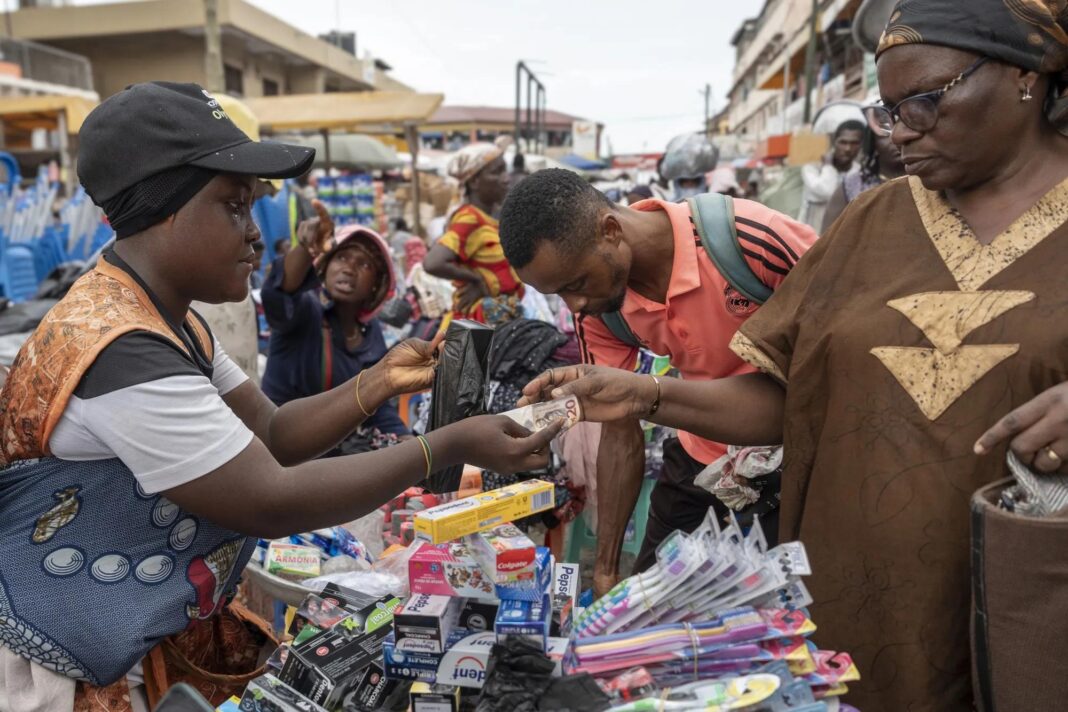

Ghana has recorded a sharp increase in the number of business establishments over the past decade, but approximately 92 per cent continue to operate informally, raising concerns about employment creation, business sustainability and the capacity of small enterprises to drive inclusive economic growth.
Government Statistician Dr Alhassan Iddrisu disclosed the figures during the launch of the Ghana Statistical Service’s Ghana in Numbers 2025 publication in Accra, where he highlighted the widening gap between the expansion of businesses and the employment opportunities they generate.

Findings from the country’s first Integrated Business Establishment Survey, known as IBES 1, show that Ghana had approximately 2.64 million business establishments in 2024, with micro enterprises accounting for nine out of every ten businesses.

Despite this substantial commercial presence, only 7.7 per cent of establishments operate within the formal sector, leaving the overwhelming majority outside it.

Dr Iddrisu explained that the figures demonstrated the scale of informality within Ghana’s business environment, emphasising that approximately 92 per cent of enterprises continued to operate informally.
The survey further revealed that the number of business establishments nearly tripled between 2014 and 2024, whereas employment within these establishments increased by only twofold.

According to the Government Statistician, the disparity raises important questions about whether the country’s expanding business sector is generating sufficient employment to accommodate its growing workforce.
He observed that businesses were multiplying at a faster pace than the jobs they provided, underscoring the need to examine not only the number of enterprises being established but also their capacity to create sustainable employment.

Although Ghana’s unemployment rate declined from 14.6 per cent in 2023 to 12.8 per cent in 2025, informality continues to dominate the labour market, with more than seven out of every ten jobs remaining within the informal economy.

The employment situation is particularly concerning for young people, who constitute a significant proportion of the country’s population and represent an important source of future economic productivity.
Dr Iddrisu disclosed that approximately 12 million Ghanaians fall within the 15 to 35 age group, highlighting the considerable potential of the country’s youthful population to contribute to national development.
However, he warned that employment opportunities remained inadequate for many young people, with nearly one in three jobseekers between the ages of 15 and 24 unable to secure work.
He further revealed that close to two million young people were neither employed nor participating in education or vocational training, while young women accounted for more than 60 per cent of this group.
The figures, he indicated, demonstrate the importance of aligning educational opportunities, vocational training and employment policies with the needs of the labour market.
Dr Iddrisu cautioned that Ghana’s ability to transform its youthful population into an economic advantage would depend largely on decisions taken over the coming decade, particularly those relating to education, skills development and job creation.
He stressed that the opportunity to harness the country’s demographic potential remained available, but warned that delays in implementing effective policies could undermine the benefits of having a large and energetic working age population.
The publication also highlighted contrasting developments in the wider economy, revealing that improvements in some economic indicators had not necessarily translated into better living conditions for all households.
Inflation declined considerably from 54.1 per cent in December 2022 to 5.4 per cent in December 2025, representing a substantial easing of price pressures compared with the peak recorded in 2022.
Nevertheless, food insecurity increased from 37.7 per cent in 2024 to 39.8 per cent in 2025, affecting an estimated 13 million people across the country.
Dr Iddrisu acknowledged the progress made in reducing inflation but emphasised that the benefits of economic improvements were not being experienced equally by all segments of the population.
The findings therefore draw attention to the distinction between improvements in national economic indicators and the everyday financial circumstances of households, particularly those struggling to afford adequate food and other essential necessities.
Beyond domestic business activity, the report provided fresh information about commercial transactions taking place across Ghana’s borders with neighbouring countries.
It recorded approximately GH¢38.4 billion in informal cross border trade involving Togo, Burkina Faso and Côte d’Ivoire, offering greater insight into economic activities that have not been fully reflected in official trade statistics.
The inclusion of these transactions provides a broader picture of Ghana’s commercial relationships within the subregion and highlights the importance of improving the measurement of informal economic activity.
Dr Iddrisu encouraged businesses, investors and other stakeholders to use the publication’s findings to inform commercial decisions, investment strategies and development planning.
He particularly emphasised the need to support smaller enterprises in expanding their operations and transitioning into the formal economy, arguing that helping such businesses grow and formalise deserved greater attention.
Formalisation could improve the visibility of business activity, strengthen economic planning and help create an environment in which enterprises can expand their operations and contribute more effectively to employment generation.
The Government Statistician also explained that Ghana in Numbers 2025, together with its accompanying online portal, would make national and district level statistics more accessible to decision makers, businesses, investors and the wider public.
The initiative is intended to strengthen evidence based policymaking by providing reliable information that can guide resource allocation, investment decisions and development interventions across the country.
Dr Iddrisu stressed that the production of statistics should not be regarded as the ultimate objective of the Ghana Statistical Service, insisting that the information must be applied in ways that generate tangible benefits for society.
He maintained that the true value of statistical information lies in its practical use and its ability to influence decisions, improve policies and produce measurable development outcomes.
The report ultimately highlights the need for Ghana to move beyond increasing the number of business establishments and concentrate on helping enterprises become more productive, create sustainable employment and operate within the formal economy.
It also underscores the importance of ensuring that improvements in economic performance translate into better livelihoods, particularly for young people, women and households facing persistent employment and food security challenges.
Ghana’s ability to convert its expanding business sector and youthful population into lasting economic gains will depend on the effectiveness of policies designed to support small enterprises, strengthen workforce skills and broaden access to decent employment.

