
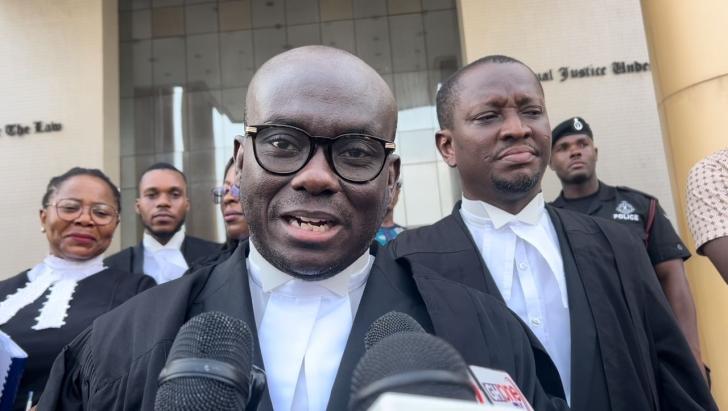

The two high-profile trials of former government officials yesterday came to a pause for two different reasons.
The criminal trial of former National Food Buffer Stock Company Chief Executive Officer Hanan Abdul Wahab
Aludiba faced difficulties after his lead counsel and former Attorney General Godfred Yeboah Dame firmly rejected
any attempt to proceed during Ghana’s legal vacation, maintaining that such proceedings depart from long
established judicial practice.
Mr Dame, who serves as lead counsel for Mr Abdul Wahab, took the position after appearing before the Accra High
Court on Monday, August 17, 2026, where the defence sought to persuade the court to suspend the proceedings until
a pending application before the Court of Appeal has been determined.
 Recent proceedings have centred on several interlocutory applications filed by the defence as the accused continues
to contest the charges brought against him.
According to Mr Dame, the defence appeared before the court specifically to demonstrate why proceedings ought to
be halted while the appellate application remains unresolved. He explained that the court had indicated that it would
first await the outcome of a matter before the Supreme Court before permitting the defence to advance its
application for a stay of proceedings.
Mr Dame subsequently made his position unequivocal, declaring that he would not make himself available for a trial
conducted during the legal vacation. He argued that his stance was consistent with the position he had maintained
throughout the controversy, namely that trials are ordinarily not conducted during the vacation unless the parties
have personally agreed to such an arrangement.
The former Attorney General further invoked his more than two decades of experience at the Ghanaian Bar,
contending that he had never encountered a situation in which an accused person or litigant was compelled to
participate in a substantive trial during the legal vacation without exceptional circumstances warranting such action.
He therefore questioned the justification for treating the Hanan Abdul Wahab case as an urgent matter, insisting that
no emergency existed that could reasonably necessitate its continuation during the recess.
Mr Dame explained that, based on his experience, superior courts have traditionally convened during the legal
vacation only in circumstances requiring immediate judicial intervention, particularly where constitutional questions
connected to elections demanded prompt determination.
As an illustration, he referred to a 2012 dispute involving the Electoral Commission, which he said he handled
alongside a former Attorney General. According to him, the urgency surrounding that matter was linked to the
proximity of the general elections and the need for the Supreme Court to determine an interlocutory application
promptly. He maintained, however, that the substantive proceedings were subsequently deferred until the ordinary
judicial calendar resumed.
The former Attorney General also contended that applications seeking a suspension of proceedings are neither
unusual nor unprecedented within Ghana’s legal system. He pointed to previous cases in which courts had
temporarily halted substantive proceedings while related applications were being considered by superior courts.
His argument comes amid a wider dispute over the judiciary’s decision to allow selected criminal matters to proceed
during the legal vacation. Defence lawyers in other high profile cases have also challenged the practice, arguing that
it departs from established judicial conventions and raises questions concerning the constitutional rights of accused
persons.
The controversy has gained further significance following proceedings involving former National Signals Bureau
Director General Kwabena Adu Boahene and his wife, Angela Adjei Boateng, where the court directed the accused
persons to ensure that their lawyers were present when proceedings resumed. The court indicated that, in the absence
of their lawyers, the accused could be required to continue the cross examination themselves.
Mr Dame has maintained that such an approach should not be extended to his client, stressing that an accused person
possesses a constitutional entitlement to legal representation and should not be compelled to conduct a criminal trial
personally because counsel is unavailable during the legal vacation.
The former NAFCO chief executive and his wife, Faiza Seidu Wuni, are facing criminal allegations arising from
their dealings with the state owned food reserve institution. The prosecution has brought charges including stealing,
defrauding by false pretences, causing financial loss to the state and money laundering, all of which remain matters
for determination by the court. Mr Abdul Wahab and his co accused continue to contest the allegations.
The case has already generated several legal disputes. In July, the High Court rejected an application by Mr Dame
seeking to strike out the entire charge sheet, although it directed the prosecution to amend two counts concerning
alleged false pretences.
With the latest proceedings now intertwined with the broader legal debate over vacation sittings, the defence is
seeking to have the relevant applications determined before the substantive trial advances further. Mr Dame’s latest
declaration therefore places his participation squarely within that continuing legal contest, as the parties await
further judicial decisions on whether the proceedings should continue during the vacation period.
Adu Boahene Trial Adjourned
Meanwhile the Accra High Court has deferred the trial of former National Signals Bureau Director General
Kwabena Adu Boahene and his wife, Angela Adjei Boateng, to August 25, 2026, as the Supreme Court prepares to
determine an application seeking to prevent the lower court from continuing the proceedings during the ongoing
legal vacation.
The injunction application, which is scheduled for hearing before the Supreme Court on Thursday, August 20, seeks
an order restraining the High Court from conducting the trial during the vacation period.
Although the mere filing of such an application does not automatically suspend proceedings, High Court Justice
Francis Apangabuno Achibonga said he was reluctant to advance a case when a superior court had been specifically
invited to consider whether the proceedings should be halted.
The case came before the court on Monday, August 17, with Peter Osei Asamoah appearing on behalf of the
substantive defence lawyer, Samuel Atta Akyea. Mr Osei Asamoah requested an adjournment, explaining that Mr
Atta Akyea had formally notified the court on August 14 that other professional responsibilities made it difficult for
him to attend during the legal vacation.
According to the defence, the request was intended to safeguard the accused persons’ constitutional entitlement to
effective legal representation. Counsel maintained that proceeding without the substantive lawyer could potentially
compromise the ability of the accused persons to receive adequate representation throughout the trial.
The Deputy Attorney General, Dr Justice Srem Sai, however, opposed the application and urged the court not to
grant the adjournment. He contended that the explanation provided by Mr Atta Akyea was substantially identical to
the reason contained in correspondence sent to the Chief Justice and failed to establish why other members of his
legal team could not appear on behalf of the accused persons.
Dr Srem Sai further reminded the court that it had previously directed that the proceedings should continue during
the legal vacation. He argued that lawyers appearing before the court could not unilaterally determine the timetable
of a criminal trial and urged Justice Achibonga to reject the defence request.
The defence subsequently brought the pending Supreme Court application to the judge’s attention, shifting the focus
of the proceedings from the availability of counsel to the broader question of whether the High Court should
continue while the superior court considers the injunction request.
Mr Osei Asamoah explained that the application before the Supreme Court expressly seeks to restrain the High
Court from conducting the trial during the legal vacation and is scheduled to be heard on August 20, only four days
after Monday’s sitting.
He was careful to clarify that the defence was not suggesting that the Supreme Court had already issued an order
preventing the High Court from proceeding. Instead, he asked Justice Achibonga to temporarily suspend the trial
until the Supreme Court had reached a determination on the injunction application.
The prosecution rejected that position, maintaining that the existence of an injunction application did not strip the
High Court of its lawful jurisdiction to hear the case.
Dr Srem Sai argued that an injunction has legal effect only after a court has actually granted the requested order.
Until such a decision is made, he maintained, there was no judicial directive preventing the High Court from
continuing with proceedings.
The Deputy Attorney General also questioned the procedural route adopted by the defence, arguing that challenges
concerning the propriety of proceedings before a lower court would ordinarily be addressed through established
judicial review mechanisms, including applications for certiorari or prohibition, rather than relying solely on an
injunction application.
In his ruling from the bench, Justice Achibonga declined to postpone the case until the next legal term. He explained
that such a decision would effectively push the trial into October and would undermine the purpose of his
appointment as a vacation judge.
The judge additionally observed that the absence of Mr Atta Akyea did not necessarily make it impossible for the
accused persons to be represented, since other lawyers within his firm could potentially undertake the responsibility.
However, Justice Achibonga adopted a more cautious position regarding the pending Supreme Court application.
While accepting the prosecution’s argument that simply filing an injunction does not automatically suspend
proceedings, the judge emphasised the need for a lower court to exercise restraint where a superior court has been
asked to determine whether the lower court should continue with the matter.

Justice Achibonga consequently held that, given the circumstances, he was not prepared to proceed with the trial
while the Supreme Court application remained unresolved. The case was therefore adjourned to August 25, 2026, at
9:30 a.m.
The proceedings involve allegations that GH¢49.1 million earmarked for the procurement of a cyber defence system
was unlawfully diverted.
Mr Adu Boahene has pleaded not guilty to charges including defrauding by false pretences, wilfully causing
financial loss to the state, using public office for personal gain and obtaining public property by false pretences.
His wife, Angela Adjei Boateng, has likewise denied the allegations against her. She is facing charges including
allegedly facilitating the use of public office for personal gain, conspiracy to commit money laundering and money
laundering.
Neither accused has been convicted of the allegations, and the charges remain matters for determination by the
court.
The latest development means attention now turns to the Supreme Court, where the injunction application is
expected to be heard on August 20, 2026. The outcome of that application could determine whether the High Court
resumes the trial on August 25 or whether further legal proceedings alter the timetable of the case.


