
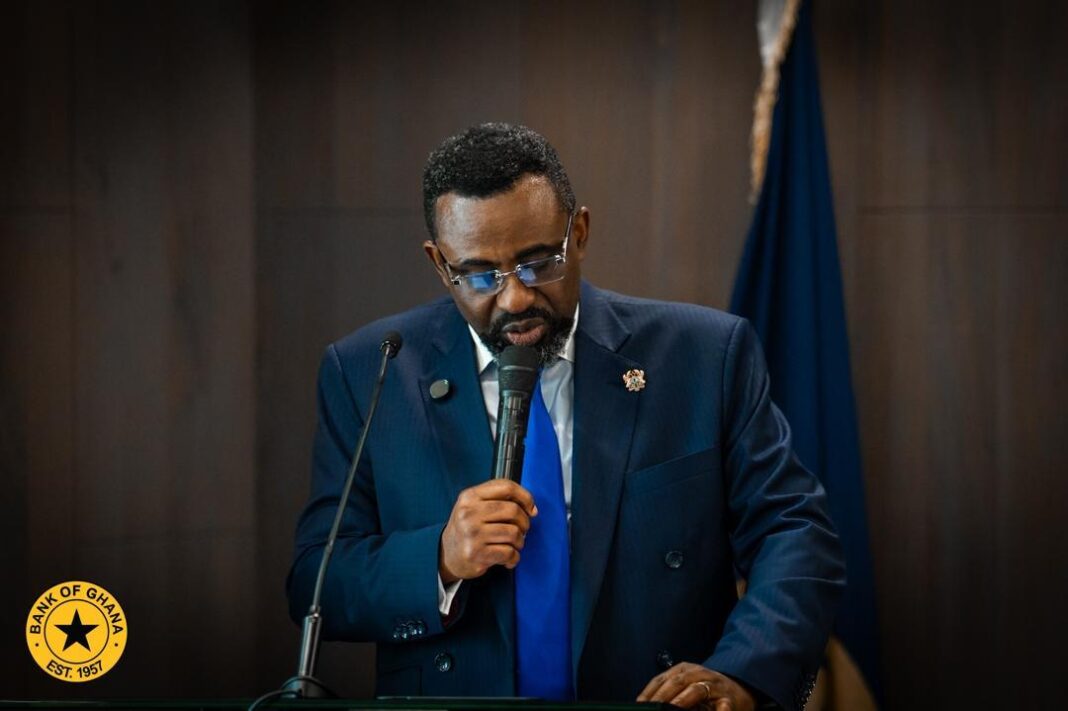

In a compelling appeal that underscores a new phase of collaborative economic governance, the Governor of the Bank of Ghana, Dr Johnson Pandit Asiama, has urged members of the UK Ghana Chamber of Commerce to assume a more assertive and participatory posture in shaping the nation’s monetary architecture and foreign exchange management regime.
Delivering remarks during a high level consultative session convened in Accra on Monday, 23 February 2026, Dr Asiama articulated a vision of policymaking that transcends traditional boundaries between regulator and regulated. He emphasised that the private sector must not be regarded as a peripheral observer of central bank directives, but rather as an indispensable partner whose conduct and expectations materially influence macroeconomic outcomes.

Businesses, he asserted, are not inert beneficiaries of monetary policy transmissions but pivotal stakeholders whose operational decisions reverberate through credit markets, price formation mechanisms and exchange rate dynamics. In his view, the effectiveness of monetary interventions is inextricably linked to the degree of comprehension, responsiveness and alignment within the commercial ecosystem.

The Governor observed that policy calibration achieves optimal efficacy when it resonates with prevailing market conditions and when economic actors possess clarity regarding both intent and implementation. Sound regulatory design, he explained, must be intelligible, adaptive to commercial realities and executed through structured engagement with principal stakeholders across industry and finance.

The gathering, he noted, was deliberately structured to foster candid deliberations concerning the central bank’s foreign exchange directives and the broader regulatory scaffolding that governs cross border transactions. He clarified that the objective extended beyond mere exposition of guidelines, encompassing instead an invitation for rigorous feedback on foreseeable constraints, operational complexities and prospective avenues for growth.
Particular reference was made to the Foreign Exchange Act, 2006, which continues to constitute the statutory foundation of Ghana’s foreign currency regulatory framework. Dr Asiama underscored that the central bank remains receptive to constructive critique and informed recommendations regarding its administration and practical impact.

According to the Governor, the overarching aims of the extant guidelines and supervisory instruments are unequivocal. They are designed to rationalise foreign exchange market operations, enhance procedural transparency, strengthen compliance culture and consolidate macroeconomic stability within an increasingly interconnected global financial environment. He maintained that clarity of purpose must be matched by measured enforcement.
At the same time, Dr Asiama acknowledged that regulatory oversight cannot be rigidly mechanical. He conceded that policy execution must be judicious and business conscious, ensuring that compliance imperatives do not inadvertently suffocate legitimate enterprise or undermine competitiveness. Pragmatism, he suggested, is essential to preserving equilibrium between systemic discipline and commercial vitality.

Beyond the technical dimensions of monetary governance, the Governor devoted considerable attention to the intangible but indispensable currency of trust. He described the presence of Ghanaian and United Kingdom affiliated enterprises at the forum as a testament to enduring confidence, reciprocal respect and institutional goodwill between the central bank and the organised private sector.

Commending the Chamber’s nearly decade long stewardship in nurturing bilateral commerce and capital flows, Dr Asiama characterised the organisation as a resilient conduit linking the Ghanaian and British economies. With a membership exceeding 230 corporations spanning diverse industries, the Chamber, he observed, embodies a formidable and influential constituency within the national business terrain.
In reaffirming the central bank’s commitment to sustained consultation, Dr Asiama emphasised that enduring macroeconomic stability cannot be decreed unilaterally. Rather, it must be cultivated through continuous dialogue, receptiveness to principled criticism and cooperative synergy between policymakers and market participants. Such partnership, he intimated, is indispensable to safeguarding monetary credibility, fortifying exchange rate resilience and sustaining investor confidence in Ghana’s evolving economic narrative.

