
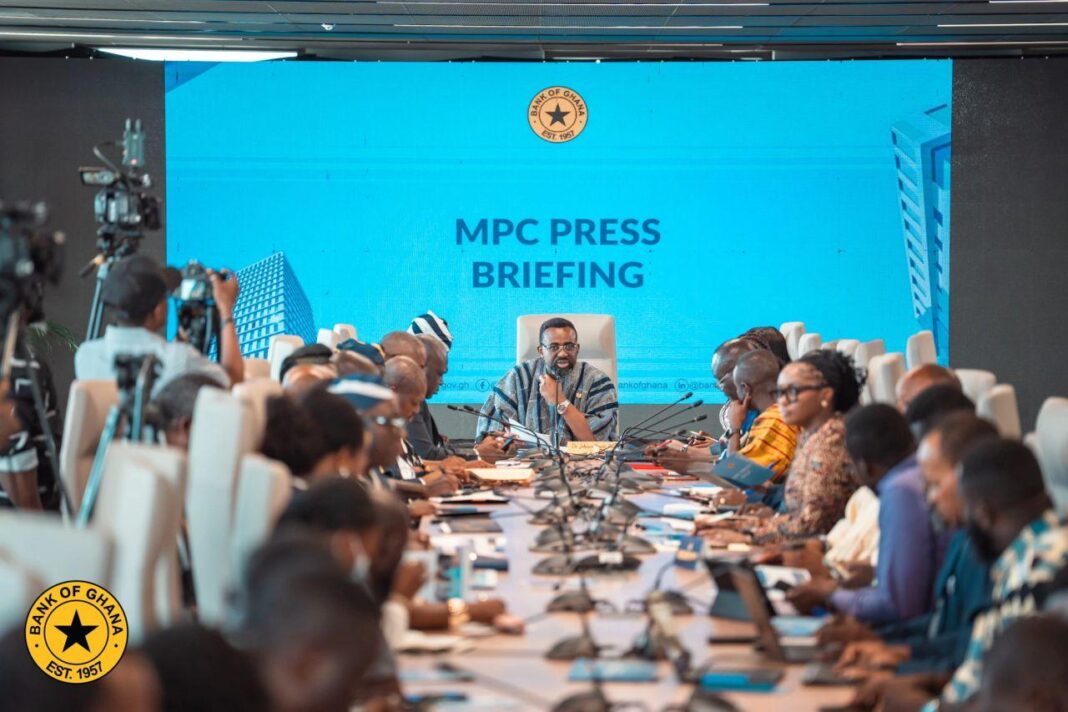

The Bank of Ghana’s Monetary Policy Committee has retained the monetary policy rate at 14 percent for the third consecutive meeting, concluding that the risks surrounding inflation and economic growth remain broadly balanced despite renewed pressures from international commodity markets, geopolitical tensions and disruptions to global supply chains.
The decision was reached unanimously at the Committee’s latest meeting, with the central bank pointing to the resilience of Ghana’s domestic economy and a moderation in underlying inflationary pressures as key considerations behind the decision.

Governor of the Bank of Ghana, Dr Johnson Asiama, said the Committee had carefully assessed developments in both the domestic and international economies before arriving at its decision.

“Based on these considerations, the Monetary Policy Committee viewed the balance of risks to inflation and growth broadly balanced, and the Committee voted by a unanimous decision to maintain the monetary policy rate at 14.0 percent,” he said.

The decision comes against the backdrop of a modest acceleration in Ghana’s headline inflation, which climbed to 5 percent in August 2026, compared with 4.6 percent in July.
According to Dr Asiama, the increase was driven principally by developments in non food inflation, which rose from 6.1 percent to 6.8 percent during the period.

The Governor attributed part of the increase to the effects of recent utility tariff adjustments and higher crude oil prices, which have begun filtering through to domestic prices.
Despite the increase in headline inflation, the central bank said several measures of underlying price pressure had continued to ease, suggesting that the recent rise in overall inflation had not translated into a broad based acceleration in underlying inflation.

“Despite this, broad inflation expectations and core inflation measures eased, indicating a moderation in underlying inflation,” Dr Asiama said.

The Bank of Ghana’s core inflation measure, which excludes energy and utility prices because of their relatively volatile movements, declined marginally from 4.3 percent in July to 4.2 percent in August.
The development has provided some support for the MPC’s assessment that underlying inflationary pressures remain relatively contained, even though several external and domestic factors continue to pose potential threats to the inflation outlook.
Dr Asiama said the outlook remained exposed to a number of upward risks, including additional utility tariff increases, higher petroleum prices and the possibility that rising fuel costs could translate into increased transport fares.
A stronger United States dollar also remains a potential source of pressure, particularly because exchange rate movements can affect the domestic cost of imported goods and services. The Governor further pointed to possible spillover effects from disruptions to global supply chains as another factor that could complicate the inflation outlook.
“On the other hand, continued fiscal consolidation, improved food supply conditions, and exchange rate stability, these present offsetting downside risks going forward,” Dr Asiama said.
The MPC’s decision therefore reflects a balance between factors that could push prices higher and developments that could help moderate inflationary pressures in the months ahead.
Beyond inflation, the Committee also took account of the continued resilience of Ghana’s economic activity during the first half of 2026.
The economy recorded real gross domestic product growth of 6 percent in the second quarter, with the expansion supported principally by activity in the services and industrial sectors.
The performance indicates that economic activity has continued to expand despite the restrictive financial conditions that have accompanied Ghana’s broader efforts to stabilise inflation and strengthen macroeconomic conditions.
Credit conditions have also shown signs of improvement, with private sector credit growth rebounding significantly to 35.5 percent in August.
The increase in lending to the private sector points to stronger credit activity and improved access to financing for businesses and other economic participants.
At the same time, the average lending rate declined substantially to 15.9 percent, compared with 24.2 percent a year earlier.
The reduction represents a notable easing in the cost of borrowing and suggests that improvements in the broader monetary and financial environment are beginning to translate into more favourable financing conditions for borrowers.
The Bank of Ghana nevertheless cautioned that Ghana’s economic outlook remains vulnerable to developments beyond the country’s borders.
Elevated crude oil prices could increase domestic fuel costs and subsequently place pressure on transportation, production and consumer prices. Continued geopolitical tensions could further disturb international trade and commodity markets, while tighter global financial conditions could increase the cost of external financing and place additional pressure on emerging economies.
The central bank’s latest decision consequently reflects a cautious approach to monetary policy, with the MPC choosing to maintain the policy rate rather than introduce another adjustment while it continues to assess the interaction between inflation, economic growth, exchange rate developments and international risks.
The unchanged 14 percent policy rate also provides continuity as the Bank of Ghana monitors whether the recent increase in headline inflation represents a temporary movement associated with specific price adjustments or develops into broader and more persistent inflationary pressure.
For households and businesses, the policy decision means that the central bank’s benchmark interest rate remains unchanged for another meeting, while the decline in average lending rates and the recovery in private sector credit indicate that financing conditions have continued to improve compared with the same period a year earlier.
The MPC will continue to monitor domestic price developments, economic activity and global conditions as it assesses the appropriate monetary policy stance for the months ahead.

