
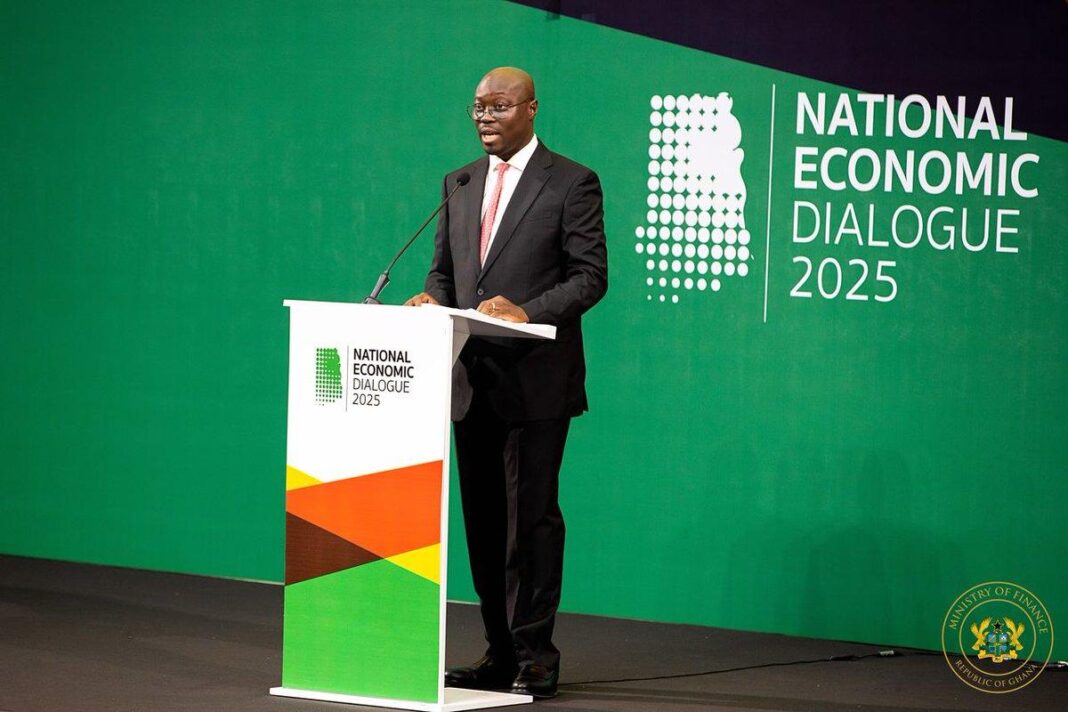

Finance Minister Dr Cassiel Ato Forson has declared that the welfare and interests of Ghanaians will remain the central consideration guiding the preparation of the 2027 Budget as the government advances consultations on its economic agenda.
Dr Forson made the assurance as the Ministry of Finance continues its engagements with ministries, departments and agencies ahead of the presentation of the 2027 Budget to Parliament. The Ministry has already issued the 2027 to 2030 Budget Preparation Guidelines, while consultations on the government’s proposed New Economy programme have been underway since the beginning of September.

According to the Finance Minister, decisions taken throughout the budget preparation process must ultimately reflect the needs, expectations and aspirations of the Ghanaian population.

“Through every hearing and every decision, one principle remains non negotiable: the interest of the Ghanaian people comes first,” Dr Forson stated.

The forthcoming budget is expected to provide the principal policy framework through which the government will set out the details of its proposed New Economy programme, an initiative designed to take Ghana beyond the period of macroeconomic stabilisation and towards increased production, employment creation, wealth generation and sustained economic expansion.
President John Dramani Mahama has indicated that the New Economy programme will involve an estimated US$10 billion investment in key sectors of the Ghanaian economy, with the comprehensive details expected to be presented as part of the 2027 Budget in November.

The government’s stated objective is to use the programme to build upon the economic stabilisation measures implemented during the administration’s earlier phase and redirect greater attention towards production, investment, employment and long term economic transformation.
Dr Forson has previously explained that the government’s economic strategy is moving from stabilisation towards a broader transformation agenda, with greater emphasis on an economy that produces more, generates employment and creates wealth from domestic productive activity.

The preparation of the 2027 Budget has consequently involved engagements with various government institutions and economic stakeholders to identify priorities and determine how public resources can be aligned with the objectives of the New Economy programme.

Among the institutions consulted is the National Development Planning Commission, which is expected to play a role in monitoring and assessing the implementation of the programme. Dr Forson has said the commission’s involvement will be important in determining whether the programme’s interventions translate into measurable development outcomes.
The engagement with the NDPC has also highlighted the government’s stated intention to address structural constraints that have affected Ghana’s economic development, including low productivity, infrastructure deficiencies and limited diversification of economic activity. The commission has emphasised the need for the New Economy Plan to translate macroeconomic stability into higher productivity, employment opportunities and improved livelihoods.
Earlier consultations with the Ministry of Trade, Agribusiness and Industry have similarly focused on identifying priority sectors and investment opportunities capable of supporting the next phase of economic growth. The Finance Ministry has indicated that such engagements are intended to ensure that sector specific priorities are incorporated into the broader economic transformation programme.
Dr Forson has also called for existing economic policies to be reviewed to determine whether they are producing the intended benefits for businesses and the wider economy. During a September engagement on the New Economy programme, he specifically cited the Free Zones framework as an area requiring assessment after several decades of implementation.
The 2027 Budget is therefore expected to outline the government’s priorities for public expenditure and investment while providing greater detail on the sectors and programmes through which it intends to pursue economic transformation.
Key areas are expected to include measures aimed at expanding productive activity, encouraging private investment, supporting businesses, strengthening infrastructure, improving productivity and creating employment opportunities. These priorities are consistent with the government’s stated objective of moving from economic stabilisation towards a more productive and resilient economy.
The budget preparation process consequently represents an important stage in determining how the government intends to translate its New Economy policy into specific programmes, financial commitments and measurable development objectives.
With the final details of the programme expected to emerge in the 2027 Budget, the government’s ongoing consultations are intended to ensure that the proposed economic policies and spending priorities correspond with the country’s development requirements and the administration’s broader objectives for employment, investment, production and sustainable growth.

