
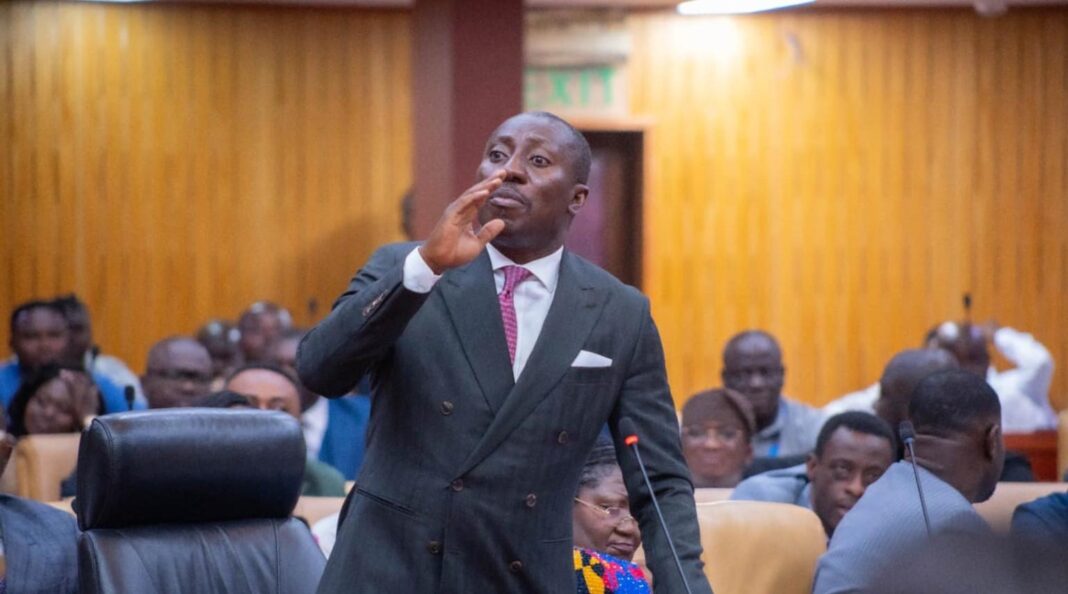

Minority Leader in Parliament, Alexander Afenyo-Markin, has asserted that the governing Majority has lost effective control over the administration of the state, citing what he describes as growing coordination failures and internal disagreements among senior government officials.
He made the remarks during parliamentary proceedings in which the House was considering a statement presented by the Finance Minister on the national economy and the conclusion of Ghana’s International Monetary Fund programme.

According to him, recent public exchanges between key ministries indicate a breakdown in internal communication and coordination within the government, undermining claims of policy coherence and economic stability.

Afenyo-Markin specifically pointed to a reported disagreement between the Ministry of Finance and the Ministry of Food and Agriculture over the release and confirmation of public funds. He suggested that contradictory statements from the two ministries reflect a deeper institutional challenge within the current administration.

He told Parliament that while one ministry had indicated that funds had been disbursed, another had denied receipt or confirmation of such releases, a situation he argued exposes inefficiencies in governance and financial management.
The Minority Leader further claimed that such developments demonstrate that the government is struggling to maintain control over its own appointees and administrative machinery, questioning the coherence of the Majority’s leadership structure in Parliament and the executive arm of government.

He argued that the situation reflects a broader lack of discipline within the governing team, insisting that the Majority’s numerical strength in Parliament does not translate into effective governance or unified decision making.
Describing the situation as evidence of internal weakness, he maintained that the governing side appears increasingly unable to coordinate its policy communication and administrative processes in a consistent manner.

His comments come at a time when the government has been highlighting progress in economic recovery efforts and the successful conclusion of Ghana’s IMF supported programme, which has been a central pillar of recent fiscal stabilisation measures.

The remarks add to ongoing political exchanges between the Minority and Majority sides in Parliament, particularly regarding the management of public funds, inter ministerial coordination, and the broader direction of economic governance.
While the Majority has continued to project confidence in the country’s economic trajectory, the Minority Leader insists that recent developments point to what he describes as systemic governance challenges that require urgent attention and improved coordination across government institutions.

