
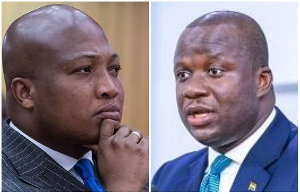

Minority demands resignation, alleges payment discrepancies and challenges government to account for evacuation funds, while the Foreign Affairs Minister insists all 1,964 returnees received their full allowances
Ghana’s Foreign Affairs Minister, Samuel Okudzeto Ablakwa, is facing mounting political pressure over the government’s GH¢49.72 million evacuation of Ghanaians from South Africa, with the parliamentary Minority demanding his resignation and threatening to initiate a vote of censure if he remains in office.

The dispute has intensified following allegations that some returnees received less financial assistance than the government said they were entitled to, questions over expenditure records, and separate accusations that opposition politicians attempted to coach evacuees to make statements critical of the government.

At a press conference in Parliament on Tuesday, October 27, 2026, the Ranking Member of Parliament’s Foreign Affairs Committee, Samuel Abdulai Jinapor, announced that the Minority would consider invoking Article 82 of the 1992 Constitution and Order 138 of Parliament’s Standing Orders to pursue a censure motion against the minister if he did not leave office.

The caucus says its demands are intended to secure accountability for public expenditure, protect the credibility of the Foreign Affairs Ministry and ensure an impartial examination of the evacuation exercise. It has also called on President John Dramani Mahama to dismiss Mr Ablakwa should he decline to resign.
The threatened parliamentary action represents an escalation of a controversy that has placed the administration’s handling of the evacuation under renewed public scrutiny. However, the allegations of financial irregularities have not been established by an independent audit or a judicial finding.

GH¢49.72 million expenditure under scrutiny
The government’s evacuation operation brought home 1,964 Ghanaians from South Africa between May 27 and September 4, 2026, following renewed concerns over xenophobic attacks and the safety of Ghanaian nationals.

Mr Ablakwa previously disclosed that the exercise cost GH¢49.72 million. The government also announced that each evacuee was entitled to GH¢5,000 in reintegration assistance and a further GH¢500 for transportation, bringing the stated support package to GH¢5,500 per person.

The Minority has questioned whether the expenditure records supplied by the ministry adequately account for the money spent and whether the payments recorded against individual beneficiaries correspond with the amounts they actually received.
Among the concerns raised are alleged duplicate entries in payment records, unsigned payment sheets, missing supporting receipts, inconsistencies in flight documentation and claims by some returnees that they received less than the amounts recorded against their names.
The caucus has previously argued that more than GH¢16.4 million in the expenditure requires further explanation, based on its examination of documents obtained from the ministry following a Right to Information request.
The disputed figures have made an independent audit a central demand in the unfolding controversy. The Minority wants an examination capable of reconciling the total expenditure, flight records, beneficiary registers and payment documentation to establish whether the accounts accurately reflect the transactions undertaken.
The figures alone, however, do not establish that money has been stolen or misappropriated. The outstanding questions concern the completeness and consistency of the records, the actual amounts received by beneficiaries and whether the expenditure can be independently verified.
Ablakwa rejects underpayment allegations
Mr Ablakwa has rejected claims that evacuees were shortchanged, maintaining that all 1,964 Ghanaians brought home received the full GH¢5,500 package, comprising the reintegration grant and transportation allowance.
Speaking to members of the Ghanaian community in Ottawa, Canada, during an official visit on Monday, October 26, the minister said the Foreign Affairs Ministry had not received a formal complaint about payment shortfalls during the more than four months in which the operation was conducted.
He explained that the beneficiaries had been informed about the allowances before leaving South Africa and were reminded of the amounts upon arriving in Ghana. According to him, the money was distributed in separate envelopes at the airport, where recipients were encouraged to open them and verify the contents.
The minister also said journalists and bloggers were present during the distribution, with some recording beneficiaries as they counted their money.
Although acknowledging that he did not personally distribute the funds, Mr Ablakwa defended the officials who administered the payments, including personnel from the ministry’s Finance Bureau, the National Disaster Management Organisation and National Security.
He insisted that the government remained committed to protecting Ghanaians abroad and that the controversy would not discourage him from assisting citizens who found themselves in danger outside the country.
His position, however, contrasts with accounts reported by the media from at least three people whose names appeared on the evacuation list and who claimed they received GH¢2,000 rather than the announced GH¢5,500.
Those competing accounts have made independent verification particularly important. Establishing whether the beneficiaries received the full amounts would require examination of the relevant payment records and supporting documents, alongside credible evidence from the individuals concerned.
Minority denies coaching evacuees
The controversy has also developed into a dispute over the conduct of the opposition itself.
At a press conference on Monday, October 26, some evacuees alleged that individuals associated with the Minority had attempted to coach them to speak against the government over the management of their return and the allowances they received.
The allegations prompted a response from Mr Jinapor, who categorically denied that the Minority had paid, persuaded or influenced any of the returnees to make accusations against the administration.
“Let me place on record that at no point in time did the Minority engage, pay, and/or convince any of these people,” he said.
Mr Jinapor maintained that some evacuees had chosen to speak publicly after becoming aware of what they believed were discrepancies between the amounts they were supposed to receive and the payments they said had reached them.
The competing claims have introduced another layer of uncertainty into the dispute, with the Minority rejecting allegations of political manipulation while continuing to question the government’s accounting for the evacuation.
Neither the allegations of coaching nor the opposition’s denial should be treated as a conclusive determination of what occurred. Establishing the facts would require examination of the accounts of those involved and any relevant supporting evidence.
What a vote of censure would mean
The Minority’s threat to initiate a censure motion raises the prospect of a formal parliamentary test of the minister’s continued tenure.
Article 82 of the 1992 Constitution permits Parliament to pass a vote of censure against a minister, provided the resolution secures the support of at least two thirds of all Members of Parliament.
The constitutional procedure also requires seven days’ notice of the motion, with the notice signed by at least one third of all MPs. Once the Speaker receives the notice, the motion must be debated within fourteen days, and the minister concerned is entitled to be heard in his defence.
If the motion succeeds, Article 82 provides that the President may revoke the minister’s appointment unless the minister resigns. The provision does not make dismissal automatic.
The proposed action would therefore require the Minority to satisfy the constitutional requirements and secure the necessary parliamentary support. Its announcement is a threat to initiate the process, not confirmation that a motion has already been formally filed or passed.
For now, the immediate political pressure centres on the Minority’s demand that Mr Ablakwa step aside and its insistence that an independent audit should determine the accuracy of the ministry’s accounts.
Independent audit emerges as the central test
At the heart of the controversy is a question that competing political statements alone cannot resolve: whether the GH¢49.72 million spent on the evacuation can be fully accounted for and whether every beneficiary received the support officially announced.
The Minority argues that the documentary inconsistencies warrant an independent examination and that the minister should accept responsibility for the administration of the exercise. Mr Ablakwa, meanwhile, maintains that the beneficiaries received their full allowances and has defended the integrity of the officials responsible for the payments.
The minister has also indicated that he invited the Auditor General to examine evacuation exercises undertaken since 2017, while maintaining that the ministry possesses airline receipts, boarding passes and a flight manifest containing the names of the 1,964 returnees.
An independently conducted audit could help reconcile the expenditure with the underlying records, verify the payments made to beneficiaries and clarify discrepancies identified in the documents. It would also provide a more reliable basis for determining whether administrative errors, incomplete documentation or other irregularities occurred.
Until such verification is completed and its findings made public, the allegations must remain allegations rather than established facts.
The controversy now presents the government with a test of public financial accountability and the Minority with the responsibility of substantiating its claims. For the evacuees whose payments are in dispute, the central concern is whether the support promised in the aftermath of a frightening experience abroad reached them in full.
The coming days are likely to determine whether the confrontation advances into formal parliamentary proceedings, whether the demand for an independent audit gains traction and whether the disputed payment records can be reconciled. The outcome could shape both the minister’s political future and public confidence in the government’s management of emergency evacuation funds.

