
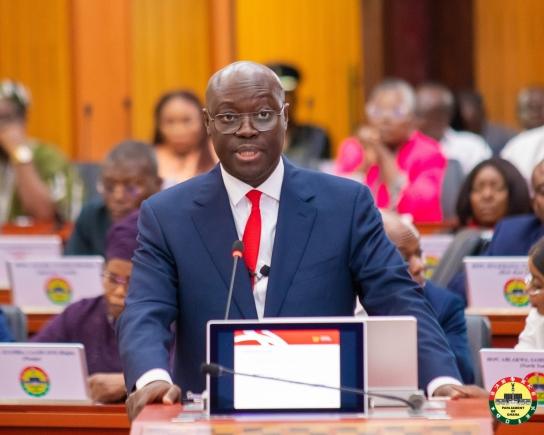

Finance Minister Dr Cassiel Ato Forson has defended the government’s handling of Ghana’s public debt, asserting that the National Democratic Congress (NDC) administration has repaid more than GH¢46.5 billion in domestic obligations inherited from its predecessor, alongside US$2.1 billion in payments to Eurobond investors.
He made the declaration in Parliament on Thursday, November 26, 2026, during the concluding debate on the 2027 Budget Statement, following the government’s successful completion of the first phase of its early redemption programme for Domestic Debt Exchange Programme (DDEP) bonds scheduled to mature in February 2027.

Dr Forson told Parliament that the current administration had made substantial payments towards outstanding domestic liabilities while also meeting significant external debt obligations inherited from the previous government.

According to him, the government had settled more than GH¢46.5 billion in inherited domestic debt and paid US$2.1 billion to Eurobond holders, a figure which includes US$700 million remitted in July.

“Together, we have paid over 46.5 billion Ghana cedis to domestic debt we inherited. We have also paid 2.1 billion US dollars to Eurobond holders, including 700 million US dollars in July,” he said.
The Finance Minister also announced that the government had concluded the first phase of its voluntary buyback of the February 2027 DDEP bonds, retiring GH¢12.6 billion in principal repayments approximately 45 minutes before the stipulated midday settlement deadline.

He explained that the voluntary redemption exercise commenced earlier in the week and closed on Wednesday, with the government completing the corresponding payments at 11:15 a.m. on Thursday.
“I am pleased to announce to the House that the early redemption was opened last Monday and ended yesterday. The cash was ready, we made the offer, and this morning at 11:15 a.m., 45 minutes ahead of the normal noon settlement time, we settled 12.6 billion Ghana cedis of the DDEP bonds,” he stated.

The exercise forms part of an earlier government commitment to redeem GH¢29 billion in DDEP bonds falling due in February 2027, using resources accumulated in the Cedi Sinking Fund Account.

Dr Forson disclosed that the account contained GH¢29 billion as of November 11, 2026, which he said provided sufficient financial backing to settle the entire principal amount falling due.
The initial redemption exercise accounted for approximately 44.1 per cent of the February 2027 bonds, with the Finance Minister indicating that the government intends to reopen the voluntary offer in two weeks to allow investors holding the outstanding securities to participate.
Dr Forson also used the parliamentary debate to contrast the economic management philosophies of the NDC and the New Patriotic Party (NPP), describing the previous administration’s approach as the “old economy” and the current government’s development agenda as the “new economy”.
He attributed the previous economic model to former Finance Minister Ken Ofori Atta and former Vice President Dr Mahamudu Bawumia, while identifying President John Dramani Mahama as the principal architect of the new economic direction.
“The architects of the old economy were Ken Ofori Atta and Alhaji Bawumia. And the architects of the new economy is John Mahama,” he remarked.
The Finance Minister further criticised the NPP’s record in managing public debt, arguing that the NDC government had assumed responsibility for settling financial obligations that its predecessor had been unable to honour.
In a strongly worded political statement, Dr Forson accused the previous administration of defaulting on its debt commitments and used a popular Christian hymn to reinforce his criticism of the NPP’s financial record.
“The NDC has paid the debt the NPP could not pay and defaulted after declaring ‘Yentumi’. In the words of the popular Sunday School song, the NDC paid the debt we did not owe. The NPP owe the debt they could not pay. The NPP needed someone to wash their sins away, and now I sing a brand new song, Amazing Grace,” he said.
He maintained that the government’s debt management strategy was based on identifying outstanding obligations, setting aside adequate financial resources and establishing repayment arrangements to meet the country’s commitments.
The Finance Minister’s defence comes as the administration seeks to demonstrate progress in restoring confidence in Ghana’s domestic debt market and meeting obligations to both local investors and international creditors.
However, the figures and political characterisations presented by the Minister remain claims made by the government and should be distinguished from an independent assessment of the country’s overall debt position.