
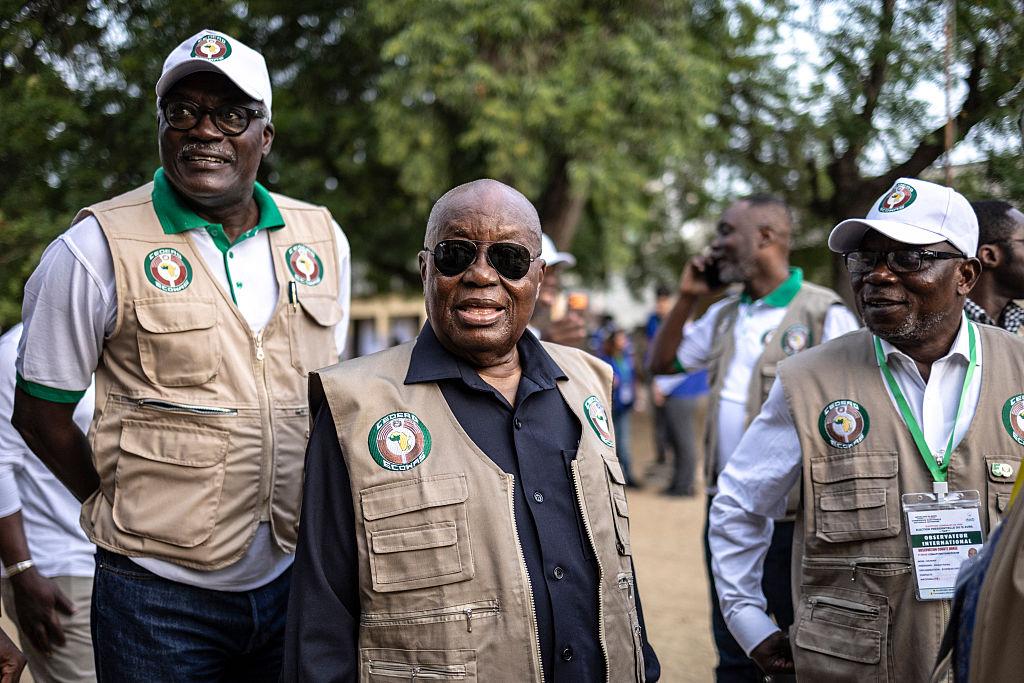

Former Ghanaian President Nana Addo Dankwa Akufo-Addo has been appointed to lead a 200-member Election Observation Mission of the Economic Community of West African States (ECOWAS) ahead of Nigeria’s January 16, 2027 presidential and National Assembly elections.
The appointment places the former Ghanaian leader at the head of a major regional electoral monitoring delegation tasked with observing the electoral process in Nigeria, Africa’s most populous country, as preparations intensify for the 2027 general elections.

According to a statement issued by the Office of Nana Akufo-Addo on Thursday, November 12, 2026, the appointment was made by ECOWAS as part of its regional commitment to promoting democratic governance, credible elections and political stability among member states.

The statement indicated that the 200-member delegation would comprise representatives drawn from several institutions within the West African regional bloc, alongside independent professionals and organisations with experience in electoral administration, democratic governance and election monitoring.

Among those expected to participate are representatives of foreign affairs ministries, national electoral management bodies, ECOWAS ambassadors based in Abuja, members of the Council of the Wise, the ECOWAS Court of Justice and the ECOWAS Parliament.
Civil society organisations, media practitioners and electoral specialists from across West Africa are also expected to form part of the mission, bringing together a broad range of institutional and professional expertise to support the observation exercise.

The deployment, according to the statement, is being undertaken in accordance with the ECOWAS Supplementary Protocol on Democracy and Good Governance, adopted in 2001, which establishes regional principles and obligations concerning democratic governance, constitutional order and electoral processes.
Nigeria’s forthcoming elections are scheduled for Saturday, January 16, 2027, for the presidential and National Assembly contests, following a revised electoral timetable issued by the Independent National Electoral Commission (INEC) in February 2026. The governorship and State Houses of Assembly elections are separately scheduled for February 6, 2027.

The presidential election will be particularly significant for Nigeria’s democratic institutions, given the country’s political influence, population size and economic importance to West Africa. Consequently, the credibility of the electoral process will have implications extending beyond Nigeria’s domestic political environment.

ECOWAS election observation missions are designed to assess the conduct of elections, engage relevant national stakeholders and promote confidence in democratic processes. Their work generally involves consultations with electoral authorities, political parties, government representatives, civil society groups and other stakeholders, alongside observation of relevant stages of the electoral process.
The regional organisation’s involvement is grounded in its commitment to democratic principles and the prevention of unconstitutional changes of government, as provided for under its Supplementary Protocol on Democracy and Good Governance.
The appointment also follows Akufo-Addo’s previous involvement in ECOWAS electoral observation activities. In March 2026, the regional organisation appointed him to lead its observation mission for Benin’s April 12 presidential election. That earlier delegation comprised 100 observers, drawn from ECOWAS member states and relevant regional institutions. His latest reported appointment therefore represents a further assignment within the organisation’s election monitoring activities.
The 200-member figure and the latest appointment are attributed to the November 12 statement from his office; I have not located a corresponding ECOWAS announcement independently confirming those specific details. This distinction is important for publication.
As Nigeria approaches the January 2027 polls, the observation mission will be expected to contribute to regional efforts to promote transparency, peaceful electoral competition and public confidence in the democratic process.

