
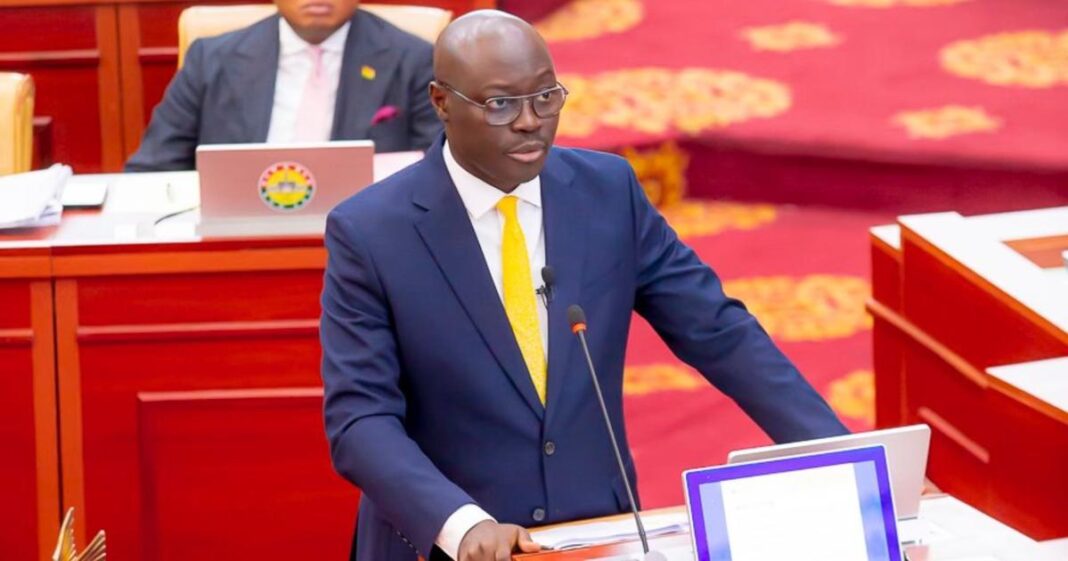

Finance Minister Dr Cassiel Ato Forson has declared that Ghana has emerged from what he describes as the most painful economic crisis in the country’s history, arguing that the return of macroeconomic stability has created an opportunity for the government to pursue a more ambitious programme of investment, industrial development and employment generation.
Presenting the 2027 Budget Statement and Economic Policy to Parliament on Thursday, November 12, 2026, Dr Forson said the country had made considerable economic progress, with stability returning and confidence gradually recovering after a prolonged period of financial and economic difficulties.

“Ghana has made significant gains and has emerged from the worst and the most painful economic crisis in our history. Stability has been achieved, and confidence is back,” he told Parliament.

The Finance Minister maintained that the recovery had created much needed breathing space for the country, but cautioned that the opportunity must be used to deliver improvements in the everyday lives of citizens rather than simply celebrate better economic statistics.

He identified unemployed graduates, farmers struggling to secure dependable markets for their produce, market women whose business capital had been weakened by inflation, pensioners affected by the domestic debt restructuring programme and entrepreneurs unable to obtain affordable long term financing as groups whose circumstances must improve under the next phase of economic management.
According to Dr Forson, the decisions taken by government at this stage would have far reaching consequences for millions of Ghanaians, making it necessary to translate macroeconomic recovery into higher incomes, sustainable employment, stronger businesses and improved living conditions.

The central policy direction outlined in the budget is the proposed US$10 billion New Economy programme, a four year investment initiative covering 2027 to 2030, which seeks to reposition Ghana’s economy from stabilisation towards increased domestic production, industrialisation, value addition and job creation.
The programme, announced by President John Dramani Mahama ahead of the budget presentation, is expected to mobilise approximately US$2.5 billion annually for investment in strategic sectors considered essential to the country’s long term economic transformation.

Government intends to concentrate the investment on commercial agriculture, agro processing, manufacturing, infrastructure, energy, critical minerals, textiles and garments, tourism, culture and the creative economy, as well as pharmaceutical manufacturing.

A major objective is to reduce Ghana’s dependence on exporting raw materials by strengthening domestic processing capacity, expanding local industries and enabling Ghanaian enterprises to produce goods that can compete more effectively in international markets.
Agriculture and agro processing are expected to occupy an important position in the initiative, particularly through efforts to improve productivity, strengthen agricultural value chains and create stronger connections between farmers, manufacturers and commercial markets.
The industrial component is also expected to encourage local production, particularly in textiles, garments, pharmaceuticals and other manufacturing activities, while investments in energy and infrastructure are intended to address some of the structural constraints affecting businesses and industrial expansion.
The government has set an ambitious target of achieving real Gross Domestic Product growth of approximately 8 per cent and reducing unemployment to below 8 per cent by 2030 under the New Economy programme.
Dr Forson also announced an intention to establish a credible pathway towards securing an investment grade sovereign credit rating, arguing that such a status must be supported by consistent economic performance rather than political declarations.
“Investment grade sovereign rating cannot be conferred in a speech. It must be earned through sustained performance,” he stated.
To demonstrate progress towards that objective, the Finance Minister announced plans to publish an annual investment grade readiness report examining the country’s performance across several economic and institutional indicators.
The assessment is expected to cover fiscal performance, public debt affordability, international reserve accumulation, monetary policy credibility, financial sector resilience, institutional quality and economic diversification.
The government’s targets come against the backdrop of measurable improvements in several economic indicators, although important vulnerabilities remain.
According to the Ghana Statistical Service, annual consumer inflation declined substantially from 23.8 per cent in December 2024 to 5.4 per cent in December 2025. It subsequently reached 5.2 per cent in September 2026 before edging upwards to 5.5 per cent in October. The October increase represented the third consecutive monthly rise, although the rate remained considerably below the 8 per cent recorded during the corresponding period in 2025.
Ghana Statistical Service+2
The distinction between declining inflation and falling prices remains important. The reduction in the inflation rate means that prices are increasing more slowly than before; it does not mean that the accumulated increases in the cost of food, transport, accommodation and other essential goods have been reversed. Indeed, the Ghana Statistical Service reported that a basket of goods and services costing GH¢100 in October 2025 cost GH¢105.50 in October 2026.
Economic growth has also strengthened. Ghana recorded real GDP growth of 6 per cent in the second quarter of 2026, while the International Monetary Fund (IMF), following its assessment of the country’s economic programme, reported that growth had reached 6.4 per cent in the first quarter of the year. The figures provide evidence of improving economic activity, although the distribution of that growth across sectors and its capacity to generate sufficient employment remain important considerations.
The recovery has also been supported by improvements in the country’s external position, stronger gold export receipts and a significant appreciation of the cedi during 2025. The Bank of Ghana’s 2025 Annual Report recorded that gross international reserves increased from approximately US$9.11 billion at the end of 2024 to US$13.83 billion by December 2025, equivalent to 5.7 months of import cover.
Bank of Ghana
However, the reserve position subsequently came under pressure. Bank of Ghana figures showed that gross international reserves declined to US$11.07 billion in August 2026, providing approximately 4.2 months of import cover, before recovering to about US$12.05 billion, equivalent to 4.5 months of import cover, by September 22. This movement demonstrates that, despite the improvement from the severe pressures experienced during the earlier crisis, maintaining adequate external buffers remains an important part of economic management.
The government’s declaration that Ghana has emerged from the economic crisis also receives some support from the IMF’s assessment. On July 27, 2026, the IMF Executive Board completed the sixth and final review of Ghana’s 39 month Extended Credit Facility programme, which was approved in May 2023 with a total financing arrangement of US$3 billion.
The completion of the final review made available a further disbursement of approximately US$371 million, bringing total disbursements under the programme to about US$3 billion.
More significantly, the IMF acknowledged substantial progress in macroeconomic stabilisation, debt restructuring, inflation reduction and reserve accumulation. It also upgraded Ghana’s risk of external and overall debt distress from high to moderate, reflecting improvements in the country’s debt sustainability position.
International Monetary Fund+1
Ghana has subsequently moved into a 36 month non financing Policy Coordination Instrument arrangement with the Fund. Unlike the previous Extended Credit Facility, the new arrangement does not provide fresh lending. Instead, it is designed to support the continuation of economic reforms, maintain policy discipline and strengthen confidence among development partners and investors.
Nevertheless, the IMF has cautioned that important vulnerabilities remain, particularly in the financial sector, public enterprises and the management of fiscal risks. Its assessment also highlights the need to strengthen domestic revenue mobilisation, improve public financial management and maintain effective oversight of state owned enterprises.
Fiscal discipline, public debt and the investment grade ambition
A particularly important component of Dr Forson’s budget presentation concerns the government’s intention to maintain macroeconomic stability while creating additional fiscal room for investment.
The Finance Minister identified sustainable macroeconomic management and access to affordable financing as the foundation of the New Economy programme. He announced that government intended to maintain a positive primary surplus of at least 0.5 per cent of GDP from 2027, preserve single digit inflation and strengthen the country’s external buffers.
He also reiterated the government’s commitment to keeping public debt consistent with a 45 per cent of GDP debt target.
These commitments require some clarification. Ghana’s legislated debt anchor is 45 per cent of GDP by 2034, rather than an immediate requirement to reduce the debt stock to that level in 2027. The IMF’s July 2026 assessment projected public debt at approximately 48.8 per cent of GDP in 2026, rising to 54.9 per cent in 2027 under its baseline projections before gradually declining. Consequently, the 45 per cent figure should be understood within the medium term debt sustainability framework and not as an already achieved position.
International Monetary Fund+1
The proposed reduction in the primary surplus target from 1.5 per cent of GDP in 2026 to 0.5 per cent from 2027 is also significant. It is intended to create additional fiscal space for productive investment without abandoning the broader commitment to debt sustainability.
The IMF has indicated that such a reduction can remain consistent with safeguarding debt sustainability, provided government makes further progress in domestic revenue mobilisation, expenditure management, public investment oversight and the supervision of state owned enterprises.
International Monetary Fund eLibrary+1
The arrangement therefore represents an attempt to balance two competing economic demands: maintaining sufficient fiscal discipline to prevent another debt crisis while releasing resources for infrastructure, industrial expansion and employment generating activities.
The investment grade ambition is closely connected to this objective. An investment grade sovereign rating would indicate that Ghana has demonstrated sufficient creditworthiness to attract investors at comparatively favourable borrowing terms. However, the government must demonstrate sustained fiscal discipline, manageable debt obligations, reliable revenue collection, strong institutions and a credible record of meeting financial commitments before such a rating can be secured.
The proposed annual readiness report could provide a framework for monitoring progress, but its effectiveness will depend on the quality of the information published, the independence of the assessment and the extent to which the government acts on identified weaknesses.
Employment targets and the challenge of translating growth into jobs
Perhaps the most consequential aspect of the New Economy programme is its employment ambition. Government wants to reduce unemployment to below 8 per cent by 2030, a target that will require more than an increase in national output.
The IMF’s 2026 assessment identified youth unemployment among Ghana’s persistent economic challenges, estimating unemployment at approximately 30 per cent among people aged 15 to 24. This highlights the scale of the employment challenge facing the country, particularly as thousands of graduates enter the labour market each year.
International Monetary Fund eLibrary
The difference between economic expansion and employment generation is especially important in Ghana, where growth in some sectors does not necessarily translate into sufficient decent and sustainable jobs.
The Government Statistician, Dr Alhassan Iddrisu, has previously drawn attention to this concern, arguing that Ghana needs to direct more investment towards sectors capable of generating substantial employment. He has also highlighted the predominance of informal businesses, which account for approximately 92 per cent of businesses in the country, and the need to improve their access to affordable financing and opportunities for formalisation.
Ghana News Agency
For this reason, the success of the New Economy programme will depend substantially on whether investments in agriculture, agro processing, manufacturing, textiles, tourism and pharmaceuticals produce measurable employment opportunities rather than simply increase the value of economic output.
There are also questions surrounding how the proposed US$10 billion investment will be mobilised and deployed. Earlier government explanations indicated that the programme would rely on domestic revenue mobilisation, fiscal savings, expenditure rationalisation and private sector participation rather than a return to expensive international borrowing. The proposed reduction in the primary surplus target is also intended to release resources for productive expenditure.
However, the distinction between government expenditure, private sector investment and funds mobilised from development partners will be essential when assessing the actual scale of the programme. A US$10 billion investment ambition should not automatically be interpreted as US$10 billion in direct government budgetary expenditure.
The programme will therefore require transparent financing arrangements, clearly identified projects, realistic implementation schedules and effective monitoring to ensure that the resources generate measurable economic returns.
For farmers, the critical test will be whether improved agricultural financing, mechanisation, storage facilities, irrigation and reliable markets increase productivity and incomes. For manufacturers, the concern will be whether energy costs, access to credit, infrastructure deficiencies and the cost of imported production inputs are sufficiently addressed to make domestic production competitive.
Market women and small business operators will also be looking for practical improvements in access to working capital, while pensioners and other individuals affected by the domestic debt restructuring exercise will expect the economic recovery to translate into stronger financial security and improved purchasing power.
Ultimately, the 2027 Budget marks an important transition in the government’s economic policy narrative. Ghana has recorded substantial improvements in inflation, economic growth, external reserves and debt sustainability, and the completion of the IMF financing programme represents a significant milestone.
Nevertheless, the declaration that the country has emerged from its economic crisis should not be confused with the conclusion of its economic challenges. Inflation has begun edging upwards again, international reserves have experienced fluctuations, unemployment remains a major concern and the debt restructuring process continues to shape the country’s public finances.
Furthermore, the Finance Minister’s description of the previous crisis as the most painful in Ghana’s history represents his assessment rather than an independently established historical ranking of the country’s economic crises.
The ultimate measure of the New Economy programme will not simply be whether Ghana achieves 8 per cent economic growth, secures an improved sovereign credit rating or maintains a primary surplus. It will be whether the country’s economic expansion creates sustainable employment, improves household incomes, strengthens local industries and makes essential goods and services more affordable.
For millions of Ghanaians who endured the consequences of the economic crisis, the expectation is that the recovery will eventually become visible in their daily lives. The 2027 Budget has therefore placed the government before a new test: demonstrating that macroeconomic stability can provide the foundation for lasting improvements in living standards.

