
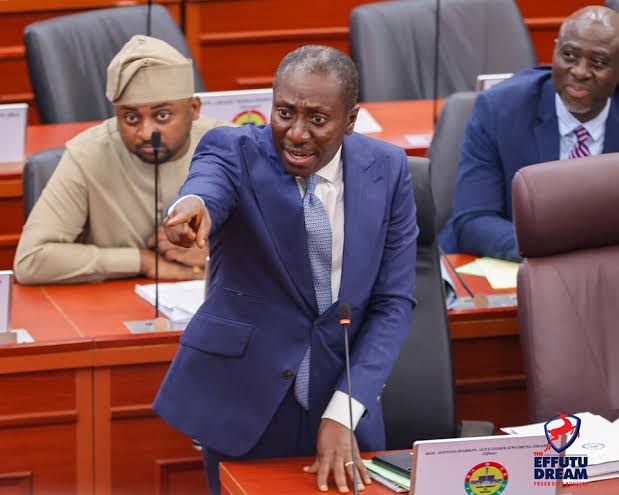

The Minority Leader in Parliament, Hon. Osahen Alexander Afenyo-Markin, has appealed to President John Dramani Mahama to grant a presidential pardon to social media activist Camilla Alhassan, who is serving a one-year prison sentence over TikTok comments she made criticizing the President and his government, which were considered offensive by the authorities.
He has also called for the immediate repeal of Section 208 of the Criminal Offences Act, 1960 (Act 29), which criminalizes the publication of false news likely to cause fear and alarm to the public, arguing that the provision has increasingly become an instrument for suppressing freedom of expression and intimidating critical voices.

Hon. Afenyo-Markin made these appeals in a forceful address at the 30th Ghana Journalists Association (GJA) Media Awards Night, held on Saturday, November 7, 2026, at the La Palm Royal Beach Hotel Convention Centre in Accra, where President Mahama was the Guest of Honour.

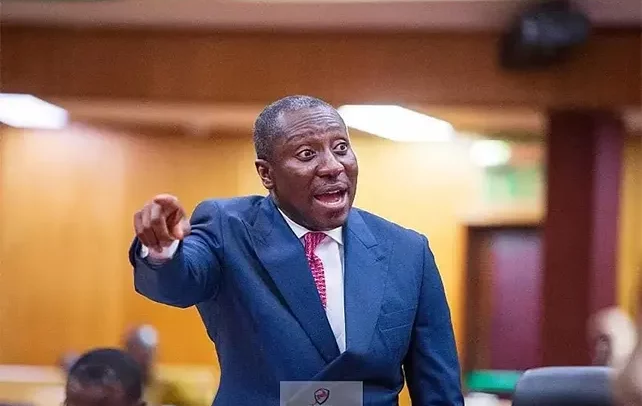
Addressing what he described as a growing culture of silence under the John Mahama-led NDC administration, the Minority Leader expressed concern about the increasing use of state institutions, particularly the police and other security agencies, in dealing with citizens over comments and publications made on social media.

He argued that Ghana risked undermining the democratic gains achieved over the years if the criminalization of speech and the intimidation of citizens for expressing dissenting opinions were allowed to become normalized.
According to him, the repeal of the criminal and seditious libel laws under the erstwhile John Agyekum Kufuor-led NPP administration in 2001 represented a significant milestone in Ghana’s democratic development, and the country must not permit practices that effectively recreate the atmosphere of fear and intimidation those reforms sought to eliminate.

In a particularly strong appeal directed at President Mahama, Afenyo-Markin urged him to exercise his constitutional authority to consider granting a presidential pardon to Camilla Alhassan, whose imprisonment, he maintained, raises serious concerns about the criminalization of free expression in a democratic society.
“I therefore appeal to H.E. the President to consider pardoning Camilla Alhassan, who is in jail because she engaged in social media activity,” he stated.

The Minority Leader further called on the President to ensure that his appointees and state institutions, particularly EOCO, operate within the limits of the law and do not engage in actions that could be perceived as political intimidation or persecution of citizens.

On the continued application of Section 208 of Act 29, Afenyo-Markin maintained that matters arising from allegedly defamatory statements, false publications or damaging remarks should ordinarily be addressed through civil remedies rather than criminal prosecution.
He was emphatic that the Minority was not advocating irresponsible speech, reckless publication or statements capable of destroying reputations, endangering lives or undermining public peace. Rather, he insisted that freedom of expression must be protected while individuals who suffer reputational harm should have recourse to civil action.
“Freedom of expression is not a license for irresponsibility, but defamation, libel and false publications should be addressed through civil action, not criminal prosecution,” he stressed.
He consequently called for the immediate repeal of Section 208, arguing that its continued use in prosecuting citizens for expressions and publications risks creating a chilling effect on public discourse, journalism and the exercise of constitutionally guaranteed freedoms.
Afenyo-Markin also urged the President not to superintend over what he described as the surreptitious return of the criminal and seditious libel regime through the use of other criminal provisions to prosecute speech.
In a passionate defense of freedom of expression, the Minority Leader declared that his side of Parliament would continue to defend the right of every Ghanaian to speak, question, and criticize, irrespective of political affiliation. He emphasized that the protection of free speech must not be limited to members and supporters of the opposition, insisting that even critics of the Minority deserve the same protection.
“We must not allow fear and panic to become the new language of political control. We must not allow prosecution of speech to become normalized. The Minority will continue to defend the right of every Ghanaian to speak, question, criticize, publish and disagree. We will defend even the critics of the Minority because freedom of speech belongs not to one party, one profession, or one class of people. It belongs to all of us as Ghanaians,” he declared.
He concluded with a call for a democratic culture that promotes accountability without intimidation and responsibility without repression, urging the country to preserve the freedoms that remain fundamental to its democratic identity.
Meanwhile, Philip Osei Bonsu, popularly known as OB of Asempa FM, was adjudged Journalist of the Year at the 30th GJA Media Awards Night.
Story by Iddi Muhayu-Deen Esq.

