
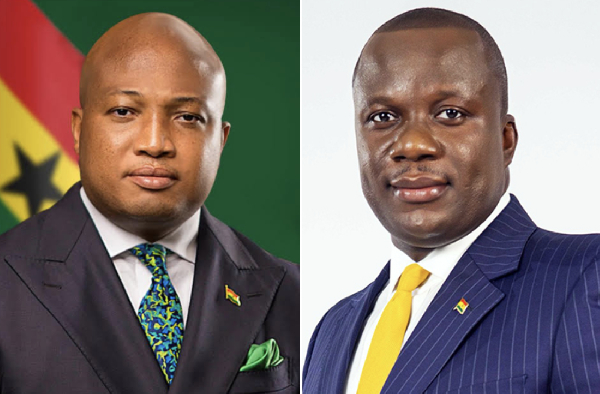

Ranking Member of Parliament’s Foreign Affairs Committee, Samuel Abu Jinapor, has called on the government to undertake a comprehensive assessment of the advantages and possible consequences of Ghana’s proposed membership of BRICS before advancing the application.
The Damongo Member of Parliament acknowledged that joining the emerging international economic grouping could create additional opportunities for Ghana, particularly through expanded commercial relationships, alternative development financing and broader cooperation with countries outside the nation’s traditional diplomatic partnerships. He nevertheless cautioned that such opportunities could also carry implications for Ghana’s national interests.

His comments followed Foreign Affairs Minister Samuel Okudzeto Ablakwa’s announcement that Cabinet had approved Ghana’s decision to formally apply to join BRICS as part of an effort to diversify the country’s international relationships and strengthen South South cooperation.

Mr Jinapor maintained that Ghana’s foreign policy must ultimately be measured against the country’s national interest. In his view, no diplomatic initiative should be pursued merely because it appears attractive internationally if the eventual consequences do not serve Ghana’s strategic priorities.

He specifically questioned the assumption that BRICS membership would automatically provide Ghana with greater financial independence through institutions such as the New Development Bank.
According to him, if access to new financing is still influenced by requirements associated with existing international institutions, then Ghana must carefully determine what additional advantage BRICS membership would actually provide.

The former Lands and Natural Resources Minister also urged Parliament and the government to examine the potential economic and political influence that major BRICS members such as China and Russia could acquire through deeper engagement with Ghana.
He argued that questions concerning Chinese influence within Ghana’s economy and broader national affairs, as well as the implications of closer relations with Russia, should form part of any serious evaluation of the proposed membership.

Mr Jinapor further encouraged the government to study the experiences of countries that have already joined BRICS rather than approaching membership solely from the perspective of its potential benefits.

He cited Ethiopia as an important case study, noting that although the country had gained access to assistance and financing opportunities associated with the New Development Bank, concerns had also emerged around trade imbalances and increased imports from BRICS economies, particularly China.
He therefore believes Ghana can draw useful lessons by examining how membership has affected other participating countries before making a final commitment.
BRICS currently comprises Brazil, Russia, India, China, South Africa, Egypt, Ethiopia, Iran, Indonesia, Saudi Arabia and the United Arab Emirates.
Mr Jinapor also raised concerns about Ghana’s existing bilateral relationship with South Africa, one of the founding members of BRICS. He described the current Ghana South Africa relationship as being in a poor state and questioned how that situation could affect Ghana’s participation in a grouping in which Pretoria remains an influential member.
He disclosed that Parliament’s Foreign Affairs Committee had received only a general briefing from the Foreign Affairs Minister concerning the government’s intention and had not yet conducted a comprehensive examination of the proposal.
While recognising the government’s objective of expanding Ghana’s international partnerships, Mr Jinapor said the country’s longstanding non aligned foreign policy should also be taken into consideration.
The government, meanwhile, maintains that the BRICS initiative is intended to provide Ghana with additional opportunities in development financing, trade, investment and industrialisation while complementing rather than replacing its existing relationships with traditional development partners.

