
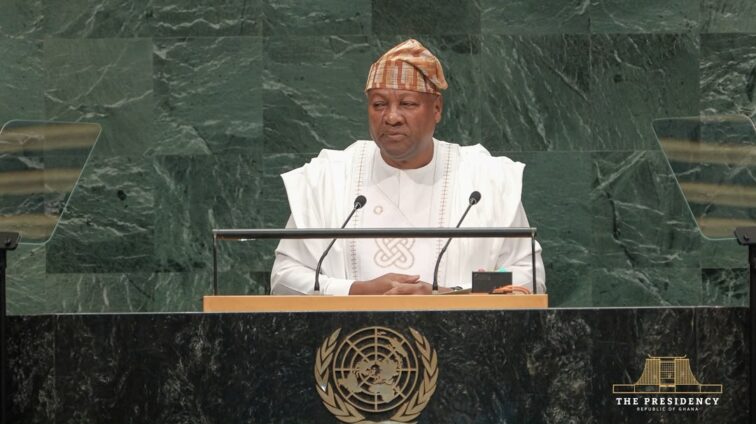

President John Dramani Mahama has used Ghana’s participation in the 81st Session of the United Nations General Assembly in New York to press for the immediate and unconditional repatriation of African human remains and looted cultural heritage, condemn the humanitarian consequences of the conflict in Gaza, reaffirm Ghana’s support for Palestinian statehood and insist that democracy must ultimately produce tangible improvements in the lives of ordinary citizens.
Speaking at a high level side event devoted to the return and restitution of cultural property and heritage, President Mahama argued that African human remains held by museums and institutions outside the continent should no longer be regarded as collectible objects or scientific specimens. He maintained that their continued retention raises a fundamental question of human dignity and should become an immediate point of departure for a more comprehensive international system governing restitution.

The President illustrated his argument with the history of King Badu Bonsu II of Ahanta, who was executed by Dutch colonial authorities in 1838 following his resistance to Dutch domination. According to President Mahama, the King was decapitated after his execution and his head was transported to the Netherlands, where it remained preserved in formaldehyde for approximately 170 years before its rediscovery and eventual return to Ghana in 2009.

President Mahama said the episode demonstrated why the treatment of African human remains could not be reduced to questions of museum ownership, scientific classification or administrative procedure.

“Human remains are not collectibles. They are not specimens. They are our ancestors. They are fathers and mothers. They are kings and elders,” he said, arguing that their restoration represents a fundamental test of shared human dignity rather than merely a dispute over legal title.
He further situated the issue within Africa’s broader experience of cultural dispossession, recalling that British forces attacked Kumasi in 1874 and looted the palace of the Asantehene. He noted that part of that heritage, including the sacred Mpomponsuo Sword, was returned to Ghana in 2024, while substantial quantities of African cultural property remain outside the continent.

The President also referred to the removal of cultural treasures from Benin City, Magdala in Ethiopia and Abomey in present day Benin, arguing that these objects should be understood not simply as historical artefacts but as components of living African traditions, communal memory and identity.
His call for restitution formed part of a wider reparatory justice agenda being advanced by Ghana. President Mahama pointed to the United Nations General Assembly’s adoption on March 25, 2026 of Resolution 80/250, which Ghana has identified as an important international milestone concerning the trafficking and enslavement of Africans and the restitution of African cultural property, sacred artefacts and national archives. He subsequently referred to the June 2026 high level consultative conference convened in Accra and the resulting “Accra Next Steps” framework as an effort to move from international acknowledgement towards practical implementation.

At the main General Assembly debate, President Mahama broadened his intervention to questions of international peace, humanitarian protection and the credibility of the multilateral system.

He argued that the United Nations must confront the consequences of the conflict in Gaza without diplomatic expressions that obscure the suffering of civilians, while maintaining that international standards must be applied consistently across conflicts.
“Nowhere is this crisis of credibility more painful than in the ongoing persecution of the Palestinian people in Gaza, the West Bank, and the occupied territories,” President Mahama said.
He questioned how many additional civilian deaths would be required before the international community exercised what he described as decisive moral authority. Referring to the death of five year old Hind Rajab and the reported killing of more than 20,000 children during the conflict, he condemned collective punishment, enforced starvation and mass displacement, describing such conduct as violations of international law.
Ghana, he said, remains committed to recognising the State of Palestine and supporting a viable two state arrangement in which Israel and Palestine coexist peacefully and securely with guaranteed borders. At the same time, he condemned acts of terrorism by Hamas and maintained that all parties to the conflict must comply with international humanitarian law.
President Mahama extended his appeal for consistent international standards beyond Gaza, arguing that civilian protection, humanitarian access, respect for sovereignty and accountability for alleged war crimes should apply regardless of the geographical location or political identity of the parties involved.
His remarks came against the backdrop of wider United Nations discussions concerning Gaza and the future of a two state settlement. UN Secretary General António Guterres, addressing the opening of the 81st General Assembly, similarly called for compliance with international law and humanitarian obligations and warned that developments in the Occupied Palestinian Territory were undermining prospects for a viable Palestinian state.
President Mahama also connected the question of international credibility with the quality of democratic governance at home. He argued that democracy should not be measured exclusively by the conduct of elections or the periodic casting of ballots but also by whether citizens experience meaningful improvements in their daily circumstances.
“I have always believed that democracy must deliver tangible social benefits,” he said, stressing that citizens should experience democratic government not merely through elections every four years but through better access to food, quality education, decent housing, healthcare and economic opportunity.
He said democratic institutions must translate political freedoms into practical opportunities that enable citizens to improve their livelihoods and participate more fully in economic and social development.
The President linked that principle to Ghana’s domestic development programme, pointing to investments in infrastructure, healthcare, education, social protection and economic activity as essential components of a democratic system that responds to the needs of its citizens. His address highlighted the government’s infrastructure programme, digital expansion, healthcare initiatives and 24 Hour Economy and Accelerated Export Development Programme as elements of the broader development agenda.
President Mahama maintained that the durability and credibility of democracy ultimately depend on whether citizens can perceive a meaningful relationship between the institutions and leaders they elect and the conditions in which they live.
His interventions at the United Nations therefore brought together three closely connected themes: the restoration of African cultural heritage, the protection of civilians and respect for international law, and the delivery of practical social and economic benefits through democratic governance.
In presenting these issues before the international community, the President placed human dignity at the centre of Ghana’s message, arguing that the principles governing the treatment of ancestral remains, civilians affected by war and citizens living under democratic government should be grounded in respect for human rights, equality and accountability.

