
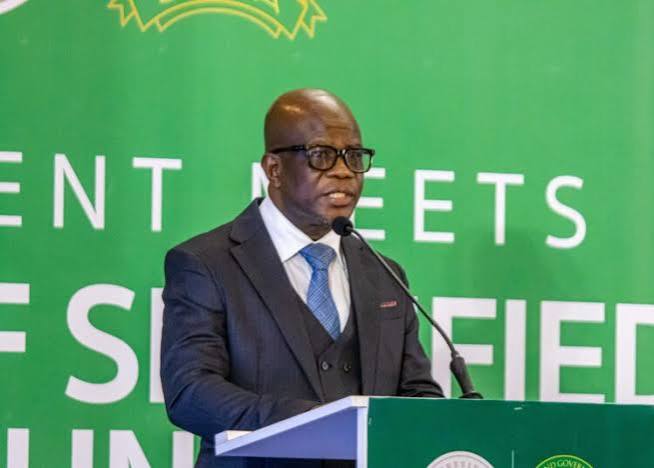

The Director General of the State Interests and Governance Authority, Professor Michael Kpessa Whyte, has expressed concern over persistent weaknesses in governance, accountability and regulatory compliance among several specified state owned entities, warning that such shortcomings could expose the public purse to avoidable financial risks.
Prof. Kpessa Whyte said compliance with key governance obligations remained disturbingly low, with only 72 out of 148 targeted entities signing performance contracts in 2025, while just 71 submitted their quarterly reports within the required period.

He made the disclosure at an event organised by SIGA at the La Palm Royal Beach Hotel, where he highlighted several areas in which state owned entities continued to fall short of their statutory and administrative responsibilities.

According to the SIGA Director General, compliance was particularly weak in relation to annual accountability meetings, an important mechanism through which boards and management teams are expected to account for their stewardship of public resources.

He revealed that only 37 of the 177 entities targeted for the exercise held annual general meetings or stakeholder engagements during the year.
“Some specified entities continue to resist or place themselves outside SIGA’s oversight. The figures are troubling,” Prof. Kpessa Whyte said.

He nevertheless acknowledged considerable improvement in the submission of audited financial statements, describing the development as an encouraging indication of stronger financial reporting across portions of the state enterprise sector.
The number of entities that submitted their audited accounts increased from 53 in 2024 to 108 in 2025, representing the highest level of coverage recorded by SIGA to date.

Prof. Kpessa Whyte explained that the wider availability of audited accounts would enable the authority to develop a more reliable assessment of the financial condition and operational performance of the country’s state owned enterprise portfolio.

“The more audited accounts we have, the more accurate the report we present is,” he said.
He cautioned, however, that progress in financial reporting could not be regarded as sufficient when other fundamental governance responsibilities remained unfulfilled.
Prof. Kpessa Whyte stressed that compliance with one requirement could not compensate for neglect of another, particularly where the outstanding obligation concerned direct accountability to stakeholders and the Ghanaian public.
“Partial compliance is not enough. An entity that files audited accounts but does not hold its annual general meeting has left a major accountability obligation unmet,” he said.
The SIGA Director General further warned that state owned entities that fail to execute performance contracts or submit their quarterly reports on schedule make it considerably more difficult for the government and regulators to detect emerging operational and financial problems before they become more serious.
He explained that timely performance reporting enables the state to identify institutional weaknesses at an early stage, evaluate whether management is meeting agreed objectives and introduce corrective measures before problems escalate.
Failure to maintain such reporting and accountability mechanisms, he cautioned, could eventually result in contingent liabilities for the state and place additional pressure on public finances, while simultaneously weakening public confidence in institutions established to manage national assets.
Prof. Kpessa Whyte also drew attention to the disappointing dividend contribution from state owned enterprises, arguing that greater attention must be devoted to ensuring that publicly owned commercial institutions generate meaningful financial returns for the government and, ultimately, the Ghanaian people.
He disclosed that only two of 53 state owned enterprises paid dividends to the government from their 2024 operations, with the two institutions collectively contributing GH¢16 million.
The entities were the Ghana Reinsurance Company and the National Development Company.
The figures highlight the continuing challenge confronting Ghana’s state enterprise sector, where the government holds significant commercial interests but has often had to contend with weak financial returns, governance deficiencies and dependence on public resources.
Prof. Kpessa Whyte’s concerns consequently reinforce the growing demand for stronger institutional oversight, more rigorous performance monitoring and greater accountability among organisations entrusted with managing state assets.
For SIGA, the objective is not simply to increase the number of entities submitting reports or signing performance agreements, but to establish a culture in which public institutions consistently demonstrate measurable performance, financial responsibility and accountability to the citizens whose resources they administer.
The disclosures also come as the government intensifies its call for State Owned Enterprises to become more efficient and financially sustainable, with President John Dramani Mahama warning that persistent losses will no longer be quietly transferred to the national budget.
Together, the positions articulated by the President and the SIGA Director General point towards a more demanding approach to public enterprise management, under which boards and executives will increasingly be expected to demonstrate that the institutions under their stewardship are protecting public assets, fulfilling their governance obligations and generating tangible value for Ghana.

