
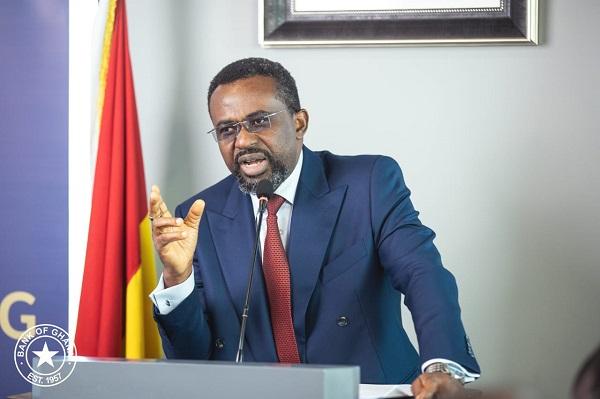

Bank of Ghana Governor Dr Johnson Pandit Asiama has disclosed that heightened tensions in the Middle East have exerted substantial pressure on Ghana’s international reserves over the past several months, compelling the central bank to extend support to critical segments of the economy amid a difficult global environment.
Dr Asiama said the country had endured an exceptionally demanding period as geopolitical developments, international commodity pressures and changing global economic conditions affected Ghana’s external position. He explained that the resulting strain had contributed to a reduction of about US$1.2 billion in the nation’s reserve holdings.

“The past three to four months have been quite challenging for us when it comes to the country’s international reserves,” the Governor stated.

He added that, given the circumstances confronting the economy, the decline did not come as a surprise.

“I am therefore not surprised that we lost 1.2 billion reserves,” Dr Asiama said.
The latest Economic and Financial Data published by the Bank of Ghana indicates that Ghana’s gross international reserves declined from approximately US$14.1 billion to US$12.9 billion. The Bank’s published data also show that the US$12.9 billion position represented about five months of import cover, providing the country with a sizeable external buffer despite the recent reduction.

Dr Asiama made the disclosure during the second part of Time with the Governor, an engagement organised for students from the Department of Economics at the University of Ghana and the University of Ghana Business School.
The participating students were involved in the 131st Monetary Policy Committee meetings through the Bank of Ghana’s Monetary Policy Committee Educational Observership Programme, giving them an opportunity to gain direct insight into the processes and considerations underpinning monetary policy decisions.

Governor stresses need for stronger reserve accumulation
Using the engagement to explain the importance of Ghana’s external buffers, Dr Asiama underscored the necessity of maintaining sufficiently robust international reserves to shield the economy from unexpected global disruptions.

He recalled that the accumulation of substantial reserves during the previous year had positioned Ghana to withstand the kind of external pressures now confronting the country.
“This is why we can say that one of the good things we did last year was to build some high reserves for interesting times like this,” he said.
The Governor explained that maintaining an adequate reserve position is particularly crucial when international economic conditions become unpredictable because foreign exchange buffers provide policymakers with greater capacity to respond to external disturbances and preserve stability.
He acknowledged that responding to such shocks often requires difficult policy choices, particularly when authorities must simultaneously protect economic stability, meet essential external obligations and support vulnerable sectors.
Despite the recent decline, Dr Asiama has previously maintained that Ghana’s reserves remain sufficient to provide protection against external shocks. In July, he said the US$12.9 billion position was adequate to support the country’s external obligations and guard against excessive pressure on the cedi.
The Governor’s latest comments nevertheless highlight the continuing importance of rebuilding the reserve position as Ghana navigates an uncertain international environment.
Asiama identifies exports as key to rebuilding reserves
Dr Asiama said Ghana’s ability to replenish its foreign exchange reserves would depend substantially on expanding the country’s capacity to generate foreign currency through exports.
He specifically pointed to cocoa exports and non traditional exports as areas where Ghana could strengthen its foreign exchange earnings.
According to the Governor, non traditional exports currently represent approximately 10 percent of Ghana’s total exports, a proportion he believes should be increased to 15 percent.
Such an expansion, he suggested, would broaden the country’s sources of foreign exchange and reduce excessive dependence on a relatively narrow range of export commodities.
The need to strengthen export earnings comes despite Ghana recording a strong external sector performance during the first half of 2026. Bank of Ghana data showed that the country’s trade surplus expanded considerably, supported largely by stronger earnings from gold and cocoa.
The challenge, therefore, is not simply to increase export receipts but also to ensure that a greater proportion of those earnings contributes to the accumulation of durable foreign exchange reserves.
Governor highlights US$8 billion remittance opportunity
Dr Asiama also identified remittances as another potentially significant source of foreign exchange for Ghana.
He noted that the country receives more than US$8 billion in remittances and argued that a greater share of these inflows should be directed towards productive economic activities rather than being used predominantly for consumption.
The Governor’s position suggests that remittances could play a broader developmental role if they were channelled into investments capable of expanding productive capacity, supporting businesses and generating additional income.
Such an approach could also strengthen Ghana’s foreign exchange position by converting a portion of remittance inflows into productive assets and enterprises capable of generating future economic returns.
For Ghana, the recent decline in reserves therefore reinforces the importance of broadening foreign exchange earnings, strengthening export competitiveness and encouraging productive investment.
The Middle East tensions have demonstrated how developments far beyond Ghana’s borders can rapidly influence energy prices, import costs, foreign exchange requirements and the country’s external buffers. The Bank of Ghana has previously warned that the prolonged conflict in the region could create additional pressure through higher energy prices and external cost pressures.
Dr Asiama’s latest assessment consequently places renewed emphasis on the need for Ghana to strengthen the foundations of its external resilience by expanding exports, increasing non traditional export earnings, making more productive use of remittances and preserving adequate international reserves.
Although Ghana’s US$12.9 billion reserve position remains a substantial buffer, the Governor’s disclosure underscores the need to replenish the funds used during the recent period of heightened global uncertainty and ensure that the country remains adequately protected against future external shocks.

