
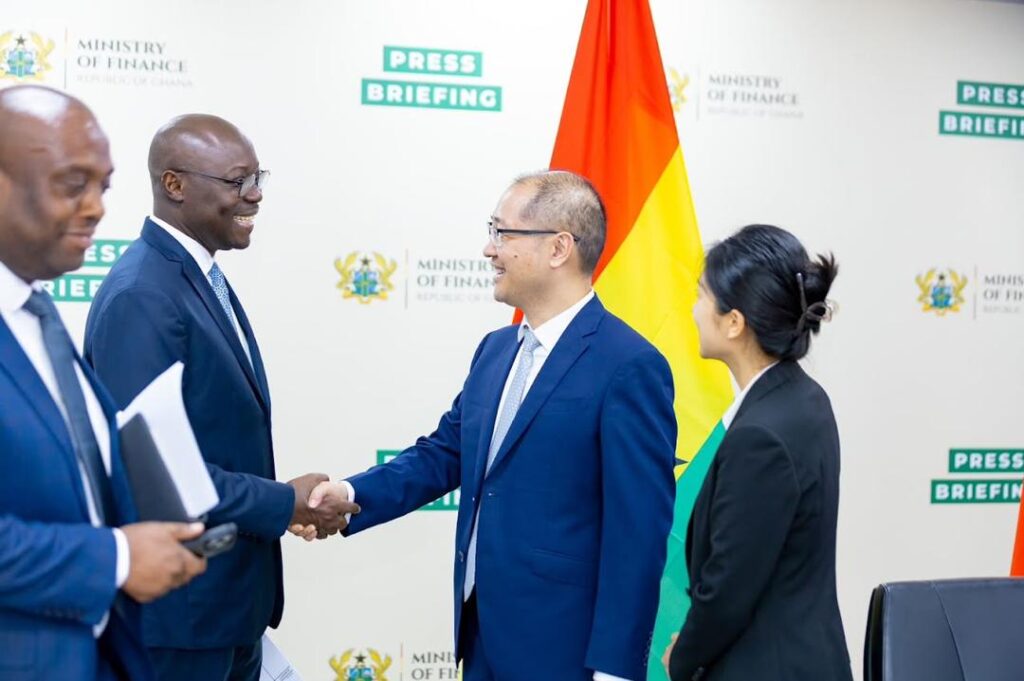

Finance Minister Dr Cassiel Ato Forson has called for a fundamental transformation in Ghana’s commercial relationship with China, urging both countries to move beyond conventional trade volumes and place greater emphasis on domestic processing, manufacturing, technology transfer and sustainable employment.
Dr Forson made the call on Monday, August 24, 2026, when he opened the Fifth Session of the Ghana China Joint Commission on Economic, Trade and Technical Cooperation. He acknowledged China’s position as Ghana’s largest trading partner but maintained that the composition of bilateral commerce must evolve if the country is to secure substantially greater economic benefits from its engagement with the Asian powerhouse.

According to the Finance Minister, Ghana’s principal objective is to retain a larger proportion of the wealth generated from its own resources by expanding domestic processing before products are shipped to international markets. He particularly highlighted the need to increase exports of processed cocoa and other value added commodities to China rather than relying predominantly on the shipment of unprocessed materials.

Dr Forson further stressed that Ghana is looking for a new generation of investments capable of strengthening productive capacity within the country. Such investments, he explained, should contribute to the establishment of factories, facilitate the transfer of modern technology, expand opportunities for Ghanaian enterprises, equip local workers with relevant skills and generate durable employment.

The Finance Minister therefore argued that the success of Ghana China economic relations should not be assessed merely by the quantity of goods exchanged or the overall value of bilateral trade. Instead, the partnership must produce measurable benefits for domestic enterprises, workers and the broader Ghanaian economy through stronger industrial capacity and increased local value creation.
His position reflects a broader push by the government to strengthen Ghana’s productive economy by encouraging investment that connects international capital with domestic manufacturing, processing and employment. The approach also aligns with the government’s wider economic transformation agenda, which seeks to convert Ghana’s considerable natural resources and market opportunities into stronger domestic industries.

The emphasis on value addition is particularly significant for commodities such as cocoa, where Ghana has historically earned substantial export revenues but continues to face the challenge of capturing a larger share of the value generated further along the international supply chain.
Under the proposed direction, a greater proportion of Ghanaian commodities would undergo processing within the country before reaching Chinese consumers. This would potentially expand industrial activity, create additional commercial opportunities for local companies and increase demand for skilled Ghanaian labour.

China signals stronger economic partnership
China’s Assistant Minister for Commerce, Zhang Li, who is visiting Ghana for the first time, welcomed the direction of the discussions and commended the government for what he described as recent improvements in the Ghanaian economy.

Mr Zhang reaffirmed Beijing’s readiness to deepen economic and commercial collaboration with Accra while indicating that China was prepared to support the government’s Big Push Programme and other strategic initiatives intended to accelerate national development.
The Big Push Programme is already being used to advance major infrastructure investments across Ghana. By July 2026, the government had commenced 87 transport infrastructure projects across all 16 regions, including trunk roads, bridges, urban roads and feeder roads.
The renewed Ghana China discussions therefore present an opportunity for cooperation to extend beyond conventional merchandise trade into infrastructure, industrial development, technology, skills development and investment.
For Ghana, however, the central issue remains the quality and domestic impact of the partnership. Dr Forson’s message is that stronger commercial relations with China should ultimately translate into more factories operating in Ghana, greater processing of locally produced commodities, stronger Ghanaian businesses, expanded technical capabilities and more sustainable employment.
The Fifth Session of the Ghana China Joint Commission consequently provides a platform for both governments to reassess the structure of their economic relationship and identify practical avenues through which bilateral cooperation can contribute more directly to Ghana’s industrialisation and long term economic transformation.

