
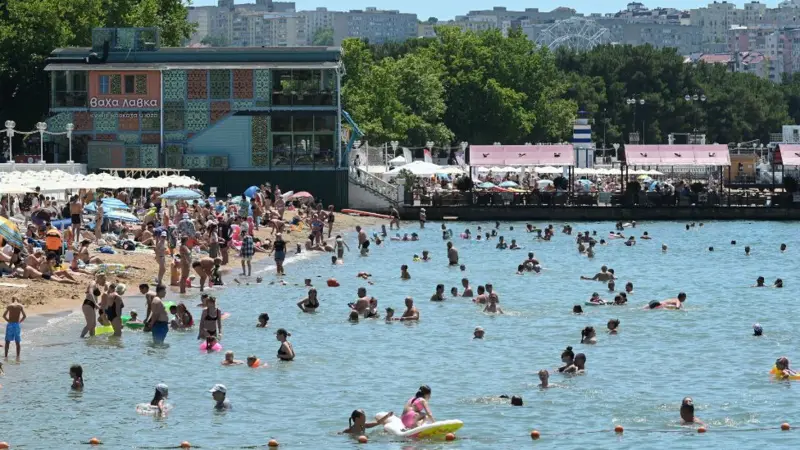

SOURCE: BBC
Russian officials say at least seven people, including three children, have been killed by a Ukrainian drone on a beach in south-west Russia – BBC Verify examines footage

It’s not clear if the drone was intercepted before landing on the beach. It has been reported it may have been targeting a Russian naval base about 25 miles (40 km) away – Ukraine has not commented

The area has long been a favourite of Russian holidaymakers, says our Europe reporter

Earlier, an apparent Ukrainian drone strike hit a warehouse belonging to Russia’s largest online retailer Wildberries, around 112 miles east of Moscow
The strike came after more deadly Russian missile attacks on Kyiv on Saturday, with at least nine people killed

Until recently, war was something happening far away for many Russians – that is changing, the BBC’s Steve Rosenberg writes
Russian Foreign Ministry spokeswoman Maria Zakharova

Russia’s foreign ministry is accusing Western nations of sponsoring “terrorist activity” in the wake of a tourist beach being hit by a drone.

“Not long ago, Nato and the EU declared a policy of zero tolerance towards terrorism,” spokeswoman Maria Zakharova says to Russia’s state-affiliated news outlet Tass.
“Now, they themselves have become part of international terrorist activity.”
Her comments were in response to questions about the drone that hit the Black Sea resort town of Gelendzhik earlier.
Russia has blamed Ukraine for the deadly incident. Neither the Ukrainian military nor officials in Kyiv have commented so far.
Our analyst writes that while it’s not possible to completely rule out the possiblity of a deliberate strike on a beach, the history of this war suggests that Ukrainians have not deliberately targeted such locations in the past and would have little to gain by doing so.
Gunfire that can be heard in clips showing the drone that hit a tourist beach on the Black Sea coast suggests that there was an ongoing attempt by Russian air defences to bring it down.
Is it possible to completely rule out the possibility of a deliberate attack on a beach in Russia?
No, but the history of this war suggests that Ukrainians have not deliberately targeted such locations in the past and that they have little to gain from something like this.
We have to also bear in mind that one of Vladimir’s Putin’s alleged palaces is located not far from Gelendzhik.
While there’s discussion going on about the possibility or impossibility of a deliberate Ukrainian attack we have to remember that there are numerous potential military targets in the area that Ukrainians would be interested in targeting.
The key to answering that question of whether it was deliberate is the gunfire. There’s also the possibility of radio electronic interference that brought it down. But, this also goes to show how dangerous and lethal these drones are no matter how far people are from the front lines.
Tourists and residents of Arkhipo-Osipovka have told local media outlet 93.ru that no sirens sounded ahead of the drone attack.
“We were on the beach, we didn’t have time to leave,” one unnamed holidaymaker was quoted as saying.
“We covered ourselves with sun loungers, and didn’t see where it exploded.”
Another said that while they did not see the drone hit they could hear “gunfire, like a machine gun” followed by an explosion.
“This all happened in front of my children. My child is having a nervous breakdown,” a third person said.
Krasnodar Krai regional governor Veniamin Kondratyev says seven people have died and more than 40 are injured after drone hit a beach near the resort town of Gelendzhik.
Here’s what we’ve learned about other deadly incidents in the past day.
A fire at the Wildberries warehouse in Russia’s Vladimir region caused by a Ukrainian drone strike wounded four people, the regional governor says
Four were killed and two others injured in a Ukrainian attack in Russian-controlled Crimea, according to the region’s Moscow-installed governor Sergei Aksyonov
The attacks come after the countries continued to trade fire over the weekend, with Russia saying eight people had been killed in Ukrainian strikes overnight going into Sunday.
Meanwhile, Volodymyr Zelensky says at least nine people were killed and a dozen injured during Russian ballistic missile strikes on Kyiv on Saturday.
The Operational Headquarters of Krasnodar Krai says that the number of people killed in the drone attack on Arkhipo-Osipovka beach has risen to seven, with three children among the dead.
In a statement on Telegram, the authority says 40 people sustained various injuries in the strike near the Russian Black Sea resort of Gelendzhik.
An additional 21 people were taken to hospital, with 19 people receiving outpatient treatment, it adds.
It’s not clear if the drone was intercepted before landing on the beach. Ukraine hasn’t yet commented on the strikes.
A video verified by the BBC shows the moment a drone hits Arkhipo-Osipovka beach near the Russian Black Sea resort town of Gelendzhik.
Krasnodar Krai’s regional governor Veniamin Kondratyev says on Telegram that six people were killed, including three children. He has blamed Ukraine for the attack.
The Ukrainian military has so far not commented on the incident.
We reported earlier that Ukrainian President Volodymyr Zelensky said the Wildberries strikes are “bringing the war back home” to Russia.
Alexandra Prokopenko from the Carnegie Russia Eurasia Center told BBC Verify that Ukraine’s other strikes on energy infrastructure will have a far greater impact on the Russian economy, “but they don’t generate public outrage the way a burning delivery warehouse does”.
“Nobody has yet calculated” how many individuals and small businesses have been affected by the Wildberries strikes and “some say openly that bankruptcy and production shutdowns are inevitable,” she says.
Kyiv also claims the warehouses are helping to supply the Russian military. The Kremlin has denied these claims.
Emily Ferris from the Royal United Services Institute told BBC Verify that although Wildberries “mostly sells consumer goods” some of its products, like sports gear, uniforms, thermal-imaging cameras and electronic components “can be used on the front line to supply troops”.
“Preventing their further distribution would technically disrupt military supply chains as well,” she said.
Russia says it has struck four Ukrainian cargo ships across both the Black Sea and port of Mykolaiv in southern Ukraine.
Its ministry of defence says unmanned drones struck two cargo ships in Mykolaiv that it claims were “unloading military cargo”.
It adds a further two ships were struck in the Black Sea that were “carrying military cargo”.
There has been no acknowledgement of the attacks from Ukraine.
BBC Verify has been checking footage of a drone hitting a beach near the Russian Black Sea resort town of Gelendzhik.
Krasnodar Krai regional governor Veniamin Kondratyev posted on his Telegram account that six people had been killed, including three children. He said 40 more had been injured and blamed Ukraine for the attack. The Ukrainian military has so far not commented on the incident.
It’s been reported the drone may have been targeted at the Russian naval base at Novorossiysk which is around 40km (25 miles) from Gelendzhik.
We have geolocated the incident to Arkhipo-Osipovka, near Gelendzhik. Recency and AI checks confirm the footage is current and genuine.
This image claiming to show a message on the roof of a warehouse belonging to Wildberries’ competitor Ozon saying in Russian “This is not Wildberries. Fly past” has spread widely across social media and has been used by some news outlets – but it’s AI-generated.
OpenAI’s online verification tool detected a SynthID digital watermark on the image. This tells us it was made using one of OpenAI’s tools.
We’ve traced the image back to a post on TikTok that has been viewed nearly eight million times.
TikTok has added an AI-generated label to the post but it has since spread across other platforms where it’s being presented as real.
A fourth person has been injured as a result of a fire at the site of the Wildberries warehouse in Russia’s Vladimir region, the local governor has said.
Alexander Avdeyev says in a post on Telegram that the blaze has been contained after stretching over an area of 100,000 sq m (0.1 sq km).
He adds the incident led to the deployment of 203 firefighters and 67 pieces of equipment, including specialists and a government helicopter.13:17
Russia has denied that online marketplace Wildberries provides Russian military gear.
Kremlin spokesman Dmitry Peskov denied accusations during a news conference on 21 July, following attacks on Wildberries hubs in the cities of Kotovsk and Elektrostal on 18 July.
“That’s not true,” Peskov said in response to a question on the matter, Moscow’s state news agency Tass reports.
Last week, the Ukrainska Pravda news website reported that Wildberries had removed the product tag “Everything for the SMO” [special military operation] from its website, citing The Moscow Times.
Ukrainian President Voldymyr Zelensky says that Russian President Vladimir Putin hopes to “drag this war out further” as Ukraine launches fresh strikes on targets across Russia.
In a speech delivered to Ukrainian diplomats, Zelensky says he cannot predict “with 100% certainty” when Ukraine’s diplomatic efforts, sanctions and strikes against Russia will leave Russia with “no alternative but peace”.
He says Ukraine will do what it can to ensure this “happens in the autumn”, but says “we clearly understand who we are dealing with”, adding that Putin “hopes to drag this war out further”.
“We see Russia’s true intentions [and] are uniting our partners and putting pressure on the aggressor,” he adds.
A plume of black smoke was seeing rising following reported Ukrainian strikes against a fuel depot in Belgorod overnight
Ukraine’s Ministry of Defence says it struck a number of Russian military targets overnight, in addition to apparent Ukrainian strikes against sites belonging to Russian retailer Wildberries.
It says it hit several logistics and communications hubs in Crimea, a drone launch site in Bryansk and a fuel depot in Belgorod.
It comes amid increasing Ukrainian attacks on Russian infrastructure, with Volodymyr Zelensky on Sunday announcing strikes against an oil refinery and military air base in Russia’s Stratov region.
“We are bringing the war back to where it came from,” he said, adding that Ukraine continues to expand its “long-range capabilities”.
Other notable infrastructure strikes in recent months include:
4 July – Ukraine hit a a major oil terminal in the city of St Petersburg, with Zelensky describing it as key “infrastructure that generates revenue for Russia’s war”
24 June – A Ukrainian strike against an electricity substation knocked out power in Sevastopol, the largest city in Russian-occupied Crimea
18 June – Plumes of black smoke filled the Moscow sky as Ukraine hit an oil refinery in one of its largest attacks since the outbreak of the war
30 April – Ukraine says it hit one of Russia’s largest oil refineries in the city of Perm, more than 1,500km (930 miles) from the front line:34
The latest set of blows between Russia and Ukraine has led to three deaths in the Russian-controlled territory of Crimea, the Moscow-installed governor has said, in what he described as a “barbaric attack”.
The region, which is internationally recognised as being Ukrainian, was illegally annexed by Vladimir Putin in 2014.
It has since become linked to Russia by road and rail connections along a land corridor through occupied areas of southern Ukraine, and since 2018 by a road and rail bridge across the Kerch Strait.
The future of the territory has remained a central point in peace talks between the two countries, with Ukrainian President Volodymyr Zelensky refusing the possibility of Kyiv recognising Russian control.
Efforts from Ukraine to isolate Crimea have ramped up in recent months as multiple blackouts have been reported amid attacks on power facilities, with Kyiv also targeting key bridges connecting the peninsula to Russia, leading to fuel shortages.
Ukrainian forces – pictured above – have been able to launch succesful counterattacks
Progress on the battlefield
Russia advanced on average 1.22 sq km per day in July, according to a recent report by, external the Institute for the Study of War (ISW).
The ISW says that Russia’s rate of advance has remained largely unchanged since February 2026 and that its summer offensive – launched the following month – has “failed to make any operationally significant gains”.
Casualty rates
Russia reportedly suffered its highest monthly casualty rate of the war in July, with the Ukrainian army estimating 42,860 Russian casualties, a number that includes people killed or injured in the conflict. The Kremlin has repeatedly denied Ukrainian casualty estimates.
The BBC’s Russian service, working with Mediazona, has confirmed 236,066 Russian military deaths between 24 Feb 2022 and 26 July 2026.
For Ukrainian soldiers, President Volodymyr Zelensky last acknowledged 55,000 deaths in February 2026.
Recruitment struggles
Ukraine is continuing to struggle to recruit enough men to fight in the war, with the country’s military ombudswoman reporting “regular” attacks against recruitment officers as a “major problem”.
Russia, meanwhile, is increasingly turning to universities to boost recruitment. BBC Russian found evidence of recruitment activity in at least 95 universities and colleges by late February.
How the war progressed – from before the invasion until February 2026
In February 2022, troops moved in quickly, accompanied by dozens of missile strikes on cities across Ukraine.
Within a few weeks, Russian forces were in control of large areas of eastern, northern and southern Ukraine – and had advanced to the suburbs of the capital Kyiv.
However, they met strong Ukrainian resistance – and by November 2022 the picture had changed dramatically. Ukraine had regained ground in the north and Russia failed to take Kyiv.
Since then, progress on both sides has slowed. In recent months, Russia has been gradually expanding the amount of territory controls – particularly in the east – but gains have been minimal.
Ukrainian forces have targeted multiple Wildberries sites in recent weeks. Pictured: The remains of the Elektrostal site struck on 18 July
Between 17% and 22% of Wildberries’ total logistics space had been affected by drone attacks by 2 August, according to an estimate by the research agency Data Insight published by Forbes Russia.
The agency calculated that between 893,000 and 1.15 million square metres of warehouse space had been damaged. Wildberries’ parent company, RWB, has previously said its logistics infrastructure covers about 5.2 million square metres.
This does not mean that a fifth of the company’s warehouses has been completely destroyed. Some facilities suffered only partial damage, and several have since resumed operations.
The independent Russian outlet Vyorstka produced a higher estimate of about 27%, but it used a different method. It counted the full size of every warehouse that was hit, rather than only the parts believed to have been damaged.

