
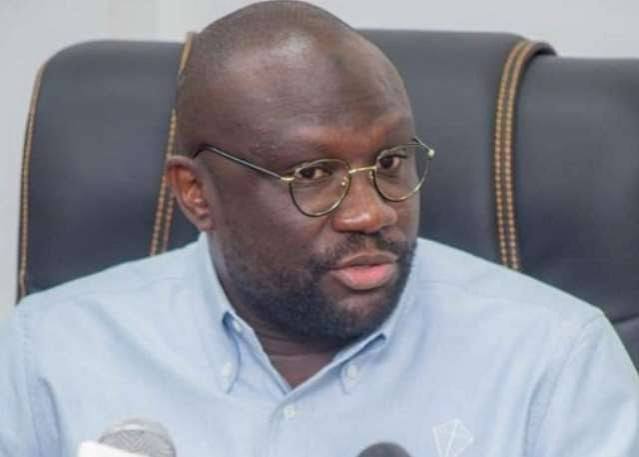

The legal battle surrounding former Chief Executive Officer of the National Food Buffer Stock Company (NAFCO), Hanan Abdul Wahab, has entered a new phase after his lawyers formally demanded the immediate release of his personal belongings seized during his arrest and subsequent detention by the Economic and Organised Crime Office (EOCO).
The legal team, led by former Attorney General Godfred Yeboah Dame, has accused EOCO of unlawfully retaining Mr Abdul Wahab’s personal property, including cash, mobile phones and passport, warning that they may pursue further legal action if the items are not returned without delay.

The demand has introduced another layer of controversy into a case that has already attracted significant public attention following the former NAFCO Chief Executive’s rearrest after the Attorney General withdrew earlier charges against him and other accused persons, citing the discovery of new evidence.

In a formal letter dated July 9, 2026, and addressed to the Attorney General and EOCO, the lawyers argued that the continued possession of their client’s belongings lacked lawful justification and amounted to an infringement of his rights.

The legal representatives stated that their client’s property was taken during his arrest at the Accra International Airport on July 4, 2026, when he was preparing to travel to the United Kingdom for what they described as a scheduled medical appointment.
Following the arrest, Mr Abdul Wahab was detained by the Bureau of National Intelligence and later by EOCO before he was released on the night of July 8 without any bail conditions.

According to his lawyers, Mr Abdul Wahab was carrying two mobile phones and three envelopes containing borrowed money intended solely to support his travel arrangements and medical expenses.
The legal team indicated that the envelopes contained £5,000, £1,700 and GH¢12,750 respectively, insisting that the funds had no connection to any alleged financial wrongdoing or accounts that may have been frozen as part of investigations.

The lawyers explained that although Mr Abdul Wahab was instructed to report to EOCO on July 9 to collect his personal items, he was only given an empty purse, a wristwatch and his boarding pass.

They alleged that the investigating officer informed their client that approval had not been granted for the release of the seized cash and the two mobile phones.
In their letter, the lawyers expressed concern over what they described as the unlawful continued retention of their client’s property and demanded immediate action from EOCO.
“We note, with serious concern, that EOCO continues to unlawfully retain the properties belonging to our client. We hereby demand the immediate release of the two mobile phones and the money seized from our client together with all other items unlawfully held in your custody,” the lawyers stated.
They further requested a complete explanation of any information or data that may have been accessed from Mr Abdul Wahab’s mobile devices while they remained in EOCO’s possession.
The legal team also raised concerns over what they described as an unauthorised examination of data contained on their client’s phones, alleging that the devices were accessed on July 6 and July 7 while he was in custody.
According to the lawyers, such actions amounted to a serious breach of their client’s constitutional right to privacy guaranteed under Article 18(2) of Ghana’s 1992 Constitution, which protects individuals against unreasonable interference with their privacy, property and communication.
The legal representatives further challenged EOCO’s continued possession of Mr Abdul Wahab’s passport, arguing that the action violated a previous High Court directive.
They pointed to a High Court order issued on June 29, 2026, which permitted Mr Abdul Wahab to travel outside Ghana and directed that his passport should be returned to the court registrar upon his return.
The lawyers argued that keeping the passport without a fresh court order was unlawful and inconsistent with constitutional protections relating to freedom of movement under Article 21(4) of the Constitution.
The dispute over the seized items comes amid wider legal proceedings involving Mr Abdul Wahab, who previously faced charges before the Attorney General discontinued the earlier case following what it described as the emergence of additional evidence.
His subsequent arrest by EOCO has since generated legal and political interest, particularly regarding the balance between investigative powers of state agencies and the protection of constitutional rights of persons under investigation.
Mr Abdul Wahab’s legal team has maintained that the money seized was legitimate personal property acquired through borrowing for medical and travel purposes and should not be treated as proceeds connected to any alleged offence.
The lawyers have therefore demanded the immediate return of the cash, mobile phones, passport and all other belongings, alongside a detailed account of any data allegedly accessed from the devices.
They concluded their demand by cautioning that failure by EOCO to comply could force them to seek judicial intervention.
“We hope we will not be compelled to resort to unnecessary litigation,” the lawyers stated.
The matter now places renewed attention on the conduct of economic crime investigations in Ghana, particularly questions surrounding asset seizure, digital privacy, constitutional safeguards and the responsibilities of state investigative bodies when handling personal property belonging to individuals under investigation.
As the legal dispute develops, the actions of EOCO and the response from Mr Abdul Wahab’s legal team are expected to remain under close public and judicial scrutiny.

