
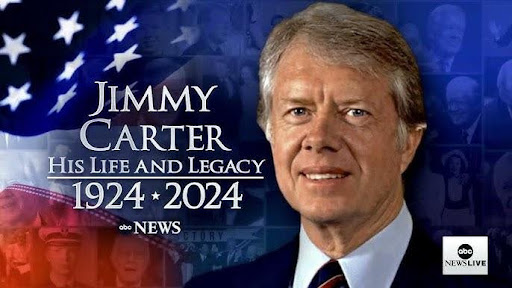

Jimmy Carter, who has died at the age of 100, swept to power promising never to lie to the American people.
In the turbulent aftermath of Watergate, the former peanut farmer from Georgia pardoned Vietnam draft evaders and became the first US leader to take climate change seriously.

On the international stage, he helped to broker an historic peace agreement between Egypt and Israel, but he struggled to deal with the Iran hostage crisis and the Soviet invasion of Afghanistan.

After a single term in office, he was swept aside by Republican Ronald Reagan in the 1980 election, winning just six states.

Having left the White House, Carter did much to restore his reputation: becoming a tireless worker for peace, the environment and human rights, for which he was recognised with a Nobel Peace Prize.
The longest-lived president in US history, he celebrated his 100th birthday in October 2024. He had been treated for cancer and had spent the last 19 months in hospice care.

James Earl Carter Jr was born on 1 October 1924 in the small town of Plains, Georgia, the eldest of four children.
His segregationist father had started the family peanut business, and his mother, Lillian, was a registered nurse.

Carter’s experience of the Great Depression and staunch Baptist faith underpinned his political philosophy.

A star basketball player in high school, he went on to spend seven years in the US Navy – during which time he married Rosalynn, a friend of his sister – and became a submarine officer. But on the death of his father in 1953, he returned to run the ailing family farm.
The first year’s crop failed through drought, but Carter turned the business around and made himself wealthy in the process.
He entered politics on the ground floor, elected to a series of local school and library boards, before running for the Georgia Senate.
Civil rights campaigner
American politics was ablaze following the Supreme Court’s decision to desegregate schools.
With his background as a farmer from a southern state, Carter might have been expected to oppose reform – but he had different views to his father.
While serving two terms in the state Senate, he avoided clashes with segregationists – including many in the Democratic party.
But on becoming Georgia governor in 1970, he became more overt in his support of civil rights.
“I say to you quite frankly,” he declared in his inaugural speech, “that the time for racial discrimination is over.”
He placed pictures of Martin Luther King on the walls of the capitol building, as the Ku Klux Klan demonstrated outside.
He made sure that African Americans were appointed to public offices.
However, he found it difficult balancing his strong Christian faith with his liberal instincts when it came to abortion law.
Although he supported the rights of women to terminate pregnancy, he refused to increase funding to make this possible.
As Carter launched his campaign for the presidency in 1974, the nation was still reeling from the Watergate scandal.
He put himself forward as a simple peanut farmer, untainted by the questionable ethics of professional politicians on Capitol Hill.
‘Adultery in my heart’
His timing was excellent. Americans wanted an outsider and Carter fitted the bill.
There was surprise when he admitted (in an interview with Playboy magazine) that he had “committed adultery in my heart many times”. But there proved to be no skeletons in his closet.
In the beginning, polls suggested he was only supported by around 4% of Democrats.
Yet, just nine months later, he toppled the incumbent president Gerald Ford, a Republican.
On his first full day in office, he pardoned hundreds of thousands of men who had evaded service in Vietnam – either by fleeing abroad or failing to register with their local draft board.
One Republican critic, Senator Barry Goldwater, described the decision as “the most disgraceful thing that a president has ever done”.
Carter confessed that it was the hardest decision he had made in office.
He appointed women to key positions in his administration and encouraged Rosalynn to maintain a national profile as First Lady.
He championed (unsuccessfully) an Equal Rights Amendment to the US Constitution which would have promised legal protection against discrimination on the grounds of sex.
One of the first international leaders to take climate change seriously, Carter wore jeans and sweaters in the White House, and turned down the heating to conserve energy.
He installed solar panels on the roof – which were later taken down by President Ronald Reagan – and passed laws to protect millions of acres of unspoiled land in Alaska from development.
A disastrous rescue mission
His televised “fireside chats'” were consciously relaxed, but this approach seemed too informal as problems mounted.
As the American economy slipped into recession, Carter’s popularity began to fall.
He tried to persuade the country to accept stringent measures to deal with the energy crisis – including gasoline rationing – but faced bitter opposition in Congress.
Plans to introduce a universal healthcare system also foundered in the legislature, while unemployment and interest rates both soared.
His Middle East policy began in triumph, with President Sadat of Egypt and Prime Minister Begin of Israel signing the Camp David accords in 1978.
But success abroad was short-lived.
The revolution in Iran, which led to the taking of American hostages, and the Soviet invasion of Afghanistan were severe tests.
Carter broke off diplomatic relations with Tehran and implemented trade sanctions in a desperate effort to free the Americans.
An attempt to rescue them by force was a disaster, leaving eight American servicemen dead.
The incident almost certainly put an end to any hope of re-election.
Defeat by Reagan
Carter fought off a serious challenge from Senator Edward Kennedy for the 1980 Democratic presidential nomination, and achieved 41% of the popular vote in the subsequent election.
But it was not nearly enough to see off his Republican opponent, Ronald Reagan.
The former actor swept into the White House with an electoral college landslide.
On the last day of his presidency, Carter announced the successful completion of the negotiations for the release of the hostages.
Iran had delayed the time of their departure until after President Reagan was sworn in.
Jimmy and Rosalynn Carter welcoming Nancy and Ronald Reagan to the White House in 1980
On leaving office, Carter had one of the lowest approval ratings of any US president. But in subsequent years, he did much to restore his reputation.
On behalf of the US government, he undertook a peace mission to North Korea which ultimately resulted in the Agreed Framework, an early effort to reach an accord on dismantling its nuclear arsenal.
His library, the Carter Presidential Center, became an influential clearing house of ideas and programmes intended to solve international problems and crises.
In 2002, Carter became the third US president, after Theodore Roosevelt and Woodrow Wilson, to win the Nobel Peace Prize – and the only one to earn it for his post-presidency work.
“The most serious and universal problem,” he said in his Nobel lecture, “is the growing chasm between the richest and the poorest people on earth.”
With Nelson Mandela, he founded The Elders, a group of global leaders who committed themselves to work on peace and human rights.
Modest lifestyle
In retirement, Carter opted for a modest lifestyle.
He eschewed lucrative speaking appearances and seats on corporate boards for a simple life with Rosalynn in Plains, Georgia, where both were born.
Carter did not want to make money from his time in the Oval Office.
“I don’t see anything wrong with it; I don’t blame other people for doing it,” he told the Washington Post. “It just never had been my ambition to be rich.”
He was the only modern president to return full-time to the house he had lived in before he entered politics, a single-floor, two-bedroom home.
According to the Post, the Carters’ home was valued at $167,000 – less than the Secret Service vehicles parked outside to protect them.
In 2015, he announced that he was being treated for cancer, the disease that killed both his parents and three sisters.
Just a few months after surgery for a broken hip, he was back to work as a volunteer builder with Habitat for Humanity.
The former president and his wife began work with the charity in 1984, and helped to repair more than 4,000 homes in the years since.
He continued to teach at a Sunday school at Maranatha Baptist Church in Plains, sometimes welcoming Democratic presidential hopefuls to his class.
In November 2023, Rosalynn Carter died. In tribute, the former president said that his wife of 77 years was “my equal partner in everything I ever accomplished”.
Celebrating his centenary a year later, Carter proved that he still had political antennae.
“I’m only trying to make it to vote for Kamala Harris” in November’s election, he said.
He did manage to cast a ballot for her, although his home state of Georgia ultimately voted for Donald Trump.
Carter’s political philosophy contained the sometimes conflicting elements of a conservative small-town upbringing, and his natural liberal instincts.
But what really drove his lifetime of public service were his deeply held religious beliefs.
“You cannot divorce religious belief and public service,” he said.
“I’ve never detected any conflict between God’s will and my political duty. If you violate one, you violate the other.”
Ghana’s president faces tough start as economic crisis drives people to leave
By Melissa Chemam with RFI
Ghana’s president-elect John Mahama, due to be inaugurated on 7 January, will have his work cut out, as the country suffers its worst economic crisis in a generation and a study finds more than 60 percent of Ghanaians want to emigrate.
Mahama has been Ghana’s main opposition figure for several years, having previously served as president from July 2012 to January 2017. He failed in his bid to be re-elected in 2016’s elections, and then again in 2020.
But while his party and supporters are rejoicing his win in December, the challenges he is facing are considerable – with rising poverty and a new study finding six out of 10 Ghanaians wish to emigrate, chiefly in search of better job opportunities.
Economic and energy challenges
Ghana is in the midst of an economic crisis. The country remains the world’s number two cocoa producer, but there is turmoil in the industry as well as in gold.
“The economic situation is dire, and I’m going to put my soul, physique and everything into it and focus on making lives better for Ghanaians,” said Mahama, after his National Democratic Congress party’s comfortable win in the election held on 7 December.
He said the “multiplicity of taxes” agreed to as part of the country’s International Monetary Fund (IMF) programme had made Ghana “unpleasant for business”.
He also believes the IMF did not put enough pressure on the previous government to cut wasteful spending, and has promised a review aimed at reducing spending, including by the president’s office.
“If the president is asking us to tighten our belts, he must also tighten his,” he said.
Mahama also promised to find sustainable solutions to Ghana’s energy problems, to avoid the regular power outages the country suffers.
“We’re going to face quite a critical situation in the energy sector,” Mahama said.
“The electricity company of Ghana is the ‘sick man’ of the whole value chain and we need to quickly fix it.”
‘A change of government is not enough’
Ghanaians facing these economic challenges are increasingly looking to emigration as a solution.
The number of people wishing to leave the country has gone up more than 20 percentage points in seven years, according to a new study by Afrobarometer Ghana.
This trend is explained by the country’s growing economic difficulties, said David Kofi Asante-Darko, an analyst at Afrobarometer Ghana and the West Africa Democracy Solidarity Network (WADEMOS).
“Ghana is in default on its debt for the first time,” he told RFI.
“We have had to face a severe debt restructuring programme. This has had negative consequences, not just on the economy but more generally on people’s opportunities.”
This is a significant trend, and according to Asante-Darko the arrival of a new president is unlikely to change things.
Highly educated and young people and the unemployed are the most likely to consider emigration, with North America the most popular destination, followed by Europe.
“These problems are endemic here: corruption, nepotism and, more generally, poor governance. A change of government is therefore not enough. What is needed is a complete revision of our country’s democratic structure, regardless of the political party in power,” Asante-Darko said.
Voter turnout in the 2024 elections was 60 percent, nearly 20 percentage points lower than in the 2020 elections.
Fighting corruption
During his campaign, Mahama said unchecked procurement processes are a major source of corruption in the country. He vowed to make fighting this and reclaiming misappropriated state funds a key pillar of his mandate, and last week appointed an anti-corruption task force.
The five-member group will strive to recover all public funds embezzled in recent years and the proceeds of corruption in the West African country.
These officials will “hold persons responsible for such corruption accountable”, said Felix Kwakye Ofosu, spokesperson for Mahama’s transition team.
The working group is made up of lawmaker Samuel Okudzeto Ablakwa, former Auditor General Daniel Domelevo, retired police chief Nathaniel Kofi Boakye, legal expert Martin Kpebu and investigative journalist Raymond Archer, Mahama’s team said.
Nearly 60 percent of African youth want to emigrate because of corruption
Emmanuel Wilson Junior, a lawyer with the organisation Crusaders Against Corruption, hailed the initiative and urged the incoming administration to act swiftly.
“This is a step in the right direction. Ghanaians are tired of corruption being swept under the carpet. We expect this team to be proactive and ensure real accountability,” Wilson told the AFP news agency.
The announcement comes amid mounting public frustration over corruption scandals under outgoing President Nana Akufo-Addo, including the $190 million Power Distribution Services deal, which critics described as financially questionable.
Several civil society groups and opposition supporters protested outside the finance ministry, accusing the government of “gross financial mismanagement”.
Corruption allegations also plagued Mahama’s previous tenure as president, although no charges were formally filed against him.
(with newswires)
It’s just a curtain-raiser – Stonebwoy shades Shatta Wale’s Vybz Kartel concert spot
Stonebwoy has consolidated his longstanding rivalry with Shatta Wale, delivering a scathing critique of his fellow artist’s upcoming performance at the highly anticipated Freedom Street Concert in Jamaica.
Speaking during an interview on Angel FM with Ike De Unpredictable, the Bhim Nation leader dismissed the significance of Shatta Wale’s involvement, portraying it as a minor achievement.
“I’ve been to Jamaica several times for major concerts,” Stonebwoy asserted. “This isn’t groundbreaking—being a warm-up act doesn’t mean much in the grand scheme of things.”
The Freedom Street Concert, organized in honour of Vybz Kartel, features a star-studded lineup, including international icons like Busta Rhymes, Popcaan, Skillibeng, and Spice.
Shatta Wale, a self-proclaimed disciple of Vybz Kartel, stands out as the only Ghanaian artist invited to the prestigious event.
While many hail Shatta Wale’s inclusion as a win for Ghana’s music scene, Stonebwoy was quick to point out his own contributions to bridging Ghana and Jamaica through music.
“I’ve brought some of the biggest names from Jamaica to Ghana for collaborations and events,” he said. “That’s a testament to my influence and impact in the industry.”
“He’s going to be a curtain raiser for the show, nothing else,” Stonebwoy said bluntly much to the shock of Ike.
Meanwhile, Shatta Wale has yet to respond to Stonebwoy’s comments, leaving room for further debate on the matter.
-MyNewsGH
Former US President Jimmy Carter dies at 100
Former President Jimmy Carter, a peanut farmer and Georgia state governor before becoming president, has died at the age of 100.
When Carter took the oath of office as president of the United States on January 20, 1977, he promised a “government as good as its people.”
He presided over four turbulent years. Rising inflation and growing unemployment marred the domestic priorities of his administration. He scored victories in foreign policy with a peace agreement between Egypt and Israel and the Panama Canal treaty. However, a hostage crisis in Iran dominated his final years in the White House and contributed to his defeat in the 1980 general election.
But Carter liked to say the end of his presidency in 1981 was the beginning of a new life, traveling the world “fighting disease, building hope, and waging peace.”
“It has turned out to open up for me and my wife, Rosalynn, a new arena of excitement and unpredictability and adventure and challenge and gratification,” he told VOA.
As the head of the Carter Center, the Carters traveled to more than 80 countries monitoring troubled elections, mediating disputes, and fighting diseases. This active post-White House life eventually led to the Nobel Peace Prize in 2002.
“I look upon the Carter Center work as an extension of what I tried to do as president. You know, we brought peace between Israel and Egypt. We opened up a humongous relationship with Latin America with the Panama Canal treaty,” he said. “So what I have done since then has been kind of an extension. But I do not think there is any doubt that when I won the Nobel Peace Prize, for instance, it was because of the work of the Carter Center. So, I would be perfectly satisfied to have a legacy based on peace and human rights. I mean, who would not?”
Carter’s journey to the White House began in the small town of Plains, Georgia, where he was born October 1, 1924.
After serving as an officer in the U.S. Navy, where he helped develop the post-World War II nuclear submarine fleet, Carter returned to his hometown in 1953 to run the family peanut-farming business.
He entered politics in the 1960s, serving two terms as a Georgia legislator before becoming the state’s 76th governor from 1971 to 1975.
In the 1976 presidential election, Carter, a Democrat, ran against Republican incumbent Gerald Ford, who assumed the presidency after Richard Nixon resigned in the wake of the Watergate scandal. Carter narrowly defeated Ford to become president.
The high point of Carter’s presidency came in 1978. Carter brought Egyptian President Anwar Sadat and Israeli Prime Minister Menachem Begin to the Camp David presidential retreat in rural Maryland to negotiate a peace treaty.
“When I became president, there had been four wars between Arabs and Israelis in the previous 25 years, with the Egyptians in the leadership supported by the Soviet Union,” he said. “They were the only country that could really challenge Israel militarily. And we had success in getting a treaty between Israel and Egypt … not a word of which has ever been violated.”
Carter also negotiated a treaty turning control of the Panama Canal over to the Panamanian government and normalized diplomatic relations with the People’s Republic of China.
But in 1979 the primary focus for Carter’s administration turned to Iran, where a revolution led by religious clerics toppled the government of the U.S. backed shah, who eventually fled to the United States, where he received treatment for cancer.
On November 4, 1979, militants angry with the U.S. for harboring the deposed shah, stormed the U.S. Embassy in Tehran, taking 66 Americans hostage, 13 were released weeks later.
Five months into the crisis, in April 1980, Carter authorized a complex military operation to free the remaining hostages. Dubbed Operation Eagle Claw, the plan called for several helicopters and military aircraft to stage at a site in the Iranian desert. Carter, who approved the plan, explained to VOA that the helicopters carrying members of the U.S. military’s elite Delta Force, were to fly from there to the U.S. embassy in Tehran, free the hostages and return to the waiting aircraft that would fly them out of Iran.
“The minimum number of helicopters required would be six very large helicopters. So I decided to send eight. One of the helicopters, in an inexplicable way, turned around and went back to the aircraft carrier. Another one went down in a sandstorm in the Iranian desert. The third one developed a hydraulic leak and ran into one of the C-130 airplanes,” he said.
The aborted mission ended in failure. Eight U.S. military members and one Iranian civilian died as a result of the crash. Walter Mondale, Carter’s vice president, told VOA that day was the lowest point of their administration.
“When that rescue mission failed and lives were lost. I mean, that was just … we were just morose that day and for some time after that,” Mondale said. Secretary of State Cyrus Vance resigned in protest of the operation.
The failure of the mission damaged Carter’s credibility with the American public. The incident occurred seven months before the 1980 presidential election and contributed to Carter’s defeat to challenger Ronald Reagan.
“The exact anniversary of the hostages being taken was Election Day,” Carter said. “Of course, the news media were completely obsessed with the anniversary of the hostages being taken and the fact that I had not been able to get them out. That was the number one issue that caused me to fail.”
The hostages were freed the day Reagan became president.
In 1981, Carter returned to Plains, unsure about the direction of his post-presidential life. His plans for a library and museum were initially modest.
“I envisioned it to be a tiny thing, where I would have an office and some nice buildings in Atlanta. And that anyone in the world that had an ongoing conflict or potential conflict could come to me and I would help them mediate the dispute and stop a war,” he said.
The Carter Center, under his direction, monitored more then 80 troubled elections and mediated disputes ranging from a nuclear standoff with North Korea in 1994, to a peace agreement between Uganda and Sudan in 1999. The center is also a leader in promoting health and fighting disease in the poorest parts of the planet.
In one of many interviews with Voice of America, Carter reflected on his life in and out of the White House. He said the greatest part of his legacy wasn’t his accomplishments as president or the Nobel Peace Prize, but the eradication of Guinea worm disease.
“There’s only been one disease in the history of humankind, ever eradicated, and that was smallpox,” he said, “So Guinea worm is going to soon be the second disease in history, to be wiped off the face of the earth.”
Thanks to Carter’s efforts, there were only 13 cases of Guinea worm recorded in 2022.
Carter led an active life until the age of 99, surviving brain cancer in 2015.
Declining health and the 2020 global coronavirus pandemic kept him confined to his hometown of Plains in his final years.
Jimmy Carter last appeared in public during funeral services for his wife, Rosalynn, in November 2023.
In one of his last public media appearances, Carter shared with VOA his hopes for the Carter Center’s future.
“I would like to see the United States in the future strive to be the number one champion in the world of peace and human rights and environmental quality, and I would say treating everyone equal,” he said. “If we could do that, we would have a real superpower in the country I love very much.”
Jimmy Carter lived the longest of any occupant of the White House, and his 76-year marriage to wife Rosalynn is the longest of any president and first lady.
Though his final resting place will be on the grounds of his home in Plains, Georgia, the work and the words of Carter live on in the pages of the dozens of books he authored throughout his life. It includes his memoirs, a fiction novel, controversial examinations of the Middle East, and a collection of his favorite poems.
—VOA

