
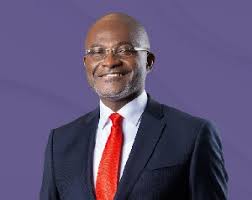
The presidential campaign of Honourable Kennedy Agyapong has sprung from the fringes
into the mainstream, making him a serious contender and catching many people off guard. What suddenly changed? And what comes next? Varied opinions, perspectives,
and personalities have sought to either demystify his rising popularity or attack his
qualifications to become President of the republic. They have made assertions that his low
frustration tolerance, impulsive temperament, vulgar utterances, arrogance, and
contemptuous disregard for those who disagree with him make him distinctly unsuitable
for the highest office of the land.
Notwithstanding these varying opinions, one thing is clear: in moments of crisis,
opportunistic and populist leaders bully the silent majority into submission and use fear,
intimidation, and manipulation to occupy the political space. Examples abound in the
wake of the disastrous legacies of Jacob Zuma of South Africa and Jair Bolsonaro of Brazil.
Certainly, the global economic crisis unleashed by the Covid-19 pandemic has presented
populist politicians such as Honourable Kennedy Agyapong with the opportunity to
project themselves as Messiahs. However, as was the case in Jacob Zuma’s South Africa,
while populist politicians are often crafty at using their narcissistic impulses to connect
with the discontented masses for their self-aggrandizement, their inherent flaws
become readily apparent once they assume office and leave behind a legacy of shattered
economies and weakened democratic institutions. Today, thanks to the populism of Jacob
Zuman and his henchmen, South Africa, which has the most sophisticated and advanced
economy on the entire African continent, is in a state of unprecedented decline.
The legacy of Jacob Zuma’s reckless rhetoric includes the formation of the Economic
Freedom Fighters (EFF) whose proclivity to violence, disruption and sabotage is
unparalleled in the history of democratic South Africa. The South African experience
could be replicated in Ghana if Honourable Kennedy Agyapong’s rhetoric prevails
because history does not only give us the tools to analyze and explain problems in the
past, it provides us with a crucial perspective for understanding current and future problems.
The purpose of this article is to call out Honourable Kennedy Agyapong’s populist
impulses as potential fodder for both anarchism and fascism in Ghana. Words are potent
forces for all causes, good or bad. And as Dorothy Neville eloquently said, the “real art of
conversation is not only to say the right thing at the right place but to leave unsaid the
wrong thing at the tempting moment.” If Honourable Kennedy Agyapong’s bombastic
rhetoric prevails, like Jacob Zuma, he can incite a crusade that can quickly morph into an
intolerant and anti-state movement, which will ultimately undermine our pluralistic state
and stability.
Honourable Kennedy Agyapong is an unusual politician: he is both a successful
businessman and a vociferous lawmaker. In business, he has leveraged his shrewdness
and access to power to build a successful empire. For example, he was an influential
member of former president Kufour’s government. He is the current Board Chair of
Ghana Gas, a position he occupies from President Akuffo Addo’s appointment.
Notwithstanding his access to power, influence, and resources, he projects himself as
a nonconformist, a maverick and not part of the elite. He also portrays himself as a
pragmatic politician who has the requisite courage to uproot corruption, fix our broken
systems and turn the economy around. In so doing, Honourable Kennedy Agyapong has
set out to occupy the crowded space of would-be Messiahs who believe they can rescue
Ghana from the global economic crisis and finally deliver the democratic promise of
providing prosperity for all.
Unsurprisingly, Honourable Kennedy Agyapong’s prescriptions for turning the economy
around and eradicating corruption are so vague that everyone seems to agree with him,
yet nobody knows how he will get them done or even get parliament to ratify them.
Nonetheless, when challenged, he uses the populist playbook of deflecting accountability
by attacking his critics and casting them as enemies of the people. Drawing from the
playbook of Jacob Zuma, Robert Mugabe, and Hugo Chavez, he sees politics as a war
between good and evil. Hence, his penchant to demonize his rivals.
Interestingly, it is his unorthodox politics that is appealing to people who are deeply
dissatisfied with the status quo and with rising poverty. These people are yearning for
radical change because state institutions have either lost their legitimacy or public
confidence in their ability to deliver good governance. He has therefore tapped into the
rising discontent to demand allegiance to his all-powerful, enigmatic personality. He
stokes the enthusiasm of his followers by identifying with their cause and inciting
suspicion of those who question his rhetoric.
The inherent danger in his populism is that even if he can change the status quo and weed
out corruption as he has promised, which of course is unlikely, his “us” versus “them”
the approach will always carry the seeds of intolerance, hate, division, and authoritarianism,
which will ultimately set the grounds for anarchism and fascism.
Throughout history, anarchist, demagogues, fascists, and their henchmen who claimed
privileged knowledge and skills to solve society’s problems have ended up crushing the
very people, they claim to represent. When populists portray their opponents as inferior,
idiotic and incompetent, it is only a matter of time before they trample on their rights and
anyone who disagrees with their agenda — thereby undermining pluralism and the rule of
law.
The current discontent in the country is not unique to Ghana but stems from the apparent
failure of democracies to close the disparity between the rich and the poor. The situation
has been compounded by the impact of the Covid-19 pandemic. As a result, democracy,
which as a social contract derives its legitimacy from the promise of improving the lives
of all the people, is failing to deliver. Thus, even in even advanced democracies such as
the United States, Italy, Sweden, etc., populist mobilization has undermined democracy
and pluralism.
Honourable Kennedy Agyapong’s populism is gaining ground because he promises
renewal and a shift in focus from meeting the needs of the powerful elite to representing
the people. However, given his narcissistic personality traits, and inability to respond to
constructive criticism, he may choose to ignore key customary practices of good
governance such as proper consultation and respect for the independence of institutions once
in power, which will ultimately undermine democracy and rule of law.
Win or lose, Honourable Kennedy Agyapong has taken populism to new heights in
Ghana. And if democratic governments appear unresponsive to public opinion and
demands, then, just like in the United States, populism in Ghana is likely to become
entrenched. The country may enter a dark era of serial populism, fostering an
environment for anarchy and fascism.
Written by Kwame Attakora Abrefah, Esquire.

Honourable Kennedy Agyapong’s bombastic rhetoric and rising populism: Why must it matter at all?
- Advertisement -
- Advertisement -
www.ghanareaders.com
- Advertisement -

