
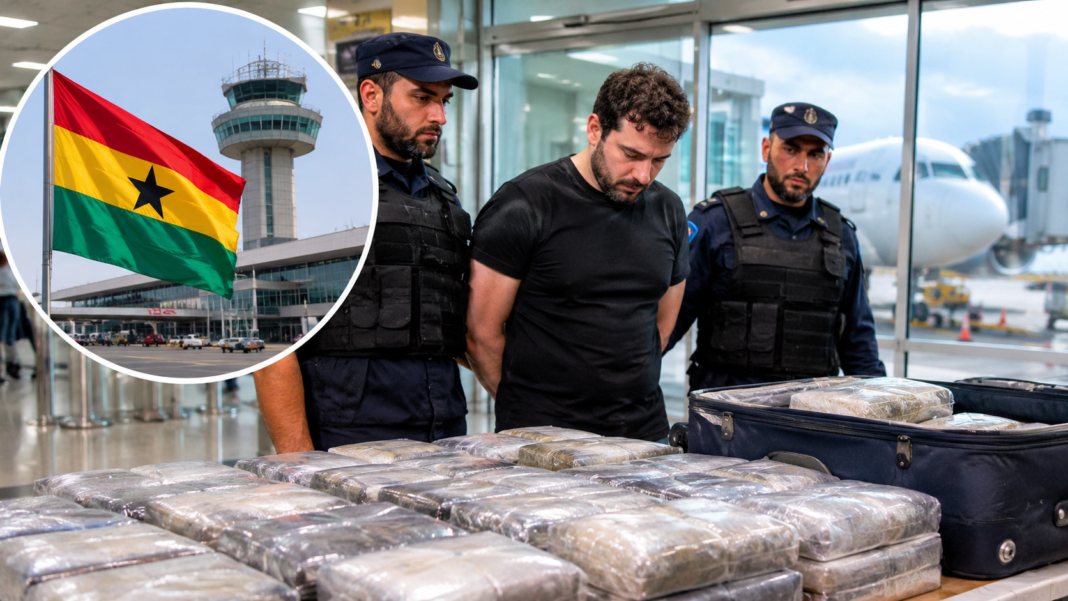

The Narcotics Control Commission (NACOC) has defended its decision to allow a Syrian national suspected of trafficking approximately 40 kilogrammes of cocaine from Ghana to travel to Lebanon, explaining that the suspect was under surveillance as part of a coordinated intelligence operation intended to dismantle a wider international drug trafficking network.
The Commission says the decision formed part of an investigative strategy known as controlled delivery, a law enforcement technique that enables authorities to monitor the movement of suspected illicit consignments across international borders in order to identify, trace and apprehend other individuals connected to organised trafficking operations.

NACOC’s Head of Public Relations, Francis Amoah, explained that the operation was not limited to securing the arrest of the individual transporting the suspected narcotics but was designed to expose the wider network allegedly facilitating the movement of cocaine between countries.

His explanation follows the arrest of the Syrian national at Rafic Hariri International Airport in Beirut, Lebanon, on Saturday, October 31, 2026, after he arrived from Accra with approximately 40 kilogrammes of suspected cocaine concealed in two pieces of luggage.

The arrest has generated questions about how the suspect was able to depart Ghana through Kotoka International Airport with such a substantial quantity of suspected narcotics, particularly given the responsibility of national security and border control agencies to prevent prohibited substances from leaving the country.
Addressing these concerns, Mr Amoah said NACOC had maintained surveillance on the suspect throughout his stay in Ghana and possessed information about his movements, including his arrival in the country, hotel accommodation and eventual departure.

He acknowledged that the suspect’s passage through Kotoka International Airport could raise questions about the effectiveness of Ghana’s drug detection and border security arrangements but maintained that the decision was connected to the broader objectives of the investigation.
According to him, international drug trafficking is a complex transnational criminal enterprise that cannot effectively be dismantled through isolated operations conducted by individual countries without intelligence sharing and cooperation between enforcement agencies.

He explained that allowing the suspected consignment to proceed to another jurisdiction could enable investigators to identify additional participants who might otherwise remain beyond the reach of an operation focused exclusively on the person transporting the drugs.

Mr Amoah said the strategy was intended to ensure that the investigation extended beyond the immediate suspect to individuals and organised groups allegedly involved in financing, coordinating, supplying and receiving illicit drug consignments.
“One thing that we do as far as our work is concerned is what we call the controlled delivery. Controlled delivery is where you know about the person, what the person is carrying, but you want the person to go to the other side because when the person gets to the other side, the person, not him alone but the network associated with him, will be arrested,” he explained.
He further stressed that international cooperation was indispensable in confronting organised narcotics trafficking, particularly because the intelligence, resources and operational capabilities required to dismantle such networks were distributed across different jurisdictions.
“It is a transnational organised crime, and one country does not have all the requisite logistics to be able to fight and fight it well,” he said.
NACOC Reveals Why It Allowed Syrian Suspect Carrying 46.7kg Cocaine to Leave Ghana for Lebanon
The Narcotics Control Commission (NACOC) has defended its decision to monitor rather than immediately arrest a Syrian national suspected of transporting a substantial consignment of cocaine from Ghana to Lebanon, explaining that the operation was deliberately structured to expose a wider international drug trafficking network and identify individuals allegedly operating at different stages of the illicit supply chain.
The Commission says the suspect was under surveillance while in Ghana and that his departure through Kotoka International Airport formed part of a coordinated cross border operation involving Lebanese drug enforcement authorities. The strategy, known as controlled delivery, allows law enforcement agencies to monitor the movement of suspected illegal consignments across national boundaries in an effort to identify, track and apprehend other individuals connected to organised criminal operations.
The explanation follows the arrest of the Syrian national at Rafic Hariri International Airport in Beirut on Saturday, October 31, 2026, after he arrived from Accra with suspected cocaine concealed in two pieces of luggage.
Although NACOC initially described the consignment as approximately 40 kilogrammes, information subsequently released by Lebanese authorities put the seized quantity at 46.7 kilogrammes, indicating that the shipment was considerably larger than the initial Ghanaian estimate.
The arrest has raised questions about Ghana’s airport security arrangements, the movement of substantial quantities of narcotics through the country’s international aviation system and the extent to which domestic enforcement agencies are collaborating with their counterparts abroad to dismantle international trafficking organisations.
Addressing the controversy, NACOC’s Head of Public Relations, Francis Amoah, said the Commission had monitored the suspect throughout his stay in Ghana and possessed intelligence concerning his movements, including his arrival in the country, accommodation and eventual departure.
He acknowledged that allowing the individual to travel through Kotoka International Airport could generate public concern but explained that the operation was not designed merely to apprehend the person physically carrying the suspected drugs.
According to him, the objective was to follow the consignment to its intended destination and create an opportunity to identify and arrest other individuals associated with the trafficking operation.
Mr Amoah stressed that international narcotics trafficking was a transnational organised crime that required cooperation among different countries because no single jurisdiction possessed all the intelligence, resources and operational capabilities necessary to dismantle such networks independently.
He explained that controlled delivery was particularly useful in circumstances where authorities had intelligence about a suspected shipment but wanted to establish the identities of individuals responsible for receiving, financing or coordinating its movement.
“One thing that we do as far as our work is concerned is what we call the controlled delivery. Controlled delivery is where you know about the person, what the person is carrying, but you want the person to go to the other side because when the person gets to the other side, the person, not him alone but the network associated with him, will be arrested,” he explained.
The NACOC official maintained that the decision to allow the suspect to proceed was therefore connected to the broader intelligence gathering objectives of the operation rather than an absence of knowledge about the suspected consignment.
He added that international cooperation was indispensable in confronting organised drug trafficking because criminal networks frequently operate across several countries, making intelligence sharing and coordinated enforcement essential.
“It is a transnational organised crime, and one country does not have all the requisite logistics to be able to fight and fight it well,” he said.
The operation has a specific legal foundation under Ghana’s Narcotics Control Commission Act, 2020 (Act 1019). Section 113 of the Act expressly defines controlled delivery as the practice of permitting suspected or illicit narcotics consignments to pass out of, through or into Ghana, or move from one location to another, with the knowledge and under the supervision of competent authorities, for the purpose of identifying individuals involved in narcotics offences.
This provision is particularly important because it establishes that controlled delivery is not simply an informal intelligence gathering arrangement or an improvised enforcement tactic. It is a recognised investigative mechanism expressly incorporated into Ghana’s domestic narcotics legislation.
The approach is also recognised internationally under Article 11 of the United Nations Convention Against Illicit Traffic in Narcotic Drugs and Psychotropic Substances, 1988. The Convention encourages participating countries to facilitate controlled deliveries through mutually agreed arrangements, where their domestic legal systems permit, to identify and bring to justice individuals involved in international drug trafficking.
Article 11 further provides that such decisions should be made on a case by case basis and with the consent of the countries concerned. Suspected consignments may be intercepted and allowed to continue with the narcotics intact, or with the substances removed or replaced, depending on the arrangements agreed between the participating authorities.
The legal framework therefore provides important context for NACOC’s explanation that the suspect’s journey from Accra to Beirut was part of a coordinated investigation rather than an ordinary failure to intercept a suspected drug shipment.
GhaLII+1
However, information subsequently emerging from Lebanon has provided additional details about the operation and the circumstances surrounding the seizure.
According to a report by Graphic Online citing the Lebanese General Directorate of Customs, the suspect, identified only by his initials B.H., had entered Lebanon from Syria through the Masnaa border crossing several weeks before the arrest.
Preliminary investigations reportedly indicated that he subsequently travelled to Accra to collect the cocaine shipment before returning to Beirut aboard Middle East Airlines flight MEA 576.
Lebanese authorities said the consignment consisted of 40 separate packages containing a combined 46.7 kilogrammes of cocaine. The drugs were allegedly concealed using sophisticated packaging and insulation materials designed to frustrate detection by airport scanning equipment.
Electronic tracking devices were also reportedly discovered inside the packages, suggesting a degree of organisation and preparation behind the shipment.
The Lebanese Customs Directorate described the seizure as the largest drug interception in the history of Rafic Hariri International Airport.
Its account further indicated that customs officials, acting on intelligence and following surveillance, coordinated with Lebanese General Security personnel to search the passenger’s luggage after his arrival.
The drugs and other items recovered were confiscated, while investigations continued under the supervision of the competent judicial authorities to establish the intended recipient, identify the individuals responsible for dispatching the consignment and trace other participants in the operation.
Graphic Online+1
The difference between the quantities reported by the two countries is also noteworthy. NACOC initially announced that approximately 40 kilogrammes of suspected cocaine had been intercepted, while the Lebanese authorities subsequently reported a measured seizure of 46.7 kilogrammes. The discrepancy has not been formally explained in the available statements, although both accounts concern the same arrest and shipment.
Meanwhile, NACOC has indicated that its investigation is not limited to the Syrian national arrested in Beirut. The Commission says it is working to identify and apprehend suspected accomplices operating in Ghana, with the intention of exposing the individuals responsible for different stages of the trafficking operation.
This is particularly significant because international drug trafficking networks rarely depend exclusively on the individual physically transporting the narcotics. Their operations may involve financiers, suppliers, intermediaries, storage operators, airport facilitators, couriers and intended recipients operating across different jurisdictions.
The arrest of a courier, therefore, does not necessarily establish that the entire trafficking organisation has been dismantled. Investigators must also establish the identities and respective responsibilities of other participants, trace the financial arrangements supporting the shipment and determine whether similar consignments have moved through the same channels.
The Lebanese investigation and NACOC’s stated efforts to apprehend accomplices in Ghana will therefore be important in determining the full extent of the alleged criminal enterprise.
Nevertheless, the decision to permit a suspected narcotics consignment to leave Ghana also raises legitimate questions about operational accountability, airport security and the safeguards governing controlled delivery exercises.
Although the legal framework recognises the technique, its use requires proper authorisation, effective supervision and coordination between the participating jurisdictions. The objective must be to strengthen investigations and facilitate the prosecution of wider criminal networks without compromising public safety or allowing illicit consignments to circulate without adequate controls.
NACOC has explained the strategic reasoning behind the operation, but further public information about the specific authorisations, surveillance arrangements and safeguards employed would help clarify how the exercise was conducted.
There are also broader implications for Ghana’s reputation as an international aviation and commercial transit destination. The movement of a consignment of this magnitude through Kotoka International Airport, even within a controlled delivery operation, reinforces the importance of maintaining effective intelligence systems, passenger screening arrangements and cooperation among the Narcotics Control Commission, Customs Division of the Ghana Revenue Authority, airport security authorities and international enforcement partners.
For Ghana, the ultimate measure of the operation’s success will not simply be the arrest made in Beirut but whether the intelligence gathered leads to the identification and prosecution of the individuals who allegedly organised, financed and facilitated the shipment.
As investigations continue in both countries, NACOC’s pursuit of suspected accomplices in Ghana will be central to determining whether the operation has succeeded in exposing a wider international trafficking network rather than merely intercepting one courier.
The case has consequently placed the spotlight on the increasingly sophisticated methods employed by international narcotics organisations and the growing importance of cross border intelligence sharing in confronting criminal enterprises that operate beyond the boundaries of individual countries.
The central issue now is whether the arrest in Lebanon will lead investigators to the wider network allegedly responsible for moving nearly 47 kilogrammes of cocaine through Ghana.

