
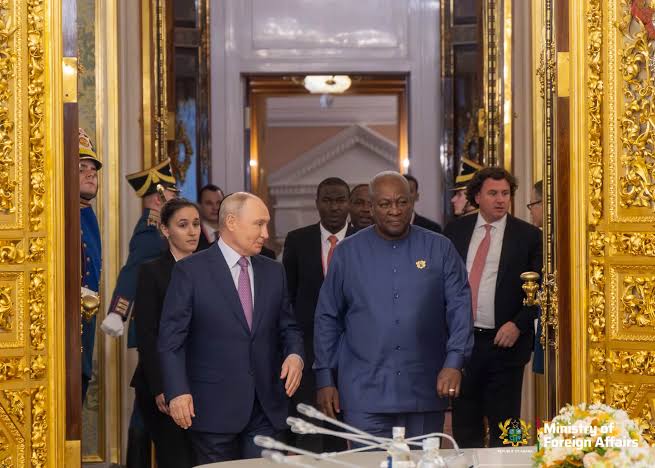

President John Dramani Mahama has obtained six major commitments from Russian President Vladimir Putin aimed at expanding bilateral cooperation between Ghana and Russia across critical sectors, including energy, defence, agriculture, education and national security.
The agreements emerged from bilateral discussions held on the sidelines of the Third Russia Africa Summit in Moscow, with Foreign Affairs Minister Samuel Okudzeto Ablakwa subsequently outlining the principal outcomes of the engagement.

According to a statement issued by Mr Ablakwa, Russia has agreed to collaborate with Ghana towards the establishment of a 2,000 megawatt nuclear power plant as part of efforts to strengthen the country’s energy security, increase electricity generation capacity and support its broader industrialisation agenda.

The proposed nuclear energy initiative is expected to revive Ghana’s longstanding aspiration to incorporate nuclear power into its national electricity generation framework, a vision historically associated with the country’s first President, Dr Kwame Nkrumah.

The Nkrumah administration had initiated preliminary preparations towards establishing a nuclear research facility as part of its scientific and technological advancement ambitions before the February 1966 military coup interrupted the programme.
In another significant outcome of the negotiations, President Mahama is reported to have secured a renewed defence cooperation arrangement intended to facilitate Ghana’s acquisition of strategic military equipment and strengthen the operational capabilities of the Ghana Armed Forces.

The proposed partnership is expected to provide an avenue for enhanced military collaboration between the two countries, particularly in strengthening Ghana’s defence preparedness and addressing emerging security challenges.
Agriculture also featured prominently in the discussions, with both governments agreeing to deepen cooperation aimed at expanding grain production and improving Ghana’s access to fertilisers.

The agricultural partnership is intended to strengthen domestic food production, improve farming productivity and support national efforts to achieve greater food security while reducing vulnerabilities associated with supply disruptions.

In the education sector, Russia has reportedly agreed to expand scholarship opportunities available to Ghanaian students seeking to pursue academic programmes at Russian institutions.
The Foreign Affairs Minister indicated that Ghana currently ranks second among African countries in terms of the number of students studying in Russia, underscoring the existing educational relationship between the two nations.
Another important issue addressed during the bilateral engagement concerned reports of Ghanaians participating in the ongoing Russia Ukraine conflict.
According to Mr Ablakwa’s account of the discussions, President Mahama raised concerns about the involvement of Ghanaian nationals in the war, following which President Putin reportedly assured him that Ghanaians would no longer be permitted to participate in the conflict, whether through unofficial recruitment arrangements or voluntary enlistment.
The reported assurance is intended to address concerns surrounding the recruitment and involvement of Ghanaian citizens in a foreign military conflict and forms part of the wider security discussions between the two presidents.
Additionally, Ghana and Russia have agreed to reactivate the Permanent Joint Commission for Cooperation (PJCC), an established bilateral mechanism designed to coordinate diplomatic engagements and advance collaborative initiatives across different sectors.
Russia is expected to host the next meeting of the commission in the coming weeks, providing an institutional platform for both countries to discuss implementation arrangements and identify further opportunities for cooperation.
Ghana and Russia have maintained formal diplomatic relations since 1958, with successive administrations on both sides pursuing diplomatic, economic, educational and technical partnerships over the decades.
The latest discussions in Moscow represent another effort to strengthen the longstanding relationship, broaden areas of mutual interest and establish new avenues for strategic and economic collaboration.
The six commitments, as outlined by Ghana’s Foreign Affairs Minister, cover nuclear energy development, defence cooperation, agricultural productivity, educational scholarships, restrictions on Ghanaian participation in the Russia Ukraine war and the reactivation of the Permanent Joint Commission for Cooperation.
Their implementation is expected to determine the extent to which the latest diplomatic engagements translate into concrete projects and lasting benefits for both countries.

