
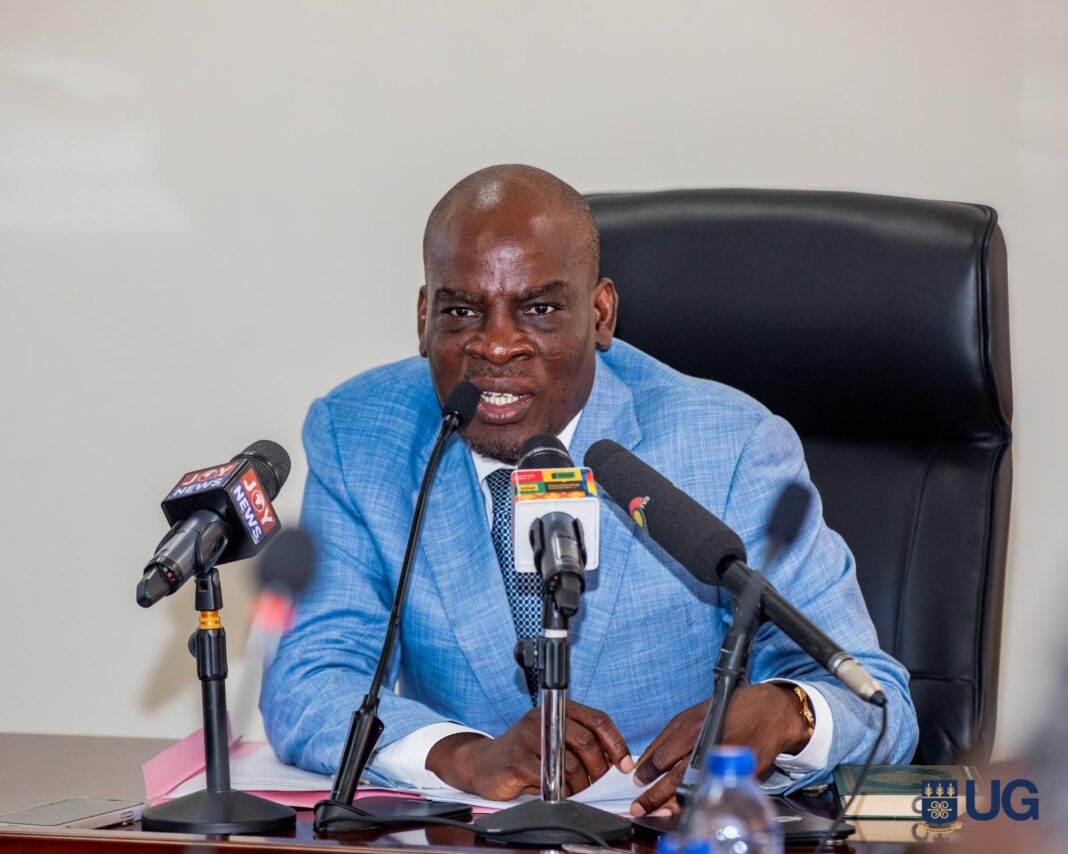

Education Minister Haruna Iddrisu has instructed the Ghana Tertiary Education Commission (GTEC) to engage public universities and ensure they announce their reopening schedules towards the end of the week, as the government steps up efforts to resolve the ongoing strike by the Ghana Association of University Administrators (GAUA).
The Minister expressed confidence that the industrial action could be brought to an end in the coming days, paving the way for the resumption of academic and administrative activities across the country’s public universities.

Mr Iddrisu made the announcement on Monday, October 12, 2026, following discussions with the leadership of GAUA, the Technical University Senior Administrators Association of Ghana (TUSAAG) and GTEC.

The industrial dispute has interrupted administrative services at public universities, compelling the University of Ghana (UG) and the Kwame Nkrumah University of Science and Technology (KNUST) to postpone their previously scheduled reopening dates.

Government Seeks to Prevent Further Disruption to Academic Calendar
Mr Iddrisu said the government was working towards reopening the universities before the end of the week to enable academic activities to resume on Monday. He emphasised that preserving the academic calendar remained a priority and that prolonged industrial action could undermine efforts to maintain a stable university timetable.
“It is my expectation that the universities can reopen towards the weekend and not later than the weekend so that academic work can begin on Monday so that we don’t lose the academic calendar to the strike and its impact,” he said.

The Education Minister described the current academic timetable as the most favourable Ghana had experienced in five years, insisting that the government would take the necessary steps to protect it from further disruption.
“Understandably, we have never come across a good academic calendar like this in the last five years. We will do everything possible to preserve the calendar,” he added.

However, the proposed reopening schedule remains dependent on the outcome of consultations between the associations and their respective members. At the conclusion of Monday’s meeting, no formal announcement had been made confirming the suspension of the strike.

Mr Iddrisu clarified that his involvement in the discussions was intended to facilitate an agreement on behalf of the government rather than conduct direct salary negotiations with the unions.
“As I’ve indicated, the Minister for Education has no mandate for salary negotiations. I’m only facilitating on behalf of government,” he stated.
He acknowledged that disagreements between employers and workers were possible, even where both parties operated within the same public sector framework. He noted that the government remained the employer of GAUA and TUSAAG members, while recognising that legitimate differences could emerge over employment conditions and remuneration.
“But you have to recognize that government remains the employer of the entire membership of GAUA and TUSAAG. And therefore sometimes even the tongue and the teeth, they quarrel even though they are all in the same mouth. There can be legitimate disagreements, there can be legitimate conflicts,” he said.
The Minister appealed to GAUA’s leadership to consider the consequences of the industrial action for students and the wider university community. He urged the association to explore a resolution that would permit academic and administrative operations to resume without further delay.
He also acknowledged that the association’s leadership would have to consult its members before communicating a final decision on whether to suspend the strike.
Disagreement Over Interim Market Premium at Centre of Strike
The industrial action, which commenced on August 10 before being temporarily suspended and subsequently reactivated on September 15, centres on alleged disparities in the Interim Market Premium (IMP) paid to senior university administrators and their counterparts in teaching positions.
GAUA maintains that a Compulsory Arbitration Award issued in 2012 established parity in the payment of the premium at 114 per cent of basic salary. The association contends that the market premium received by members of the University Teachers Association of Ghana (UTAG) has increased over time, whereas the corresponding allowance for GAUA members has remained unchanged.
The disagreement has consequently developed into a dispute over remuneration equity and the implementation of the arrangements governing the market premium.
The strike has affected essential administrative functions at public universities, including admissions processing, student registration and the allocation of accommodation. These disruptions have complicated preparations for the new academic year and contributed to uncertainty over when students can return to campus.
In an effort to secure an amicable settlement, the Ministry of Education announced on Sunday, October 11, that it had invited GAUA and GTEC to an urgent meeting to discuss the dispute.
Monday’s engagement brought the relevant parties together, but the immediate outcome now depends on consultations between the associations and their members, as well as any subsequent agreement on the outstanding issues.
For students, parents, university management and other stakeholders, the central concern remains whether the negotiations will produce a timely resolution that allows public universities to resume normal operations.
Although the Education Minister has directed GTEC to facilitate the announcement of reopening dates towards the weekend, the proposed timetable should not be interpreted as confirmation that the strike has ended. Until GAUA formally communicates its decision and the universities announce their respective schedules, the resumption of academic and administrative activities remains uncertain.

