
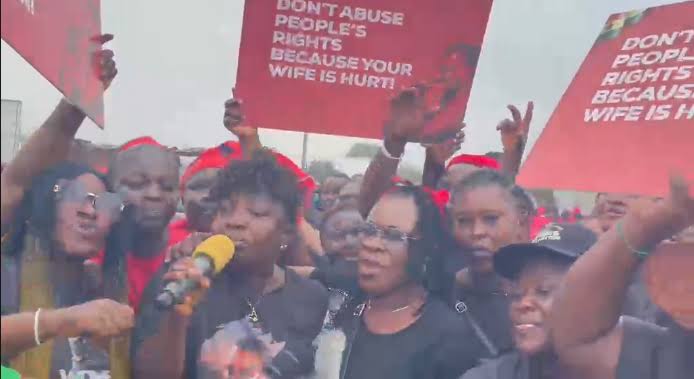

Chants of “Free Salomey now” reverberated through parts of Accra on Tuesday as a group of women took to the streets to demand the immediate release of Salomey Awitey Baffoe, whose continued detention has triggered growing public concern.
The demonstrators, participating in the “Women’s Voices Matter” protest, assembled at the AMA Park before moving to the premises of the Economic and Organised Crime Office, EOCO, where they intensified their calls for what they described as justice, fairness and respect for the rights of Ms Baffoe.

The protesters issued a 24 hour appeal to President John Dramani Mahama to intervene in the matter, with some participants chanting “John Mahama, free Salomey” and expressing frustration over what they regard as the prolonged detention of the 40 year old woman.

The demonstration was characterised by intense emotion, with some of the women breaking down in tears as they demanded answers about the circumstances surrounding Ms Baffoe’s continued stay in custody.

Ms Baffoe was arrested during a midnight operation at her residence in Hansua in the Techiman Municipality of the Bono East Region on Sunday, September 13.
She was subsequently brought before the courts in connection with allegations arising from the Ghana Jollof TikTok case. Reports indicate that she is accused of abetting the publication of false news.

On Thursday, September 24, the High Court refused an application for bail filed on her behalf after the prosecution argued that she remained relevant to ongoing investigations.
The court cited the cyber related nature of the investigation and expressed concern that releasing Ms Baffoe at that stage could create a risk of interference with witnesses. The Republic was consequently directed to expedite its investigations.

The protesters, however, have maintained that the decision to keep Ms Baffoe in custody requires greater scrutiny. They argue that the continuation of her detention should not become excessive and insist that she should be treated fairly and in accordance with the law while the investigation proceeds.

According to the women, their concerns extend beyond the individual circumstances of Ms Baffoe. They said women already contend with considerable social and economic pressures and that those who become involved in legal or investigative proceedings should receive treatment that respects their rights and dignity.
They stressed that the demonstration was therefore intended to draw attention not only to Ms Baffoe’s situation but also to broader concerns surrounding the treatment of women in Ghana and the need for women to be heard when they raise grievances about their circumstances.
KOKA joins demonstrators
Among those who joined the protest was KOKA, who said he had decided to participate because issues affecting women should be regarded as matters of concern to the entire society.
He pointed to the women in his own family as part of his motivation, noting that he has sisters and a mother and therefore believes the concerns being raised by the demonstrators should not be ignored.
KOKA also questioned the continued detention of Ms Baffoe, particularly the explanation that investigators still require her assistance in accessing information connected to her mobile phone.
He argued that because the authorities already have possession of the device, investigators should be capable of examining its contents without necessarily requiring Ms Baffoe to remain behind bars.
His position echoed one of the principal concerns raised by the demonstrators, who believe that Ms Baffoe could be allowed to remain outside custody while investigations continue.
The defence has similarly questioned the basis for continued detention, with lawyer Nana Agyei Baffour Awuah previously arguing that the police had already seized Ms Baffoe’s phones and that the remaining investigative work involved other persons allegedly connected to the redistribution of the videos. The defence has also indicated that it intends to challenge the High Court’s refusal of bail.
KOKA further questioned what he regarded as differences in the manner in which various cases receive public attention and official communication.
He referred to other serious incidents and questioned why, in his view, there appeared to be such intense public attention surrounding Ms Baffoe’s case.
He also raised wider concerns about the conditions confronting women across the country, arguing that women occupy an important position within families and communities and should therefore receive serious consideration when national issues are being discussed.
KOKA pointed to the presence of a woman in the country’s highest executive leadership and argued that concerns raised by women should receive meaningful attention from the authorities.
He maintained that the difficulties confronting women extend well beyond Ms Baffoe’s detention and include the daily struggle to provide for families, educate children and earn a livelihood.
He particularly highlighted the pressures faced by women engaged in trading and other forms of small scale economic activity, saying many continue to confront difficult circumstances while attempting to support their families.
He also questioned whether initiatives announced to support women, including proposals for a women’s bank, had translated into sufficient practical assistance for women struggling to make ends meet.
For KOKA, the demonstration consequently represents a broader discussion about the treatment of women, their economic circumstances and the extent to which their concerns receive attention from the authorities.
At the EOCO premises, the protesters maintained their chants and continued to demand Ms Baffoe’s release, with some participants visibly overcome with emotion.
The demonstration comes amid growing public and political interest in Ms Baffoe’s case following the High Court’s refusal to grant bail. Other public figures and political actors have also called for her release or intervention in the matter, while the prosecution and the court have maintained that the ongoing investigation and the possibility of interference with witnesses were relevant considerations in the bail proceedings.
Attention is now turning to the next stage of the legal proceedings.
Ms Baffoe is expected to return to court on Tuesday, September 30, when the case is scheduled to come before the court again.
For the women who marched through Accra, however, the immediate demand remains unchanged. They want the authorities to reconsider Ms Baffoe’s continued detention and have directed their appeal principally at President John Dramani Mahama, calling for intervention while the legal process continues.

