
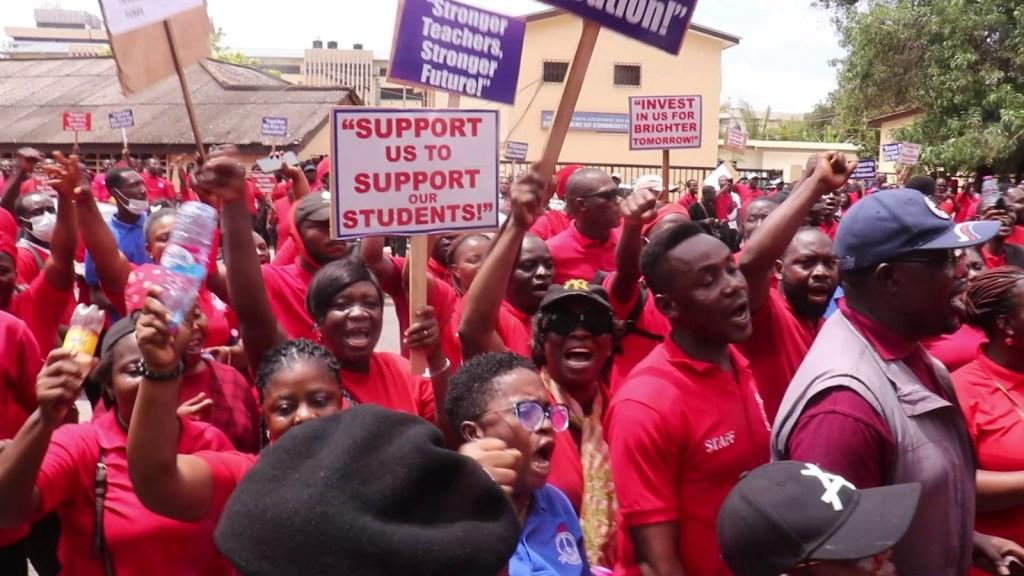

The Ghana Education Service has appealed to the country’s pre tertiary teacher unions to suspend their ongoing industrial action and return to the classroom, warning that the disruption could jeopardise recent progress made towards restoring stability and greater predictability to Ghana’s academic calendar.
Director General of the Ghana Education Service, Professor Ernest Kofi Davis, made the appeal during a media engagement on Tuesday, September 29, 2026, as government institutions continued discussions with the affected teacher unions over their outstanding grievances.

Professor Davis said the Ghana Education Service was working alongside the Ministry of Education, the Ministry of Labour, the Controller and Accountant General’s Department and other relevant stakeholders to address the issues raised by the teachers and find a workable resolution to the impasse.

He said the industrial action had come at a particularly sensitive point in the academic year, barely two weeks after the commencement of the new school year, when authorities were seeking to consolidate recent efforts to return the education system to a more orderly timetable.

According to the GES Director General, the reopening of schools in September represented an important development after several years during which disruptions had affected the regularity of Ghana’s academic calendar.
“For the first time in approximately six years, we have reached a point where students across the various levels of our education system have reported to school within September. This did not happen by accident. It was achieved through hard work,” he said.

Professor Davis explained that the achievement had contributed to a more coordinated and foreseeable academic schedule, thereby enabling parents, educational institutions and other stakeholders to organise their activities with greater certainty.
He consequently appealed to the teacher unions to reconsider their decision and allow negotiations with the government to continue without further disruption to teaching and learning.

“We wish to associate ourselves therefore with the Ministry of Education’s appeal to teachers to rescind their decision as we work hard to address their issues,” he stated.

The Director General also pointed to measures undertaken by the Ghana Education Service to respond to concerns affecting teachers, including the mechanisation of promotion processes introduced last year.
He assured teachers that the Service remained committed to fulfilling its responsibilities and addressing matters falling within its mandate despite the wider challenges confronting the education sector.
The government has separately outlined steps intended to address concerns surrounding promoted teachers who have not yet been placed on their appropriate salary grades. The Ghana Education Service has also been directed to provide relevant data to the Controller and Accountant General’s Department to facilitate the processing of affected teachers.
Professor Davis maintained that protecting the continuity of the academic year remained a major consideration and called on all parties involved in the dispute to work towards a resolution that would allow schools to operate without further interruption.
The industrial action was declared by the Ghana National Association of Teachers, the National Association of Graduate Teachers and the Pre Tertiary Teachers Association of Ghana. The unions commenced the nationwide strike on September 25, 2026, citing unresolved concerns relating to teachers’ conditions of service and outstanding financial obligations.
Among the issues raised by the unions are outstanding promotion arrears and the demand for the automatic placement of teachers who successfully completed promotion examinations onto the appropriate salary scales, together with payment of arrears arising from their promotions.
The unions have also raised concerns over delays in negotiations for a new Collective Agreement following the expiration of the previous agreement. They have further demanded implementation of the Deprived Area Allowance for teachers serving in underserved communities.
Government has indicated that negotiations on the Collective Agreement and related conditions of service will continue, while a validation process is also being undertaken concerning the proposed allowance for teachers serving in deprived areas.
The strike has already disrupted academic activities in some public pre tertiary schools. Reports from parts of Accra and the Volta Region have indicated that classrooms were affected by teacher absences, with some pupils left without normal teaching and supervision.
The Ghana Education Service is therefore seeking an end to the industrial action while discussions continue, with the Service emphasising the importance of resolving the teachers’ outstanding concerns without reversing recent efforts to establish a more consistent and synchronised academic calendar.

